President John F. Kennedy's Address on the Cuban Missile Crisis - October 22, 1962
1962 · Washington, D.C., United States
President John F. Kennedy addresses the United States about the Cuban Missile Crisis, announcing a naval blockade of Cuba.
January 5, 1957
President Dwight D. Eisenhower announces the Eisenhower Doctrine, which stated the United States would use armed forces to assist any Middle Eastern country requesting help in resisting communist aggression.
Washington D.C., United States | United States government
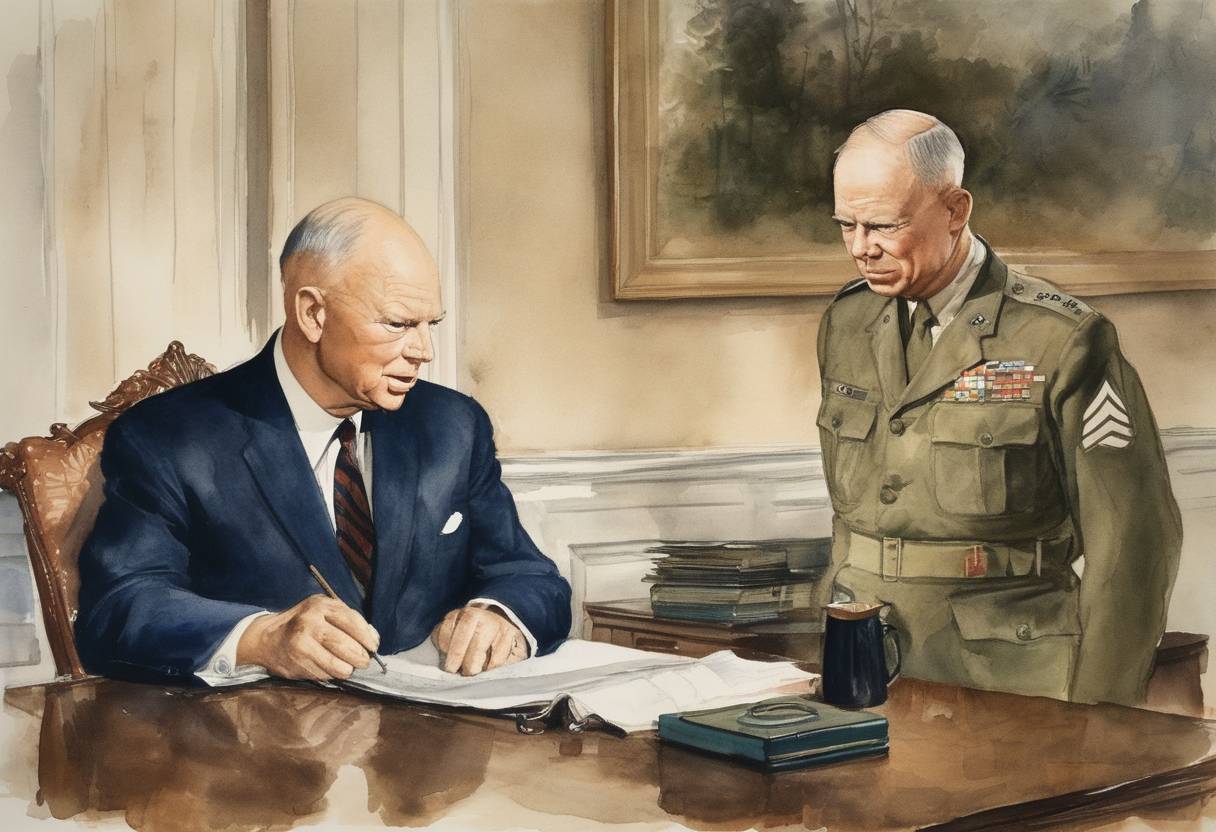
On January 5, 1957, President Dwight D. Eisenhower addressed a joint session of Congress to announce a significant shift in U.S. foreign policy concerning the Middle East. This policy, famously known as the Eisenhower Doctrine, articulated the U.S. commitment to protect the Middle East from the spread of communism.
The Eisenhower Doctrine emerged during the Cold War, a period characterized by geopolitical tension between the United States and the Soviet Union. Following World War II, many nations in the Middle East gained independence but remained vulnerable to political instability and external influences. The Soviet Union’s expanding influence, coupled with the recent Suez Crisis of 1956, alarmed U.S. policymakers. The crisis underscored the strategic importance of the Middle East and the need for a robust policy to counteract Soviet advances.
Military Assistance: The United States would provide economic and military assistance to any Middle Eastern nation requesting help in defending against armed aggression by any nation controlled by international communism.
Use of Armed Forces: The doctrine stated the willingness of the U.S. to use armed forces to protect the independence and territorial integrity of Middle Eastern countries threatened by communist aggression.
Support for Sovereignty: The policy was aimed at ensuring the sovereignty and independence of Middle Eastern states, positioning the U.S. as a protector of nations against communist subversion and warfare.
The Eisenhower Doctrine was a clear declaration of U.S. intentions to counter communist expansion in the Middle East, solidifying America’s commitment to containment strategies that marked much of its Cold War policy. It also reflected broader strategic interests, including maintaining access to vital oil resources and securing Western-aligned regimes in the region.
In the immediate aftermath, several countries, including Lebanon and Jordan, sought U.S. support under this new framework. While the policy sought to stabilize the region, it also sometimes led to controversial engagements, where U.S. intervention was viewed as a form of neo-imperialism by critics.
The Eisenhower Doctrine set a precedent for future American interventions in the Middle East, shaping policy decisions and strategies in the region for decades. It marked the beginning of continued U.S. involvement in the complex political dynamics of the Middle East, a factor that remains relevant to global geopolitics to this day.
Source: www.eisenhowerlibrary.gov