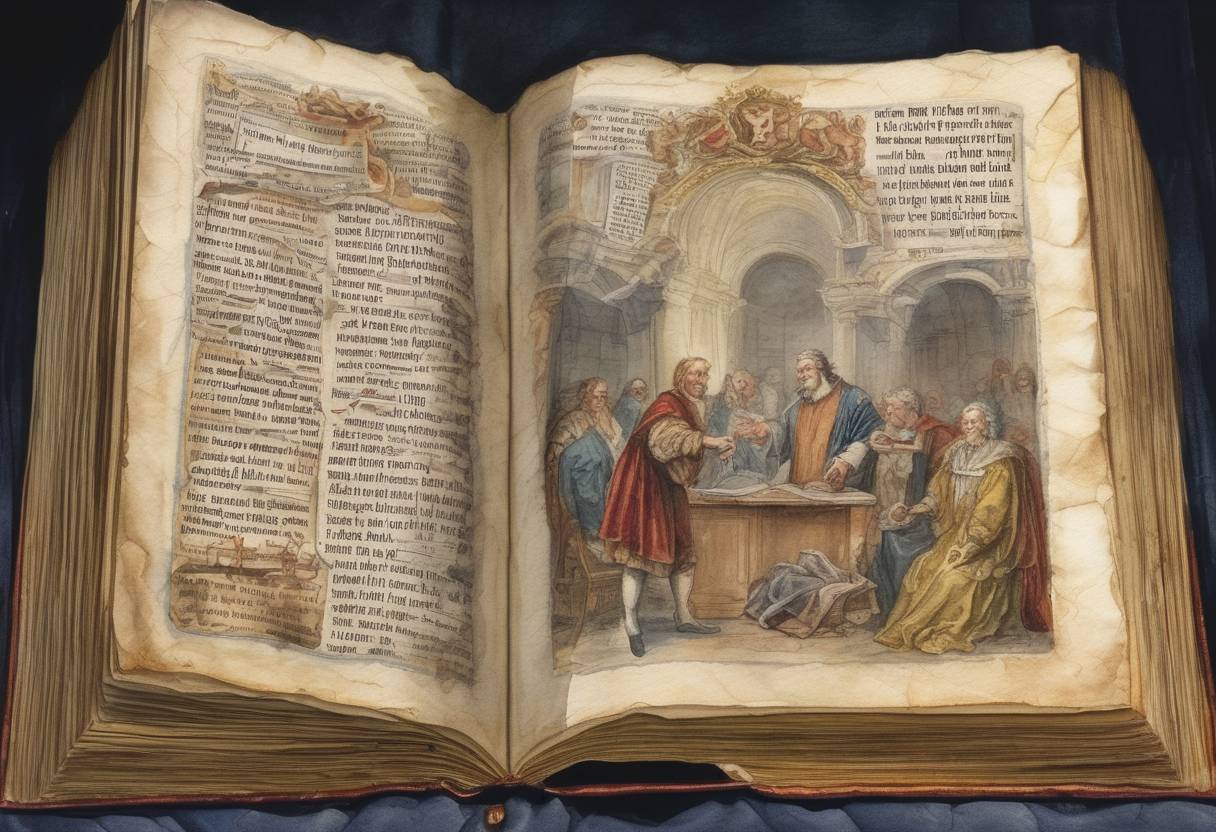
The Publication of the King James Version of the Bible
On May 2, 1611, the King James Version (KJV) of the Bible was published for the first time in London, England. This translation has since become one of the most influential and enduring versions of the Bible in the English-speaking world.
Historical Context
The early 17th century was a period of religious transformation and tension in England. The Protestant Reformation had significantly altered the religious landscape of Europe, and England was no exception. The Church of England, established by King Henry VIII, sought to distance itself from the Roman Catholic Church, leading to a need for English translations of the Bible that would be accessible to the general populace.
Prior to the KJV, several English translations existed, including the Great Bible (1539) and the Bishops’ Bible (1568). However, these translations were often criticized for their inaccuracies and lack of accessibility.
Commissioning the King James Version
The KJV was commissioned by King James I of England in 1604. The king convened the Hampton Court Conference, where it was decided that a new translation of the Bible was necessary. The goal was to create a version that would be acceptable to all factions within the Church of England and would unify the religious practices of the nation.
The translation was undertaken by a group of 47 scholars, divided into six committees, each responsible for different sections of the Bible. These scholars were instructed to use the Bishops’ Bible as a base text but to consult other translations and original Hebrew and Greek texts to ensure accuracy and clarity.
The Translation Process
The translation process was meticulous and collaborative. The scholars adhered to a set of guidelines that emphasized accuracy, literary quality, and doctrinal neutrality. They aimed to produce a text that was both faithful to the original scriptures and elegant in its English prose.
The KJV was completed in 1611 and was published by Robert Barker, the King’s Printer. It was initially printed in a large folio edition, intended for use in churches.
Impact and Legacy
The King James Version quickly gained popularity and became the standard Bible for English-speaking Protestants. Its influence extends beyond religious contexts; the KJV has had a profound impact on English literature, language, and culture. Its phrases and idioms have permeated everyday speech and have been referenced in numerous literary works.
The KJV’s enduring legacy is attributed to its majestic prose and its role in shaping the religious and cultural identity of English-speaking communities. It remains one of the most widely read and respected translations of the Bible to this day.
Conclusion
The publication of the King James Version of the Bible on May 2, 1611, marked a significant moment in religious and literary history. Its creation was a monumental scholarly effort that has left a lasting imprint on the English language and on Christian worship practices worldwide.