The Battle Near Santarém: March 28, 1188
1188 · Santarém, Portugal
A firefight occurred between the knights of Portugal and the Almohad dynasty near Santarém, affecting territorial control in the region.
October 25, 1147
The Siege of Lisbon ends as the city is captured by Afonso I of Portugal and his Christian forces, marking a significant victory during the Second Crusade.
Lisbon, Portugal | Christian Crusaders
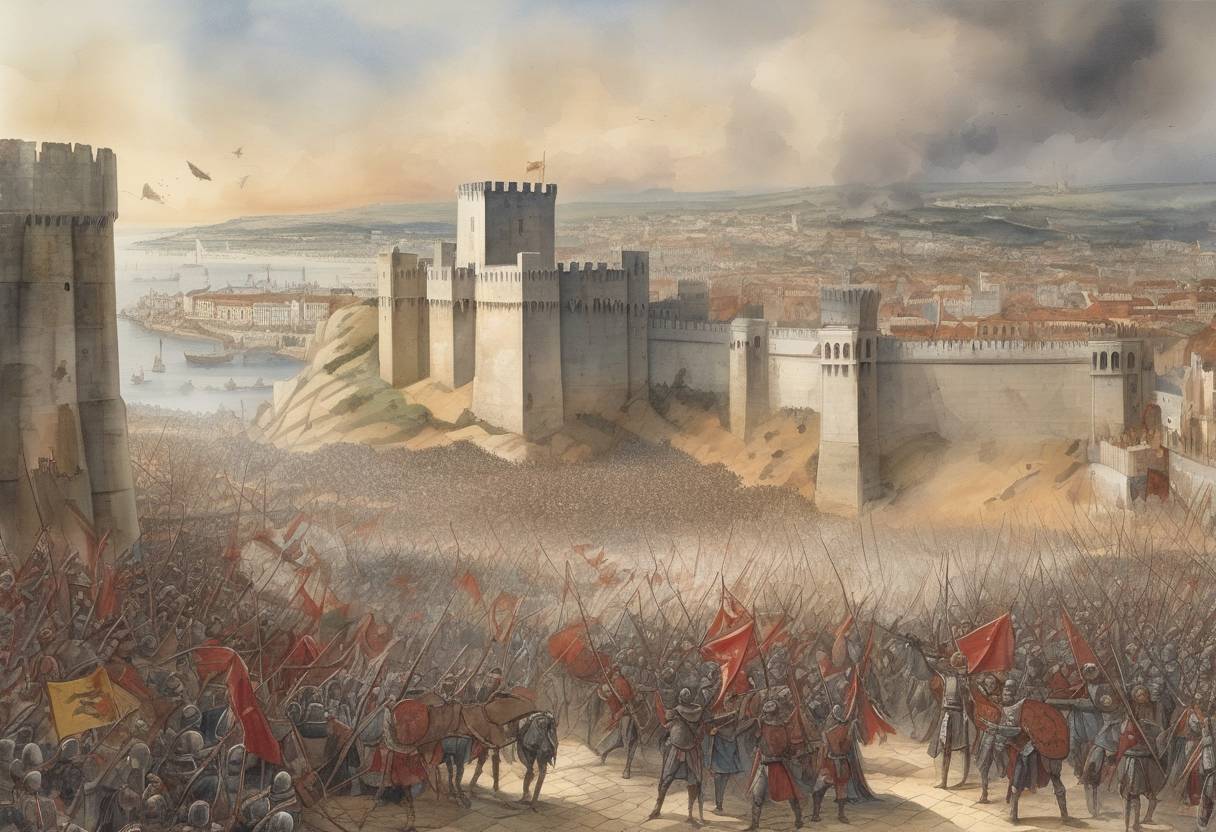
On October 25, 1147, the Siege of Lisbon concluded with the capture of the city by Afonso I of Portugal and his Christian forces. This event marked a significant victory during the Second Crusade and had lasting implications for the Reconquista and the establishment of Portugal as a sovereign nation.
The Siege of Lisbon occurred within the broader context of the Second Crusade (1147–1150), which was initially launched in response to the fall of the County of Edessa in the Holy Land. While the primary focus of the crusade was the Levant, Pope Eugene III encouraged European monarchs to also target Muslim-held territories in the Iberian Peninsula as part of the Reconquista—a centuries-long series of campaigns by Christian states to reclaim territory from Muslim rule.
Afonso I, also known as Afonso Henriques, was the first King of Portugal. He sought to expand his realm and secure his kingdom’s independence from the Kingdom of León. The capture of Lisbon, a strategic port city, was crucial for both military and economic reasons.
The siege began in July 1147, when Afonso I allied with a fleet of crusaders from Northern Europe, primarily from England, Flanders, and the Rhineland. These crusaders were en route to the Holy Land but agreed to assist Afonso in exchange for spoils and the promise of absolution.
The siege was characterized by a combination of naval blockades and land assaults. The defenders, primarily Muslim Moors, were well-fortified within the city walls. However, after several months of intense fighting, dwindling supplies, and internal strife, the defenders were forced to surrender.
On October 25, 1147, Lisbon fell to the Christian forces. The terms of surrender allowed the Muslim inhabitants to leave the city with their lives and possessions, a relatively humane outcome for the time. The capture of Lisbon was a turning point in the Reconquista, significantly bolstering Afonso I’s position and contributing to the consolidation of the Portuguese nation.
Following the siege, Lisbon became the capital of Portugal, a status it retains to this day. The victory also encouraged further crusading efforts in the Iberian Peninsula, contributing to the eventual Christian reconquest of the entire region.
The successful siege demonstrated the potential for cooperation between local Iberian rulers and international crusading forces, setting a precedent for future campaigns. It also underscored the interconnectedness of European and Mediterranean politics during the medieval period.
The capture of Lisbon was not only a military triumph but also a significant step in the cultural and political development of Portugal. It laid the groundwork for the nation’s maritime expansion in the centuries to follow, ultimately leading to the Age of Discoveries.
In summary, the Siege of Lisbon was a defining moment in the history of Portugal and the broader Christian-Muslim conflicts of the Middle Ages, illustrating the complex dynamics of power, religion, and territorial ambition that shaped the era.
Source: en.wikipedia.org