Mariner 4 Launch: November 28, 1964
1964 · Cape Canaveral, United States
Mariner 4 is launched by NASA, the first spacecraft to successfully fly by Mars and send back images.
December 14, 1962
NASA's Mariner 2 spacecraft became the first to conduct a successful flyby of Venus, providing valuable data about the planet's atmosphere and surface.
N/A, United States | NASA
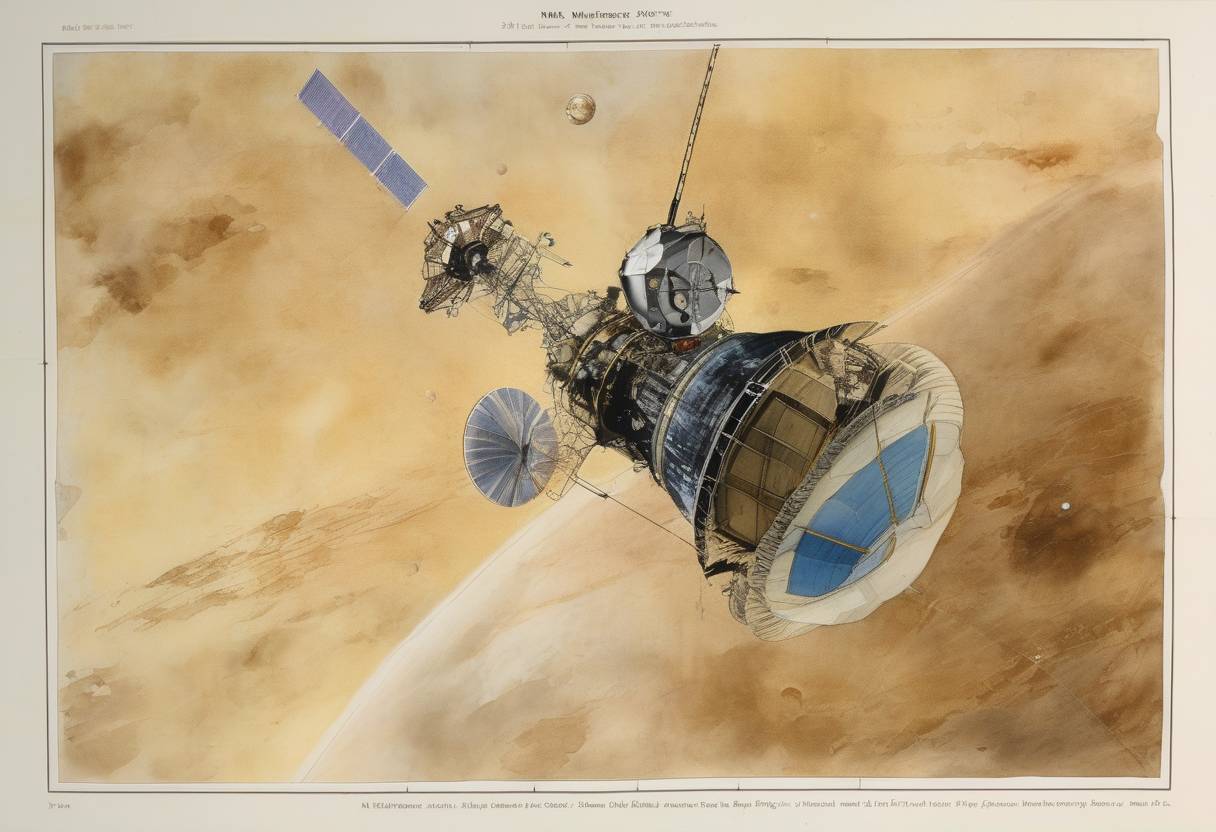
On December 14, 1962, NASA’s Mariner 2 spacecraft made history by becoming the first spacecraft to successfully conduct a flyby of Venus. This landmark event marked a significant achievement in space exploration, providing humanity with its first close-up observations of another planet.
The Mariner program was initiated by NASA to explore the inner planets of the solar system. Mariner 2 was launched on August 27, 1962, from Cape Canaveral, Florida, aboard an Atlas-Agena rocket. It was designed as a twin to Mariner 1, which unfortunately failed shortly after launch. Mariner 2’s mission was to gather scientific data about Venus, a planet shrouded in mystery due to its thick cloud cover.
Launch and Trajectory: After its successful launch, Mariner 2 embarked on a 109-day journey to Venus. The spacecraft followed a heliocentric trajectory, using solar panels for power and a suite of scientific instruments to conduct its mission.
Instruments and Objectives: Mariner 2 was equipped with a microwave radiometer, an infrared radiometer, a magnetometer, a cosmic dust detector, a solar plasma spectrometer, and a cosmic ray detector. These instruments were designed to study Venus’s atmosphere, magnetic field, and surface temperature.
On December 14, 1962, Mariner 2 passed within approximately 34,773 kilometers (21,607 miles) of Venus. During the flyby, the spacecraft successfully collected and transmitted a wealth of data back to Earth, despite the challenges posed by the planet’s harsh environment.
Mariner 2’s flyby provided groundbreaking insights into Venus:
Atmospheric Composition: The data confirmed that Venus has an extremely hot surface temperature, averaging around 425°C (797°F), and a thick atmosphere composed primarily of carbon dioxide, with clouds of sulfuric acid.
Magnetic Field: The spacecraft detected no significant magnetic field around Venus, suggesting that the planet’s core might be different from Earth’s.
Surface Conditions: The high surface temperature and pressure indicated a hostile environment, challenging previous assumptions about Venus’s habitability.
The success of Mariner 2 was a pivotal moment in the history of space exploration. It demonstrated the feasibility of interplanetary missions and paved the way for future exploration of the solar system. The data collected by Mariner 2 significantly advanced our understanding of Venus and contributed to the broader field of planetary science.
The mission also underscored the importance of robotic spacecraft in exploring distant worlds, setting the stage for subsequent missions to Venus and other planets. Mariner 2’s achievements remain a testament to the ingenuity and determination of the scientists and engineers who made this historic mission possible.
Source: en.wikipedia.org