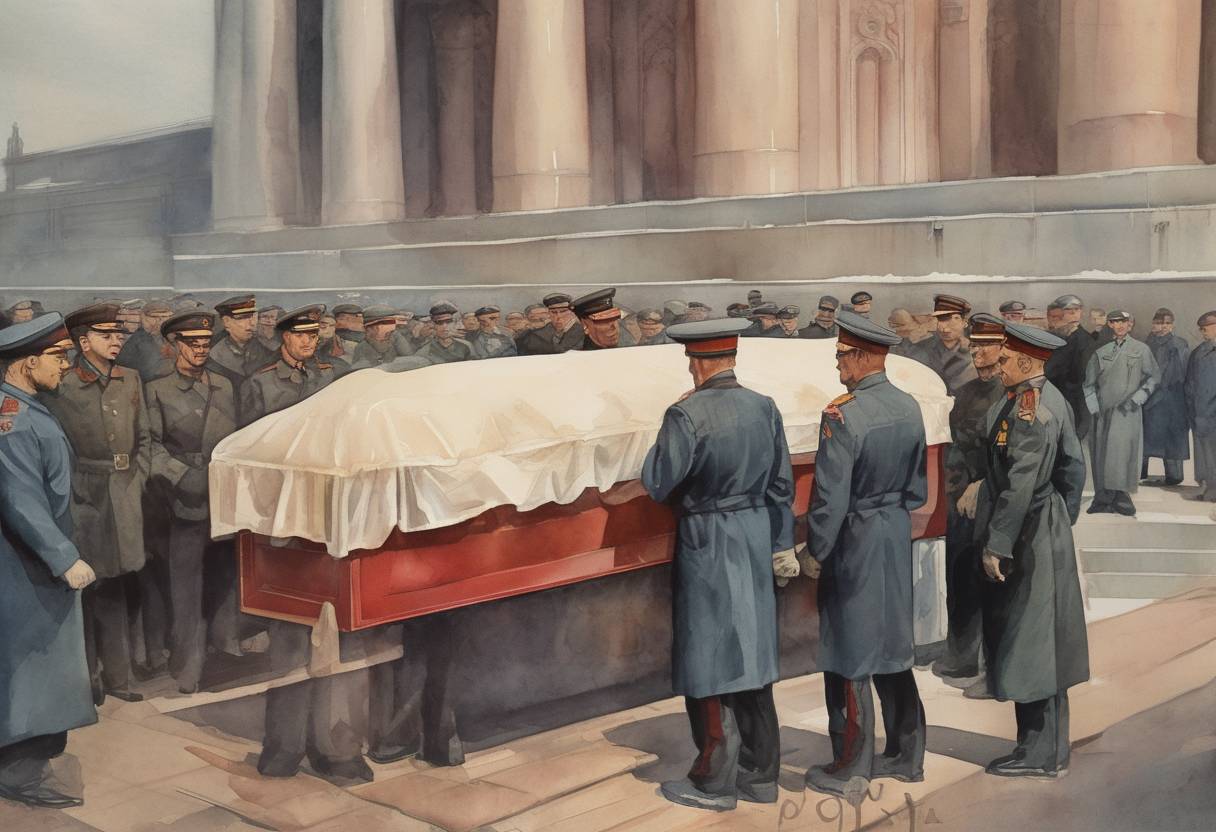
Removal of Joseph Stalin’s Body from Lenin’s Mausoleum
On October 31, 1961, a significant event in Soviet history took place as part of the broader de-Stalinization process: the removal of Joseph Stalin’s body from Lenin’s Mausoleum in Moscow’s Red Square. This event marked a pivotal moment in the Soviet Union’s efforts to distance itself from the legacy of Stalin’s authoritarian rule.
Context and Background
De-Stalinization: Initiated by Nikita Khrushchev after Stalin’s death in 1953, de-Stalinization aimed to dismantle the cult of personality surrounding Stalin and to reform the political and social systems he had established. This process was formally introduced during the 20th Congress of the Communist Party of the Soviet Union in 1956, where Khrushchev delivered his famous “Secret Speech” denouncing Stalin’s purges and oppressive policies.
Stalin’s Death and Initial Burial: After Stalin’s death on March 5, 1953, he was embalmed and placed in a mausoleum alongside Vladimir Lenin, reflecting his status as a revered leader at the time.
The Removal
21st Congress of the Communist Party: The decision to remove Stalin’s body was made during the 22nd Congress of the Communist Party, which took place in October 1961. The congress emphasized the need to continue de-Stalinization and further criticized Stalin’s tyrannical regime.
Execution of the Removal: On the night of October 31, 1961, Stalin’s body was quietly removed from the mausoleum. This operation was conducted with minimal public attention to avoid unrest or backlash from Stalin’s remaining supporters.
Reburial: Following its removal, Stalin’s body was interred in a simple grave near the Kremlin Wall Necropolis, a less prominent location that symbolized his diminished status in Soviet history.
Aftermath and Significance
Symbolic Break: The removal of Stalin’s body from the mausoleum was a powerful symbolic act, representing the Soviet leadership’s commitment to moving away from Stalinist policies and practices. It was part of a broader effort to reform the Soviet Union and promote a more collective leadership model.
Public Perception: While the removal was largely supported by the Communist Party leadership, it was met with mixed reactions among the Soviet populace. Some viewed it as a necessary step towards progress, while others saw it as a betrayal of Stalin’s contributions to the Soviet state.
Legacy: The event underscored the complexities of Stalin’s legacy in Soviet history. It highlighted the challenges faced by Khrushchev and subsequent leaders in reconciling the achievements and atrocities of Stalin’s era.
The removal of Stalin’s body from Lenin’s Mausoleum remains a significant moment in the history of the Soviet Union, reflecting the ongoing struggle to redefine the nation’s identity and legacy in the post-Stalin era.