Thomas Edison Patents the Motion Picture Camera
1891 · West Orange, United States
Thomas Edison patents the motion picture camera, a significant development in the history of film and entertainment.
August 31, 1897
Thomas Edison patented the Kinetoscope, a device for viewing moving pictures.
West Orange, United States | Edison Manufacturing Company
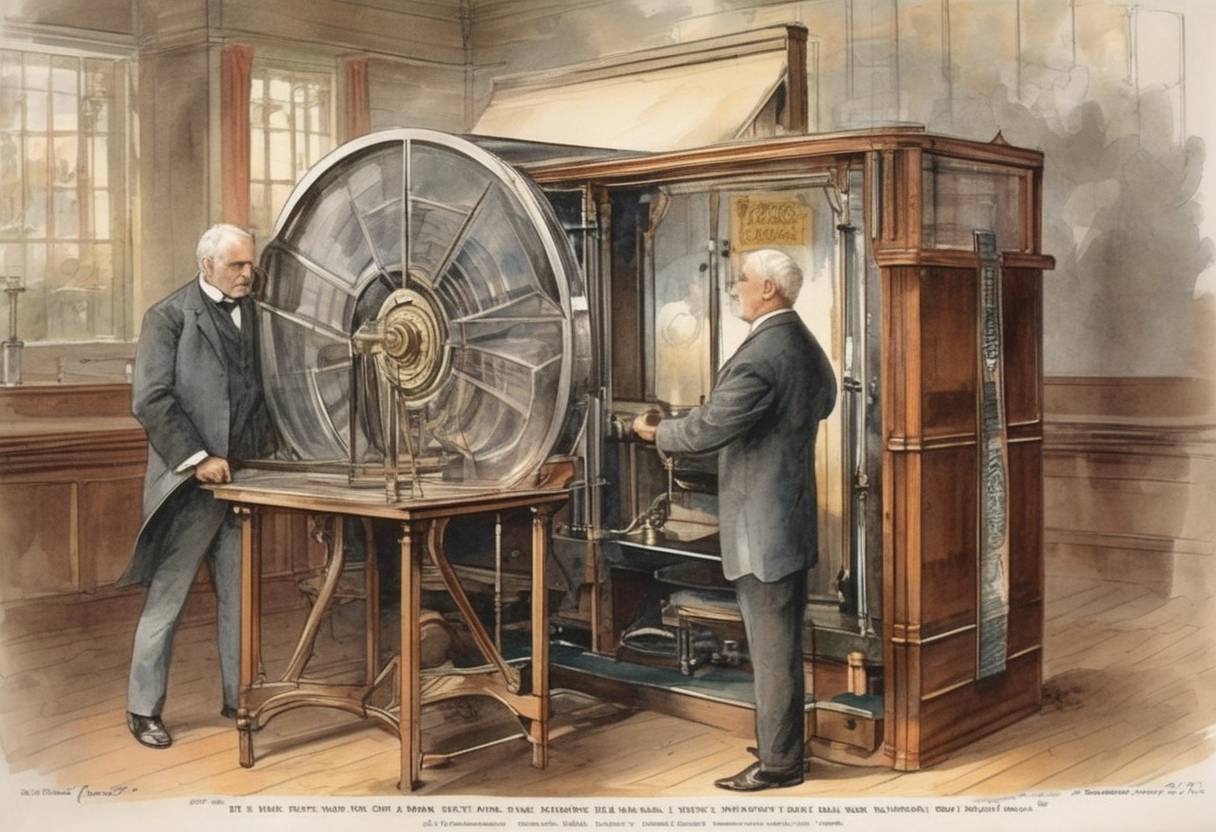
On August 31, 1897, Thomas Edison was granted a patent for the Kinetoscope, a pioneering device designed for viewing moving pictures. This invention marked a significant milestone in the history of cinema and laid the groundwork for the development of motion picture technology.
Thomas Edison, a prolific American inventor, had already made substantial contributions to various fields, including electric power generation and sound recording. By the late 19th century, Edison turned his attention to the burgeoning field of motion pictures. The Kinetoscope was developed as part of Edison’s efforts to create a device that could capture and display moving images.
The Kinetoscope was a single-viewer device that allowed individuals to watch short films through a peephole. It worked by running a strip of perforated film over a light source with a high-speed shutter, creating the illusion of motion. The films were typically about 50 feet long, which translated to roughly 20 seconds of viewing time.
Collaboration with William Kennedy Laurie Dickson: Edison collaborated with his assistant, William Kennedy Laurie Dickson, who played a crucial role in the development of the Kinetoscope. Dickson’s work on the device’s mechanics and film format was instrumental in its success.
Commercial Success: The Kinetoscope was first publicly demonstrated in 1893 and quickly became a commercial success. Kinetoscope parlors, where people could pay to watch short films, sprang up in various cities, introducing the public to the concept of motion pictures.
Influence on Cinema: Although the Kinetoscope itself was limited to individual viewing, it inspired further innovations in film projection technology. The desire to project films to larger audiences led to the development of the Kinetograph and eventually the Vitascope, which allowed for public screenings.
Edison’s patent for the Kinetoscope was a crucial step in the evolution of the film industry. While the device itself was eventually surpassed by more advanced projection systems, its impact on the entertainment industry was profound. It paved the way for the development of cinema as a popular form of mass entertainment and set the stage for the technological advancements that followed.
The Kinetoscope’s legacy is evident in the way it helped shape the early film industry and influenced future inventors and filmmakers. Edison’s work in motion pictures remains a foundational chapter in the history of cinema, highlighting his role as a key figure in the technological advancements of the late 19th and early 20th centuries.
Source: en.wikipedia.org