The Battle of Poltava: A Turning Point in the Great Northern War
1709 · Poltava, Ukraine
The Battle of Poltava took place, marking a decisive victory for Peter the Great of Russia over Charles XII of Sweden in the Great Northern War.
September 11, 1708
Charles XII of Sweden stopped his march to conquer Moscow outside Smolensk, marking a turning point in the Great Northern War.
Smolensk, Russia | Swedish Army
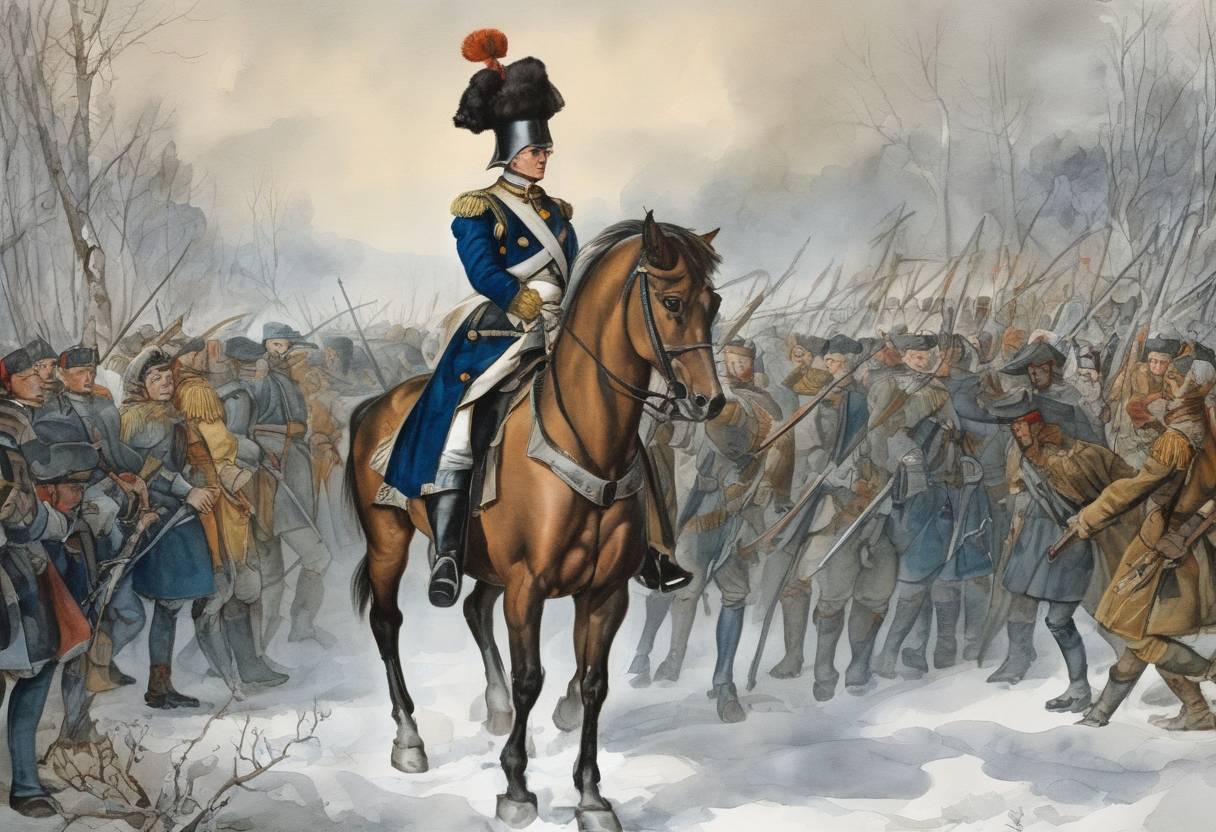
On September 11, 1708, during the Great Northern War (1700-1721), King Charles XII of Sweden made a pivotal decision to halt his advance towards Moscow near Smolensk. This moment marked a significant turning point in the conflict, which pitted Sweden against a coalition of Russia, Denmark-Norway, and Saxony-Poland-Lithuania, among others.
The Great Northern War: This war began in 1700 as a coalition of European powers sought to challenge Sweden’s dominance in Northern Europe. Charles XII, known for his military prowess, had initially achieved several victories, notably at the Battle of Narva in 1700.
Charles XII’s Campaign: By 1708, Charles XII had embarked on an ambitious campaign to invade Russia, aiming to decisively defeat Tsar Peter the Great and secure Swedish supremacy. His army, though seasoned and formidable, faced logistical challenges as it moved deeper into Russian territory.
Strategic Considerations: As Charles XII approached Smolensk, he faced the harsh realities of extended supply lines, the onset of the Russian winter, and the scorched earth tactics employed by the Russians, which left his troops without adequate provisions.
The Halt: On September 11, 1708, Charles decided to halt his march towards Moscow. This decision was influenced by the need to regroup and secure supplies, as well as the realization that a direct assault on Moscow might not be feasible under the current conditions.
Turning Point: The halt at Smolensk marked a turning point in the Great Northern War. It allowed the Russian forces to regroup and prepare for future engagements, ultimately leading to the decisive Battle of Poltava in 1709, where Charles XII suffered a catastrophic defeat.
Impact on Sweden: The failure to capture Moscow and the subsequent defeat at Poltava significantly weakened Sweden’s military and political position in Europe. It marked the beginning of the end for Sweden as a major power in the region.
Rise of Russia: The events following the halt at Smolensk contributed to the rise of Russia as a dominant power in Eastern Europe. Tsar Peter the Great’s reforms and military successes during the war laid the foundation for the Russian Empire’s expansion.
The decision to halt the march on Moscow was a critical moment in the Great Northern War, illustrating the challenges of extended military campaigns and the impact of strategic decisions on the course of history. It underscored the resilience of Russian defenses and marked the decline of Swedish influence, reshaping the balance of power in Europe for years to come.
Source: en.wikipedia.org