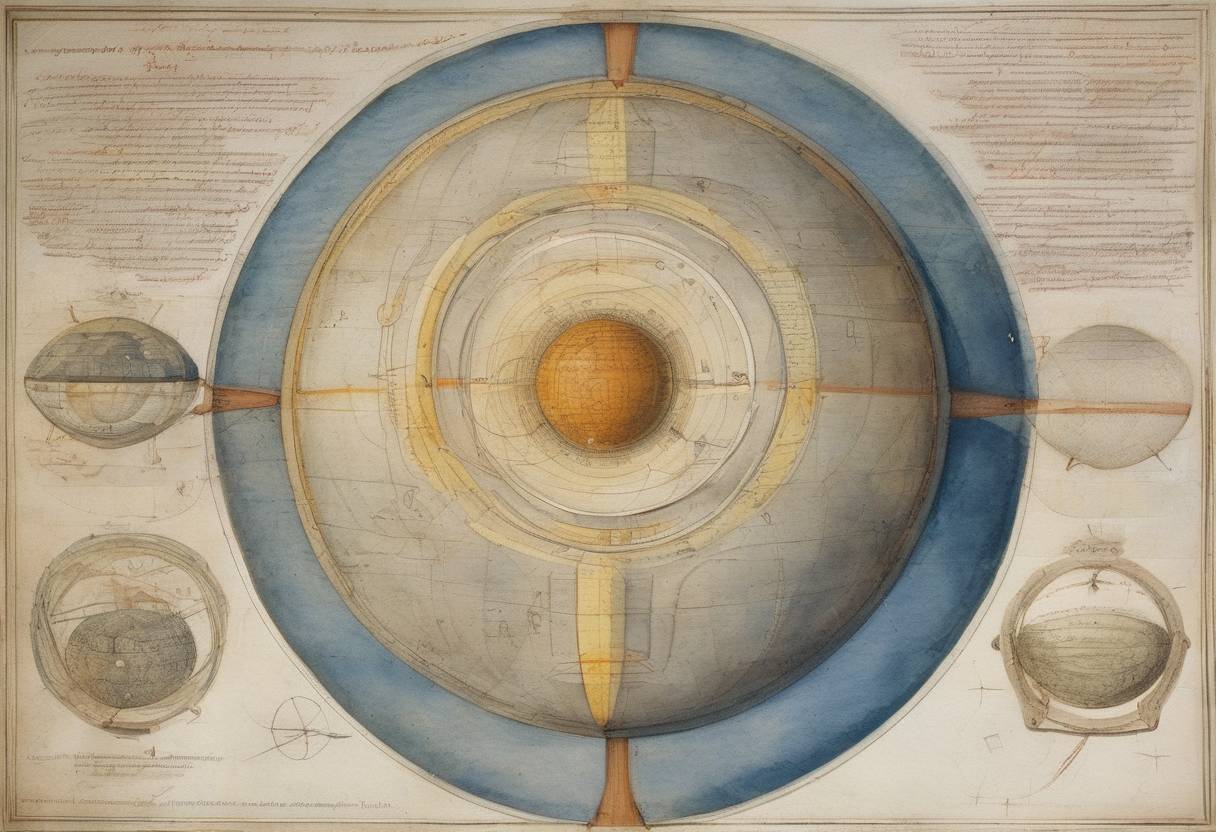
Johannes Kepler and the Confirmation of the Third Law of Planetary Motion
On May 15, 1618, the renowned German mathematician and astronomer Johannes Kepler confirmed his third law of planetary motion, a significant milestone in the field of astronomy. This law, which he had previously formulated, describes the precise relationship between the distance of planets from the Sun and their orbital periods.
Background
Johannes Kepler, born in 1571, was a key figure in the scientific revolution. His work laid the groundwork for modern astronomy and physics. Kepler’s interest in the heavens was deeply influenced by the heliocentric model proposed by Nicolaus Copernicus, which posited that the Sun, rather than the Earth, was at the center of the solar system.
Kepler’s employment as an assistant to the Danish astronomer Tycho Brahe provided him access to a wealth of astronomical data. After Brahe’s death in 1601, Kepler inherited his detailed observations of planetary motions, which he used to develop his laws of planetary motion.
The Three Laws of Planetary Motion
First Law (1609): Also known as the Law of Ellipses, it states that planets orbit the Sun in elliptical paths, with the Sun at one of the two foci.
Second Law (1609): Known as the Law of Equal Areas, it asserts that a line segment joining a planet and the Sun sweeps out equal areas during equal intervals of time, implying that planets move faster when they are closer to the Sun.
Third Law (1618): The Law of Harmonies, which Kepler confirmed on May 15, 1618, establishes that the square of the orbital period of a planet is directly proportional to the cube of the semi-major axis of its orbit. Mathematically, it can be expressed as:
[
T^2 \propto a^3
]
Where ( T ) is the orbital period of the planet, and ( a ) is the semi-major axis of its orbit.
Significance and Impact
Kepler’s third law was groundbreaking because it provided a mathematical relationship that could predict planetary positions with unprecedented accuracy. This law was crucial in supporting the heliocentric model and laid the foundation for Isaac Newton’s theory of universal gravitation. Newton later showed that Kepler’s laws were a natural consequence of his own laws of motion and gravitation.
Kepler’s confirmation of the third law marked a pivotal moment in the history of science, as it demonstrated the power of mathematical laws to describe natural phenomena. His work not only advanced the understanding of our solar system but also influenced the broader scientific method, emphasizing observation, hypothesis, and mathematical validation.
Conclusion
Johannes Kepler’s confirmation of his third law of planetary motion on May 15, 1618, was a landmark achievement in astronomy. It exemplified the transition from a qualitative to a quantitative understanding of the cosmos, setting the stage for future scientific discoveries and the eventual formulation of classical mechanics.