The Second Defenestration of Prague: May 23, 1618
1618 · Prague, Czech Republic
The Second Defenestration of Prague took place, triggering the Thirty Years' War.
July 30, 1419
The First Defenestration of Prague occurs, marking the beginning of the Hussite Wars.
Prague, Bohemia
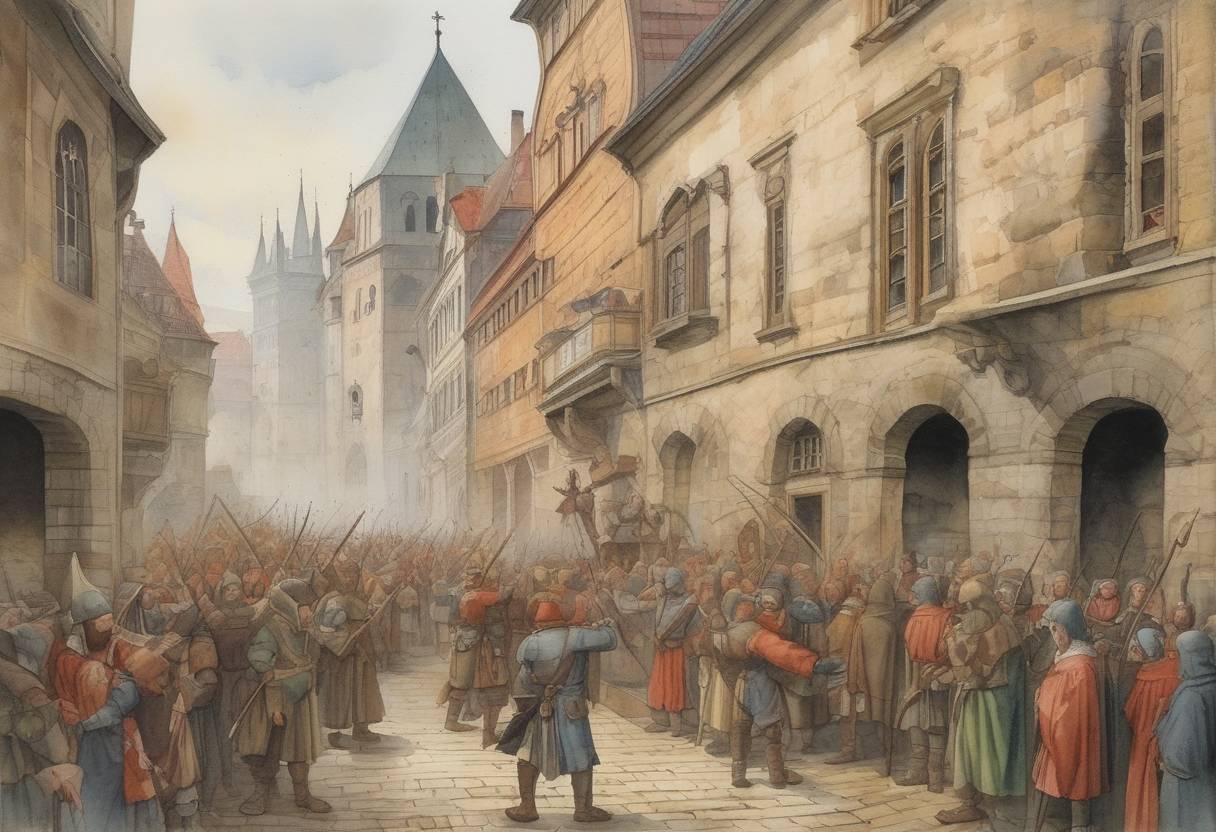
The First Defenestration of Prague, which occurred on July 30, 1419, is a pivotal event in European history that marked the beginning of the Hussite Wars. This incident took place in the city of Prague, within the Kingdom of Bohemia, and was a significant moment in the religious and political upheavals of the early 15th century.
The defenestration was deeply rooted in the religious reform movement led by Jan Hus, a Czech theologian and philosopher who criticized the Catholic Church’s practices and called for reforms. Hus’s teachings gained substantial support in Bohemia, leading to tensions between his followers, known as Hussites, and the Catholic authorities. Hus was executed for heresy in 1415, which further inflamed the situation and galvanized his supporters.
On July 30, 1419, a group of Hussite radicals, led by the priest Jan Želivský, marched to the New Town Hall in Prague. They were protesting against the imprisonment of some of their members and the refusal of the town council to acknowledge their demands for religious reform. The situation escalated when the protesters stormed the town hall. In a dramatic act of defiance, they threw several Catholic councilors out of the windows. This act of defenestration resulted in the death of the councilors, as they fell onto the spears of the crowd below.
The First Defenestration of Prague set off a series of conflicts known as the Hussite Wars, which lasted from 1419 to 1434. These wars were characterized by a series of battles between the Hussite forces and the Catholic loyalists, including the Holy Roman Empire and various European monarchs. The Hussite Wars were notable for their use of innovative military tactics, including the deployment of war wagons.
The wars ultimately led to significant religious and political changes in Bohemia. Although the Hussites were eventually defeated, the conflict weakened the influence of the Catholic Church in the region and paved the way for further religious reforms. The Hussite movement also contributed to the broader Protestant Reformation that would sweep across Europe in the following century.
The First Defenestration of Prague is often cited as an early example of popular resistance against established authority and a precursor to the larger Protestant Reformation. It highlights the growing discontent with the Catholic Church and the desire for religious and political autonomy that characterized much of European history in the late Middle Ages and early Renaissance.
In summary, the First Defenestration of Prague was a catalyst for the Hussite Wars and a significant event in the history of religious reform in Europe. Its impact resonated far beyond the borders of Bohemia, influencing the course of European history for generations to come.
Source: en.wikipedia.org