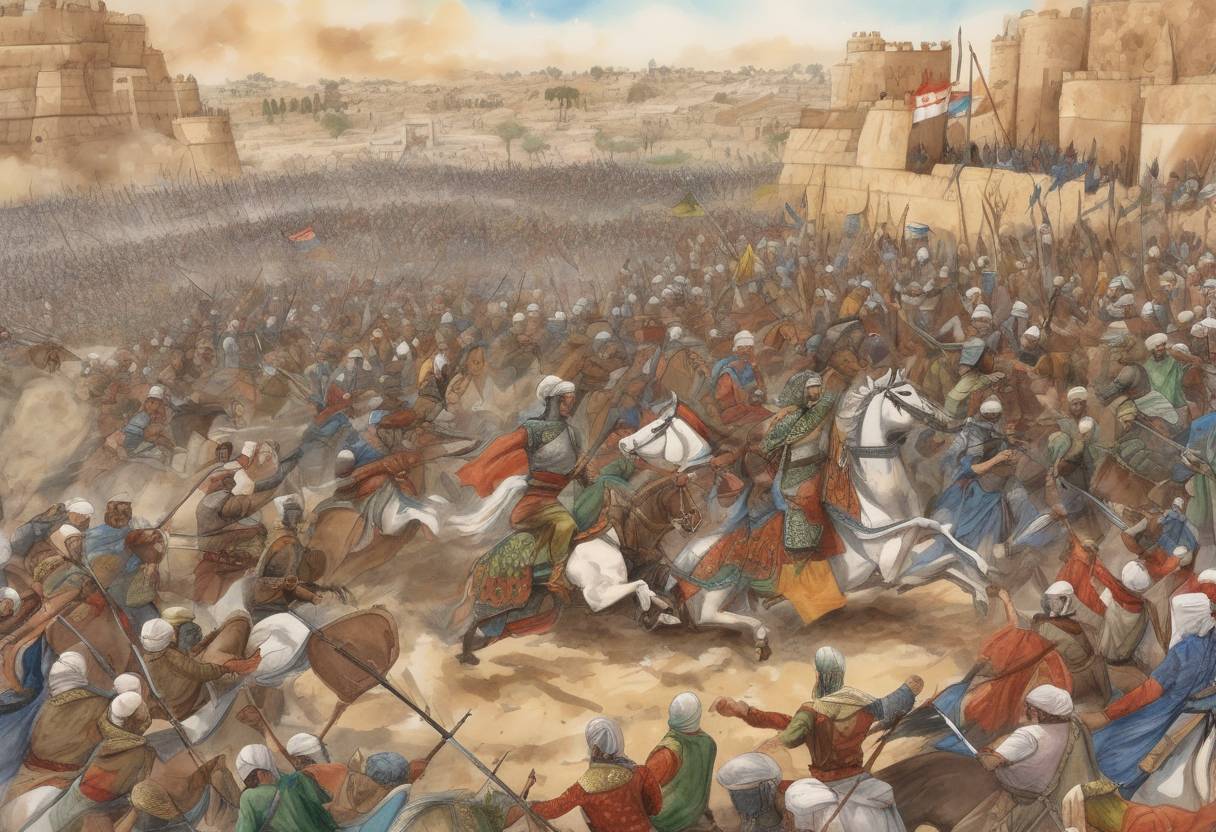
The Battle of Marj Rahit: August 18, 684
The Battle of Marj Rahit, fought on August 18, 684, was a pivotal conflict during the Second Fitna, a period of civil war within the Islamic Caliphate. This battle marked a significant moment in the struggle for power between the Umayyad dynasty and the supporters of Abdullah ibn al-Zubayr.
Context Leading to the Battle
The Second Fitna (680–692) was a time of political and military turmoil following the death of the Umayyad caliph Muawiya I. His son, Yazid I, succeeded him, but his rule was contested by various factions, most notably by Abdullah ibn al-Zubayr, who declared himself caliph in Mecca. The death of Yazid in 683 further fragmented the caliphate, leading to a power vacuum and intensified rivalries.
Marwan ibn al-Hakam, a member of the Umayyad family, sought to restore Umayyad control. In 684, he was proclaimed caliph in Damascus, but his authority was challenged by Ibn al-Zubayr’s supporters, who had gained significant influence in the Hejaz and Iraq.
The Battle
The Battle of Marj Rahit took place near Damascus, in present-day Syria. Marwan I led the Umayyad forces against the Qaysi tribes allied with Ibn al-Zubayr. The Qaysi tribes were part of a larger coalition that opposed the Umayyads, seeking to establish Ibn al-Zubayr’s claim to the caliphate.
Marwan’s forces, composed mainly of the Kalb tribe and other loyalist factions, were well-organized and determined to secure Umayyad dominance. The battle was fierce, with both sides fighting for control over the strategic region of Syria.
Outcome and Aftermath
The Umayyad victory at Marj Rahit was decisive. Marwan I’s forces successfully defeated the Qaysi tribes, solidifying his position as caliph and re-establishing Umayyad control over Syria. This victory was crucial for the Umayyads, as it allowed them to regroup and strengthen their hold on the caliphate.
The aftermath of the battle saw Marwan I consolidating power, eventually leading to the reunification of the caliphate under Umayyad rule. However, the Second Fitna continued for several more years, with ongoing conflicts between the Umayyads and Ibn al-Zubayr’s supporters until the eventual defeat of Ibn al-Zubayr in 692.
Historical Significance
The Battle of Marj Rahit was a turning point in the Second Fitna, demonstrating the resilience and military capability of the Umayyad dynasty. It underscored the deep tribal and political divisions within the Islamic world at the time and set the stage for the eventual stabilization of Umayyad rule, which would continue to shape the Islamic caliphate for decades to come.