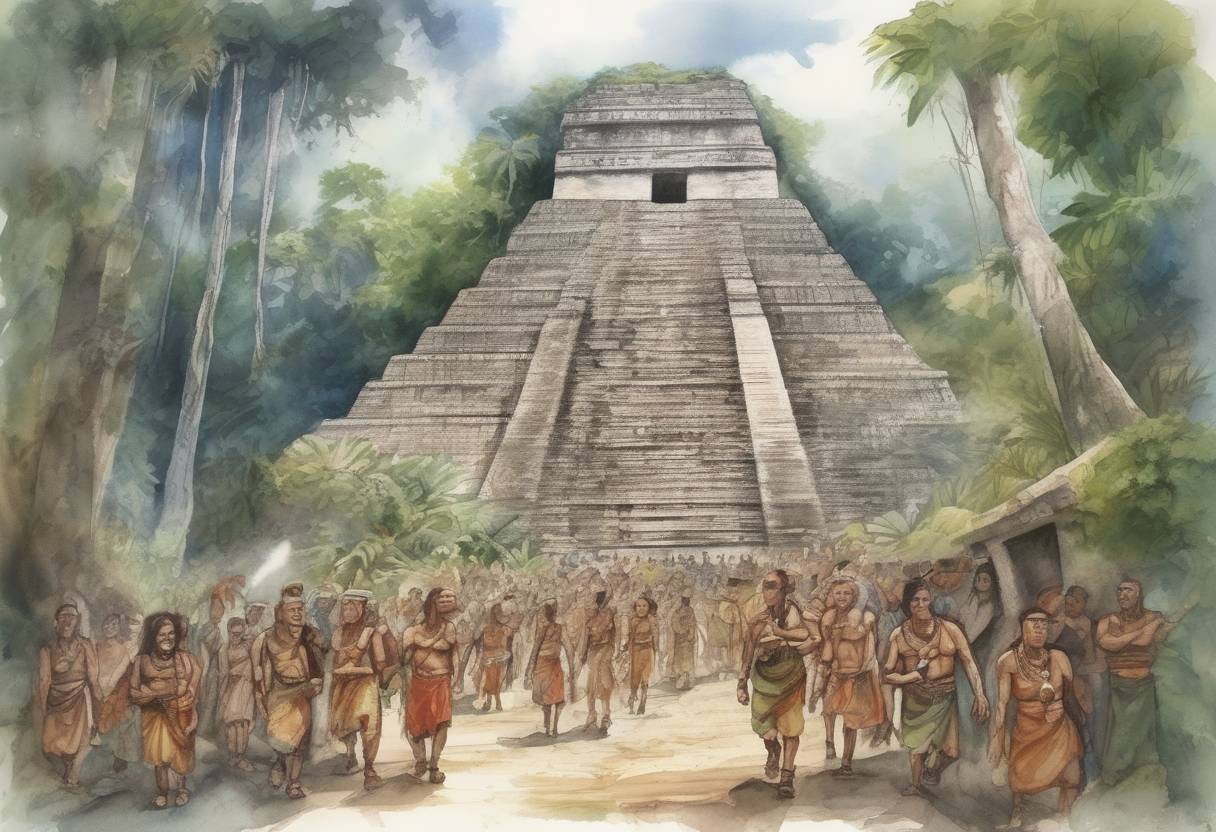
General Siyaj K’ak’ Arrives in Tikal - January 14, 378
On January 14, 378, a pivotal event in the history of the Maya civilization occurred when General Siyaj K’ak’ (also known as “Fire is Born”) arrived in the city of Tikal. This event marked a significant turning point in the political landscape of the Maya region, with far-reaching implications for the power dynamics among Maya city-states.
Context and Background
The Maya Civilization: The Maya civilization was one of the most sophisticated and advanced cultures in pre-Columbian America, known for its achievements in writing, art, architecture, mathematics, and astronomy. The civilization was organized into city-states, each with its own ruler and political system.
Tikal: Located in present-day Guatemala, Tikal was one of the most powerful and influential Maya city-states. Before Siyaj K’ak’s arrival, Tikal was already a major center of commerce, culture, and political power in the Maya lowlands.
Teotihuacan Influence: Teotihuacan, located in the Valley of Mexico, was a dominant cultural and political force in Mesoamerica during this period. The arrival of Siyaj K’ak’ is often associated with the influence of Teotihuacan over the Maya region.
The Arrival of Siyaj K’ak’
General Siyaj K’ak’: Siyaj K’ak’ was a prominent military leader, believed to have been sent from Teotihuacan. His arrival in Tikal is documented in Maya inscriptions, which describe him as a figure of great authority and power.
Political Change: The arrival of Siyaj K’ak’ coincided with the death of the reigning Tikal king, Chak Tok Ich’aak I, on the same day. This event is often interpreted as a coup or a significant shift in power, possibly orchestrated by Teotihuacan.
Installation of New Leadership: Following the arrival of Siyaj K’ak’, a new ruler, Yax Nuun Ahiin I (also known as “Curl Snout”), was installed in Tikal. He is believed to have been connected to Teotihuacan, either by lineage or political alliance.
Significance and Consequences
Teotihuacan-Maya Relations: The arrival of Siyaj K’ak’ and the subsequent changes in Tikal’s leadership marked the beginning of a period of increased Teotihuacan influence in the Maya region. This influence is evident in the architectural styles, iconography, and political alliances that emerged in the following years.
Cultural Exchange: The interaction between Teotihuacan and the Maya led to a rich exchange of cultural and technological ideas, contributing to the development of both civilizations.
Regional Power Dynamics: Tikal’s alignment with Teotihuacan strengthened its position as a dominant power in the Maya lowlands, affecting its relationships with neighboring city-states and altering the balance of power in the region.
In conclusion, the arrival of General Siyaj K’ak’ in Tikal on January 14, 378, was a transformative event that reshaped the political and cultural landscape of the Maya civilization. It highlights the complex interactions between different Mesoamerican cultures and underscores the importance of Tikal as a central hub of power and influence during this period.