Mars 2 Lander: The First Human-Made Object on Mars
1971 · Mars, Soviet Union
The Soviet space program's Mars 2 lander became the first human-made object to reach the surface of Mars, although it crash-landed.
December 15, 1970
The Soviet spacecraft Venera 7 successfully lands on Venus, becoming the first spacecraft to return data from the surface of another planet.
Venus, Soviet Union | Soviet space program
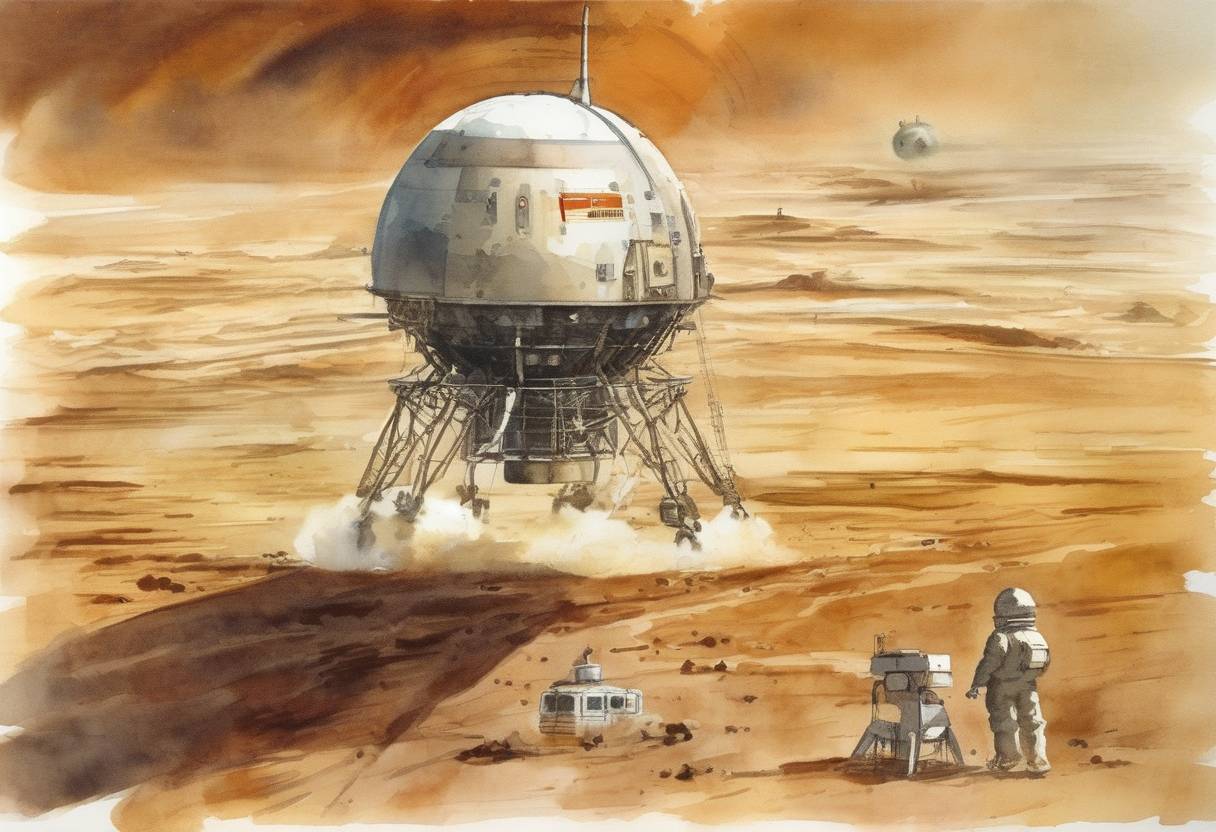
On December 15, 1970, the Soviet spacecraft Venera 7 achieved a historic milestone by becoming the first spacecraft to successfully land on the surface of another planet and transmit data back to Earth. This event marked a significant achievement in space exploration, particularly in the study of Venus, Earth’s closest planetary neighbor.
The Venera program, initiated by the Soviet Union in the early 1960s, aimed to explore Venus, a planet shrouded in mystery due to its thick cloud cover. Previous missions had attempted to reach the surface, but Venera 7 was the first to accomplish this goal successfully. The primary objectives of the Venera 7 mission were to:
Venera 7 was launched on August 17, 1970, from the Baikonur Cosmodrome. The spacecraft was designed to withstand the extreme temperatures and pressures of Venus’s atmosphere. Key features of the spacecraft included:
After a journey of nearly four months, Venera 7 entered Venus’s atmosphere on December 15, 1970. During its descent, the parachute partially failed, causing the spacecraft to impact the surface at a higher speed than planned. Despite this, Venera 7 managed to land intact.
Venera 7 transmitted data back to Earth for approximately 23 minutes from the surface of Venus. The data confirmed the extreme conditions on Venus, with surface temperatures around 475°C and atmospheric pressure about 92 times that of Earth. These findings provided invaluable insights into the Venusian environment and validated the spacecraft’s design and engineering.
The success of Venera 7 was a landmark achievement in planetary exploration. It demonstrated the feasibility of landing on and studying other planets, paving the way for future missions to Venus and beyond. The data collected by Venera 7 contributed to our understanding of Venus’s hostile environment and helped refine models of planetary atmospheres.
The Venera program continued with subsequent missions, each building on the successes and lessons learned from Venera 7. This mission remains a testament to the ingenuity and determination of the Soviet space program during the era of intense space exploration competition.
In summary, Venera 7’s successful landing and data transmission marked a pivotal moment in space exploration history, expanding humanity’s reach beyond Earth and deepening our understanding of the solar system.
Source: en.wikipedia.org