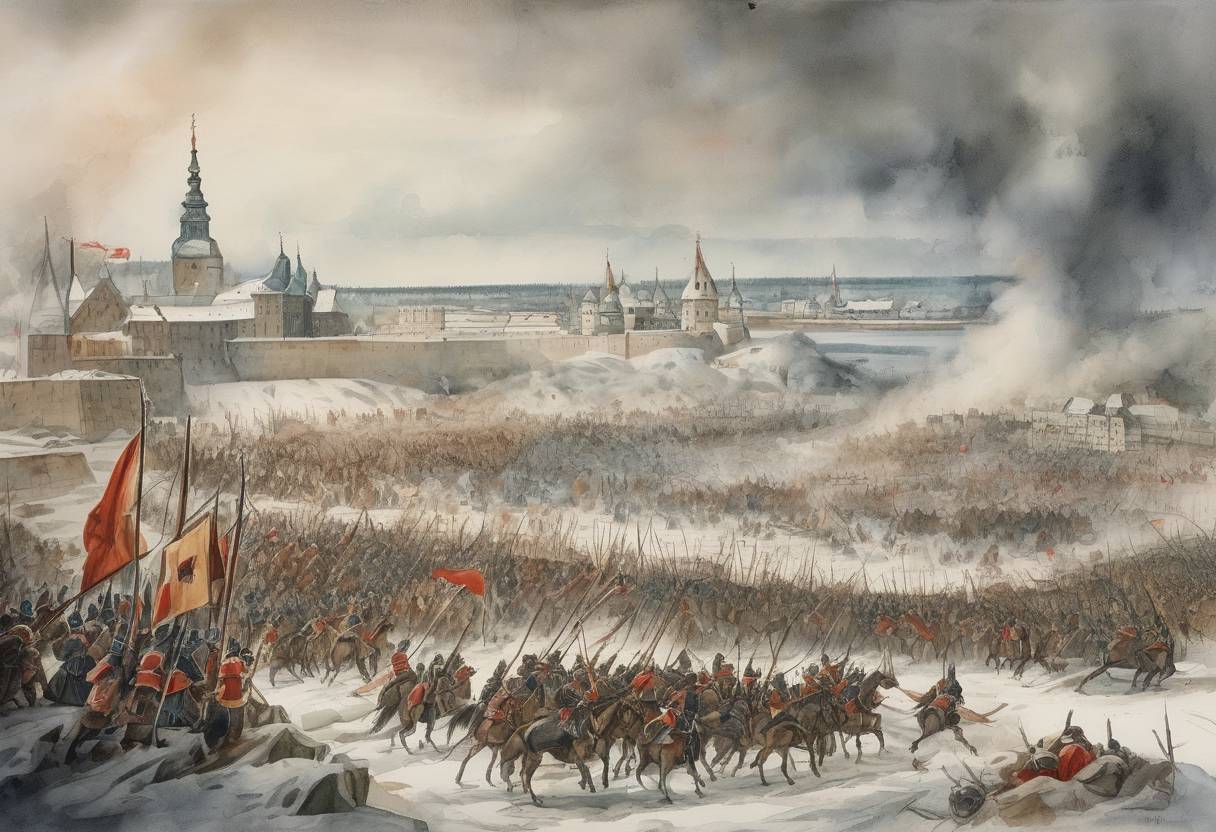
The Battle of Narva: November 30, 1700
The Battle of Narva, fought on November 30, 1700, was a significant early engagement in the Great Northern War (1700–1721), a conflict that pitted a coalition of several European powers against the Swedish Empire. This battle marked a remarkable victory for the Swedish forces under the command of King Charles XII against a numerically superior Russian army led by Tsar Peter the Great.
Context and Prelude
The Great Northern War began as a coalition of Denmark-Norway, Saxony-Poland-Lithuania, and Russia sought to challenge Sweden’s dominance in the Baltic region. The war aimed to curb Swedish influence and territorial control, which had been established during the 17th century.
- Sweden’s Position: At the war’s outset, Sweden was a formidable military power with a well-trained army and a young but capable monarch, Charles XII, who ascended to the throne at the age of 15 in 1697.
- Russia’s Ambitions: Tsar Peter the Great sought to expand Russian influence and secure access to the Baltic Sea, which was crucial for trade and military strategy. The capture of Narva, a key fortress in present-day Estonia, was part of this strategic goal.
The Battle
- Forces Involved: The Swedish army, numbering around 10,000 men, faced a Russian force estimated to be between 30,000 and 40,000 soldiers. Despite being heavily outnumbered, the Swedish troops were highly disciplined and well-led.
- Weather Conditions: The battle took place under harsh winter conditions, with a blizzard providing cover for the Swedish forces as they approached the Russian positions.
- Tactics and Execution: Charles XII capitalized on the element of surprise and the disorganized state of the Russian army. The Swedish troops launched a decisive attack, exploiting gaps in the Russian lines and causing chaos among the Russian ranks.
Outcome and Aftermath
- Swedish Victory: The battle resulted in a resounding victory for Sweden. The Russian army suffered heavy casualties, with thousands killed, wounded, or captured. The Swedish forces captured a significant amount of Russian artillery and supplies.
- Impact on Russia: The defeat at Narva was a major setback for Peter the Great, highlighting the need for military reform and modernization. In response, Peter embarked on a series of reforms to strengthen the Russian army, which would eventually contribute to Russia’s resurgence later in the war.
- Charles XII’s Reputation: The victory at Narva bolstered Charles XII’s reputation as a brilliant military leader and solidified his status as a formidable opponent in the Great Northern War.
Broader Historical Significance
The Battle of Narva demonstrated the effectiveness of Swedish military tactics and the leadership of Charles XII. However, it also served as a catalyst for Russian military reforms that would eventually alter the balance of power in the region. The Great Northern War continued for over two decades, ultimately leading to the decline of Swedish dominance and the rise of Russia as a major European power.
The battle remains a notable example of how tactical ingenuity and leadership can overcome numerical disadvantages in warfare.