President Woodrow Wilson's War Message to Congress: April 2, 1917
1917 · Washington D.C., United States
President Woodrow Wilson asks the U.S. Congress for a declaration of war against Germany, leading the United States into World War I.
December 7, 1917
The United States declares war on Austria-Hungary during World War I.
Washington D.C., United States | United States Congress
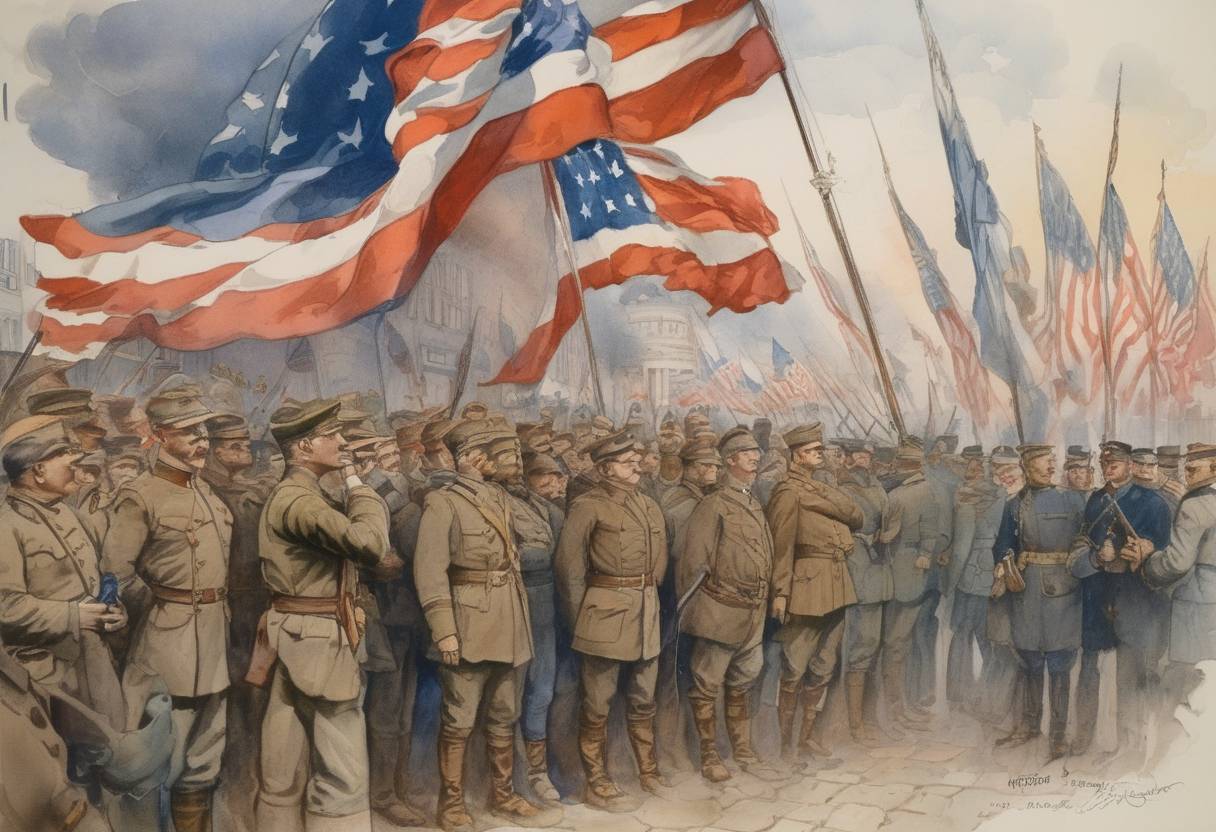
On December 7, 1917, the United States formally declared war on Austria-Hungary, marking a significant expansion of its involvement in World War I. This decision came several months after the U.S. had entered the war against Germany on April 6, 1917. The declaration against Austria-Hungary was part of a broader strategy to align with the Allied Powers and to counter the Central Powers’ influence in Europe.
U.S. Entry into World War I: The United States initially maintained a stance of neutrality when World War I broke out in 1914. However, several factors, including Germany’s unrestricted submarine warfare and the Zimmermann Telegram, which proposed a military alliance between Germany and Mexico, prompted the U.S. to join the conflict on the side of the Allies in April 1917.
Allied Strategy: By late 1917, the United States was fully committed to supporting the Allies, which included the United Kingdom, France, and Italy, among others. Austria-Hungary, as a key member of the Central Powers alongside Germany, was a logical target for the U.S. to extend its military efforts.
Diplomatic Relations: Prior to the declaration, diplomatic relations between the U.S. and Austria-Hungary had deteriorated. The U.S. had severed diplomatic ties with Austria-Hungary in April 1917, following its declaration of war on Germany.
Congressional Action: The declaration of war was passed by the U.S. Congress with overwhelming support. The Senate voted 74 to 0, and the House of Representatives voted 365 to 1 in favor of the declaration.
President Woodrow Wilson’s Role: President Woodrow Wilson, who had initially sought to keep the U.S. out of the war, became a leading advocate for American involvement. He presented the war as a fight for democracy and a necessary step to ensure global peace and security.
Military Engagement: The declaration allowed the United States to engage more directly with Austria-Hungary, although the primary focus remained on the Western Front against Germany. The U.S. military contribution to the war effort included troops, supplies, and financial support.
Diplomatic and Political Impact: The declaration reinforced the U.S. commitment to the Allied cause and helped to solidify its role as a major player on the international stage. It also underscored the ideological framing of the war as a battle between democracy and autocracy.
End of World War I: The war would continue for another year, with the Central Powers eventually collapsing under the sustained pressure from the Allies. The armistice on November 11, 1918, marked the end of hostilities, leading to the Treaty of Versailles in 1919.
The U.S. declaration of war on Austria-Hungary was a pivotal moment in World War I, reflecting the broader geopolitical dynamics and the shifting role of the United States in global affairs.
Source: www.loc.gov