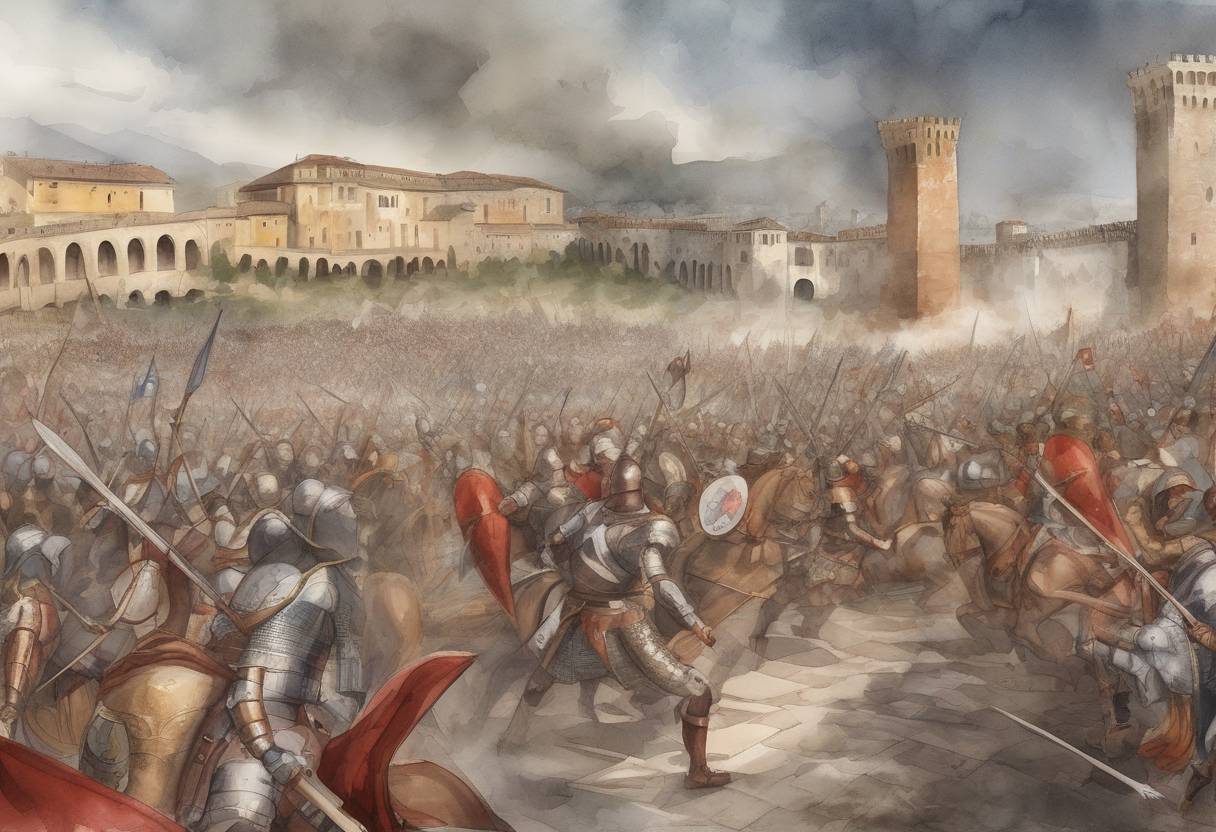
The Battle of Verona: September 27, 489
The Battle of Verona, fought on September 27, 489, was a pivotal conflict between Theodoric the Great, king of the Ostrogoths, and Odoacer, the king of Italy. This battle was a significant event in the series of conflicts that led to the establishment of the Ostrogothic Kingdom in Italy.
Background
Theodoric the Great: Born around 454 AD, Theodoric was the king of the Ostrogoths, a Germanic tribe that had settled in the Balkans. He was initially an ally of the Eastern Roman Empire but later sought to expand his power into Italy.
Odoacer: A Germanic chieftain of the Scirian tribe, Odoacer deposed the last Western Roman Emperor, Romulus Augustulus, in 476 AD, marking the end of the Western Roman Empire. He ruled Italy as its king, maintaining a nominal allegiance to the Eastern Roman Emperor.
Prelude to Battle: Theodoric, with the backing of the Eastern Roman Emperor Zeno, invaded Italy in 488 AD. Zeno saw Theodoric as a means to remove Odoacer, who had become a problematic ruler. Theodoric’s campaign aimed to establish Ostrogothic control over Italy.
The Battle
Location: The battle took place near Verona, a strategic location in northern Italy.
Forces: Theodoric led a formidable Ostrogothic army, while Odoacer commanded his own forces, which included remnants of the Roman military and various Germanic tribes.
Outcome: The battle resulted in a decisive victory for Theodoric. His forces managed to outmaneuver and defeat Odoacer’s troops, significantly weakening Odoacer’s hold on Italy.
Aftermath
Continued Conflict: Despite the victory at Verona, Theodoric’s campaign against Odoacer continued for several more years. Odoacer retreated to Ravenna, where he held out until 493.
Theodoric’s Rule: After a prolonged siege of Ravenna, Theodoric eventually captured the city and executed Odoacer in 493. This marked the end of Odoacer’s reign and the beginning of Theodoric’s rule over Italy.
Ostrogothic Kingdom: Theodoric established the Ostrogothic Kingdom, ruling as king of Italy. His reign is noted for its relative stability and efforts to preserve Roman traditions and infrastructure while integrating the Ostrogoths into Italian society.
Historical Significance
The Battle of Verona was a crucial step in the transition from Roman to Germanic rule in Italy. Theodoric’s victory and subsequent establishment of the Ostrogothic Kingdom represented a significant shift in the power dynamics of post-Roman Europe. His reign is often seen as a period of cultural synthesis, blending Roman and Germanic elements, which laid the groundwork for the medieval European landscape.