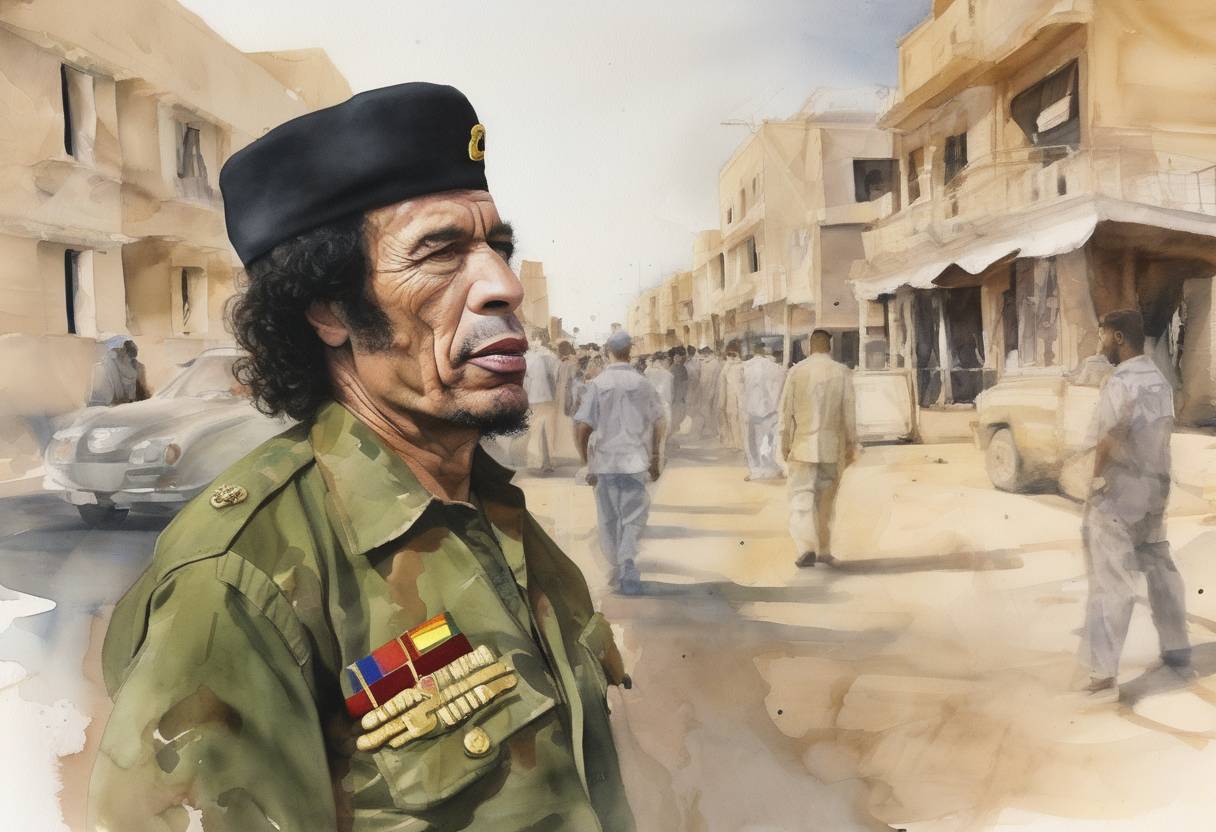
The Capture and Death of Muammar Gaddafi: October 20, 2011
On October 20, 2011, Muammar Gaddafi, the long-time leader of Libya, was captured and killed by rebel forces in his hometown of Sirte. This event marked a pivotal moment in the Libyan Civil War and the end of Gaddafi’s 42-year rule.
Background
Muammar Gaddafi came to power in Libya in 1969 through a coup that overthrew King Idris I. He established a regime characterized by a blend of Arab nationalism, socialism, and his own political ideology, which he termed the “Third International Theory.” Gaddafi’s rule was marked by authoritarianism, human rights abuses, and a complex relationship with the international community, including periods of isolation due to his support for terrorism.
The Libyan Civil War
The Libyan Civil War began in February 2011, inspired by the broader wave of the Arab Spring protests across the Middle East and North Africa. Libyan citizens, frustrated by decades of repression and economic mismanagement, took to the streets demanding political reform and Gaddafi’s ouster. The regime’s violent crackdown on protesters escalated into a full-scale civil war.
The conflict saw the formation of the National Transitional Council (NTC), which sought international recognition and support. NATO intervened in March 2011, launching a military campaign to protect civilians under a United Nations mandate, significantly aiding the rebel forces.
Capture and Death of Gaddafi
By October 2011, Gaddafi’s regime had lost control of most of the country, with Sirte being one of the last strongholds. On October 20, 2011, Gaddafi was found hiding in a drainage pipe outside Sirte after a NATO airstrike hit his convoy. Rebel forces captured him, and in the ensuing chaos, he was killed.
The exact circumstances of his death remain controversial, with various reports suggesting he was executed by the rebels. His death was confirmed by the NTC, which declared Libya liberated on October 23, 2011.
Aftermath and Significance
Gaddafi’s death marked the end of an era in Libya and was a significant moment in the Arab Spring. It led to the dissolution of his regime and the establishment of a new government under the NTC. However, Libya faced significant challenges in the aftermath, including political instability, militia violence, and economic difficulties.
The power vacuum left by Gaddafi’s fall contributed to ongoing conflict and fragmentation within the country, with various factions vying for control. The situation in Libya remains complex, with efforts toward national reconciliation and rebuilding continuing to face obstacles.
Gaddafi’s death underscored the transformative yet tumultuous nature of the Arab Spring, highlighting both the potential for change and the challenges of achieving stable governance in the post-revolutionary period.