The Death of Tomás de Torquemada: September 16, 1498
1498 · Ávila, Spain
Tomas de Torquemada, the first Grand Inquisitor of the Spanish Inquisition, died.
July 12, 1562
Fray Diego de Landa, a Spanish Franciscan priest, ordered the burning of Maya codices and idols in Maní, Yucatán, an event that led to the loss of much of the Mayan written history.
Maní, Mexico | Spanish Inquisition
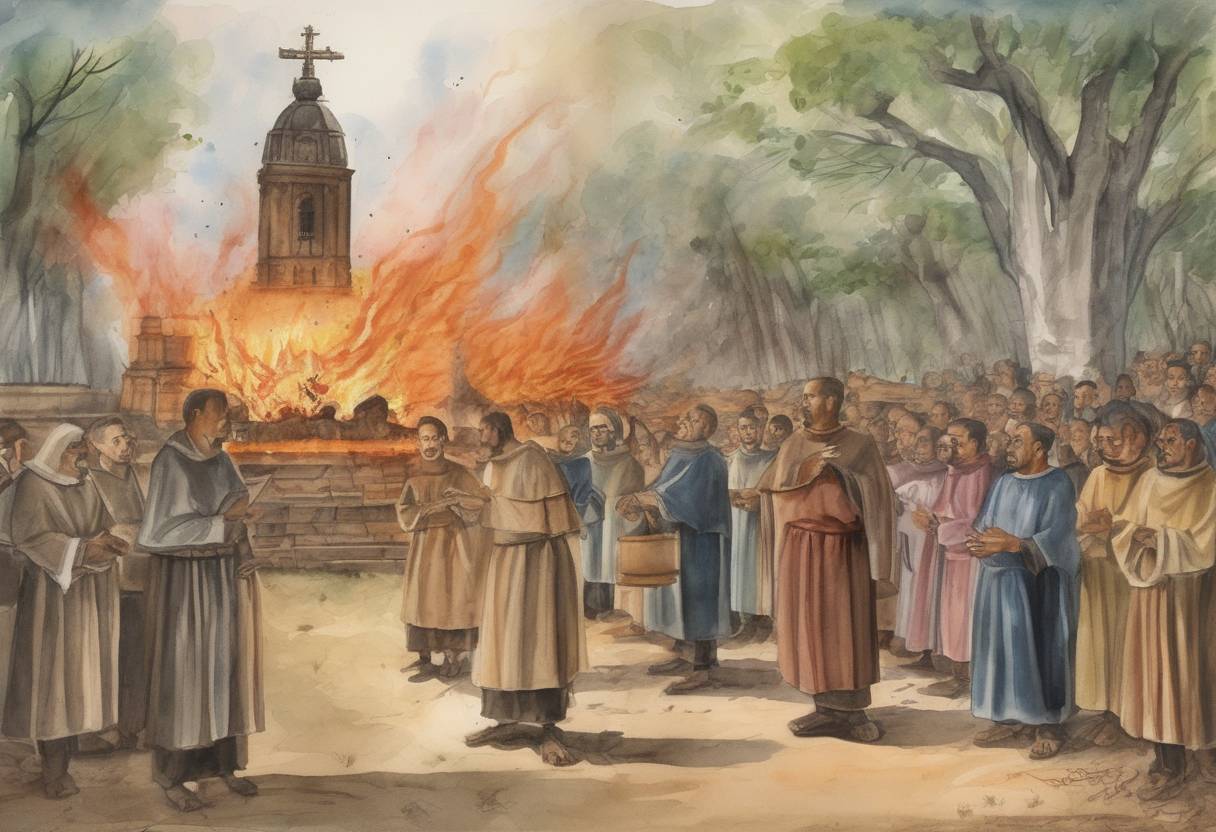
On July 12, 1562, a significant and tragic event in the history of the Maya civilization occurred in Maní, Yucatán, when Fray Diego de Landa, a Spanish Franciscan priest, ordered the burning of Maya codices and idols. This act led to the irreparable loss of much of the Mayan written history and cultural heritage.
Fray Diego de Landa was born in 1524 in Spain and joined the Franciscan order at a young age. He was sent to the Yucatán Peninsula as a missionary, where he became deeply involved in the conversion of the indigenous Maya people to Christianity. The Spanish conquest of the Yucatán was part of a broader effort by Spain to expand its empire and spread Christianity in the New World.
Landa’s actions were driven by his belief that the Maya practices and beliefs were idolatrous and incompatible with Christianity. On July 12, 1562, he conducted an auto-da-fé in the town of Maní, where he ordered the destruction of numerous Maya religious artifacts, including idols, altars, and most tragically, the codices—folded books made of bark paper that contained vast amounts of knowledge about Maya history, culture, religion, and science.
Landa’s decision was based on his conviction that these items were tools of paganism and needed to be eradicated to save the souls of the Maya people. He later justified his actions in his writings, claiming that the destruction was necessary to eliminate the influence of the devil.
The burning of the Maya codices is considered one of the greatest cultural losses in history. Only a few Maya codices survived, such as the Dresden Codex, the Madrid Codex, and the Paris Codex, which are now invaluable sources of information about the Maya civilization. The loss of these documents has left significant gaps in the understanding of Maya history, language, and knowledge systems.
Fray Diego de Landa’s actions were met with controversy even among his contemporaries. He was eventually recalled to Spain to face an inquiry into his conduct, although he was later exonerated and returned to Yucatán as a bishop.
The destruction of the Maya codices by Fray Diego de Landa highlights the broader impacts of European colonization on indigenous cultures. It serves as a poignant reminder of the cultural and historical erasure that can occur during periods of conquest and religious zealotry. Despite the loss, the resilience of the Maya people and their descendants continues to be evident in the preservation and revival of their cultural practices and languages today.
This event underscores the importance of cultural preservation and the need to respect and protect the heritage of all peoples.
Source: en.wikipedia.org