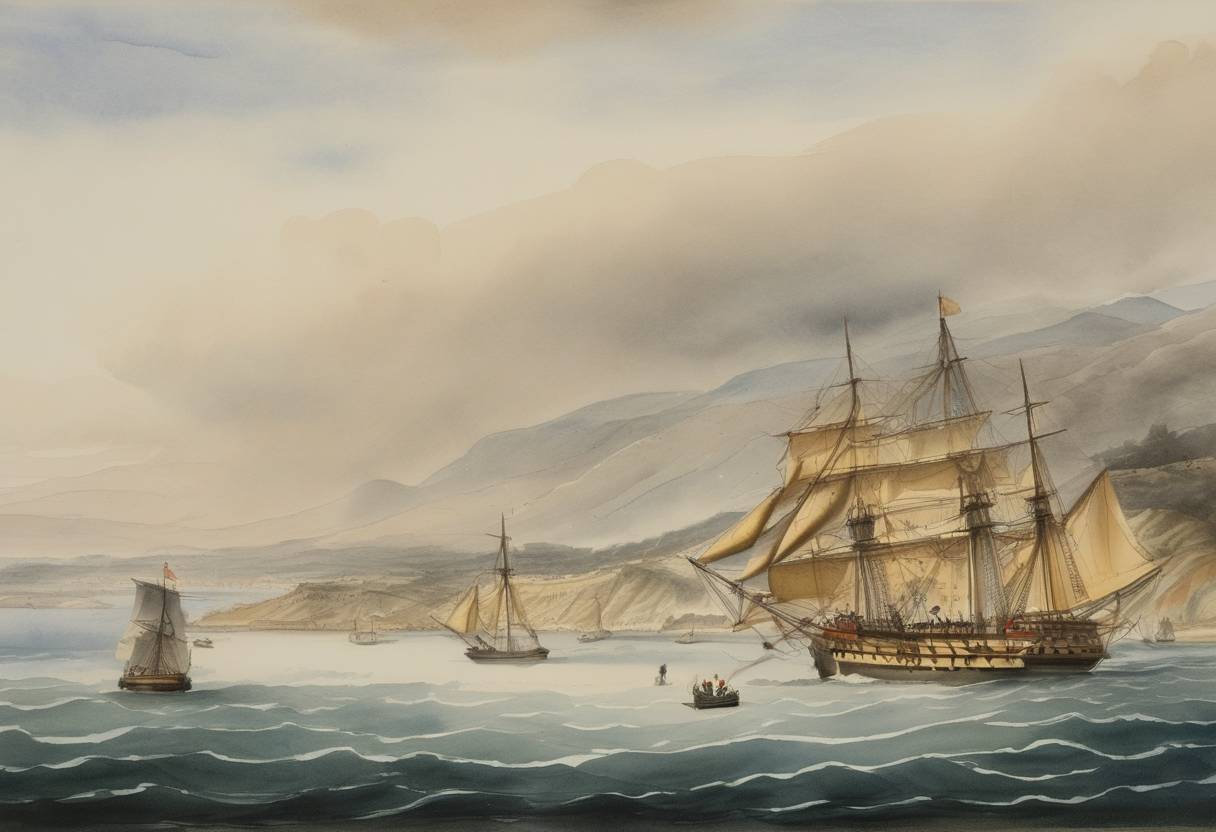
The Annexation of California: July 7, 1846
On July 7, 1846, during the Mexican-American War, Commodore John D. Sloat of the United States Navy declared California to be part of the United States. This substantial action took place in Monterey, California, marking a significant moment in the territorial expansion of the United States.
Context
The Mexican-American War, which began in April 1846, was the culmination of tensions between the United States and Mexico over border disputes and the annexation of Texas. As part of a broader strategy to seize Mexican territories, U.S. military leaders targeted California due to its strategic importance and burgeoning population.
The Declaration
Commodore John D. Sloat, commanding the U.S. Pacific Squadron, landed in Monterey, then the capital of Alta California, with a contingent of marines and seamen. Upon his arrival, Sloat raised the American flag over the Customs House and read a proclamation announcing the U.S. annexation of California. His orders were to assert control over the province in the name of the United States, maintaining a naval blockade to enforce U.S. claims and to preempt potential British interest in the region.
Reaction and Aftermath
The local Mexican authorities were caught off guard by Sloat’s swift actions. Although there was some resistance, the relative lack of significant military presence and the internal dissent among Mexican officials in California contributed to the relatively smooth transition of power.
Sloat’s decree set the stage for further military actions by the United States in California. After a few weeks, Commodore Robert F. Stockton relieved Sloat and took command. Stockton would later direct further operations that helped solidify American control over the region.
Historical Significance
The annexation of California significantly impacted both U.S. and Mexican histories. For the United States, it represented a critical step in the realization of “Manifest Destiny,” the 19th-century doctrine advocating for the territorial expansion across the North American continent. California’s vast resources and advantageous location would later contribute to its pivotal role in the American economy and its cultural evolution.
For Mexico, the loss of California and subsequent territories exemplified the consequences of the war and Mexico’s weakened political state, leading ultimately to the Treaty of Guadalupe Hidalgo in 1848. This treaty formalized the cession of California and other Mexican territories to the United States, redrawing the national boundaries drastically.
Conclusion
The annexation of California on July 7, 1846, remains a defining moment in U.S. expansionist history and highlights the complex dynamics of 19th-century North American geopolitics. It set the stage for California’s eventual statehood in 1850, following the Gold Rush, which dramatically altered the region’s demographics and economic landscape.