Pope John XXII's Condemnation of the Pre-Judgment Day Beatific Vision
1329 · Avignon, Papal States (modern-day France)
Pope John XXII issues a formal statement that condemns the belief in the Beatific Vision before Judgment Day as heretical.
May 27, 1332
Pope John XXII canonizes Thomas Aquinas, a Catholic priest and philosopher whose works laid the groundwork for much of modern philosophy and education within the Church.
Avignon, Papal States | Catholic Church
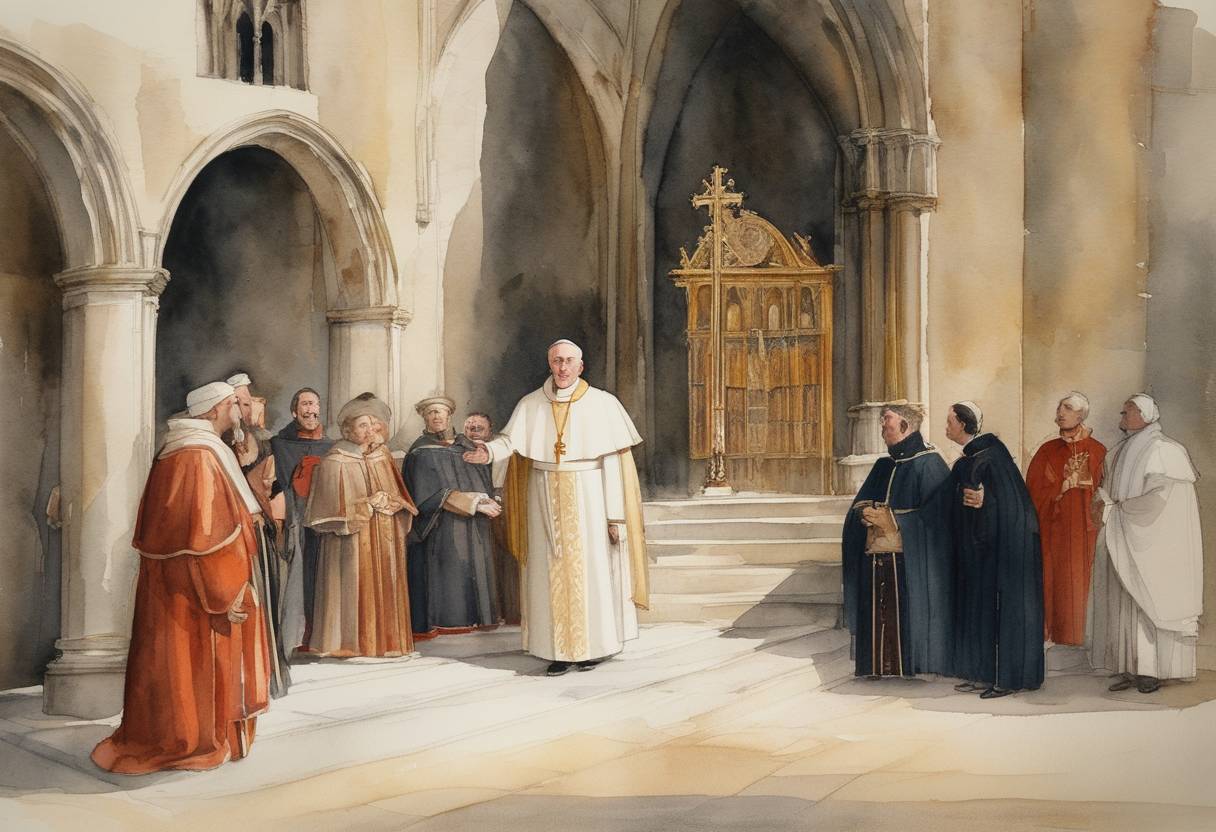
On May 27, 1332, Pope John XXII officially canonized Thomas Aquinas, a pivotal philosopher and theologian whose extensive works continue to influence Christian theology and Western philosophy to this day. This formal declaration recognized Aquinas as a saint within the Catholic Church.
Thomas Aquinas, born in 1225 in the Kingdom of Sicily, was a Dominican friar and a leading scholastic philosopher and theologian. Throughout his lifetime, Aquinas wrote extensively on the nature of God, the relationship between faith and reason, and ethics, laying the groundwork for Thomistic philosophy.
One of his most renowned works, Summa Theologica, is a comprehensive compendium that systematically explores Christian theology and seeks to unify and reconcile Aristotelian philosophy with Christian doctrine. This intellectual pursuit made significant contributions to both religious and secular thought, supporting a rational foundation for the discussion of faith.
By canonizing Thomas Aquinas, Pope John XXII solidified his teachings and philosophies as essential components of Catholic doctrine and education. Aquinas’ works became integral to the development of Church teachings and were later emphasized in the curriculum of Catholic institutions, influencing a broad spectrum of intellectual pursuits beyond theology, such as philosophy, law, and ethics.
The canonization of Thomas Aquinas cemented his status as one of the most important figures in Christianity. He was later declared a Doctor of the Church in 1567 by Pope Pius V. Thomism, the school of thought based on his teachings, continues to be a central part of theological study in seminaries and universities. Aquinas is recognized for shaping Scholasticism and offering a framework for engaging with philosophical ideas within the context of faith, setting a precedent for future theological discourse.
Thomas Aquinas’ influence extends beyond ecclesiastical circles as a key figure in the history of Western philosophy. His approach to integrating faith and reason has had a lasting effect on both religious and secular intellectual traditions.
Source: en.wikipedia.org