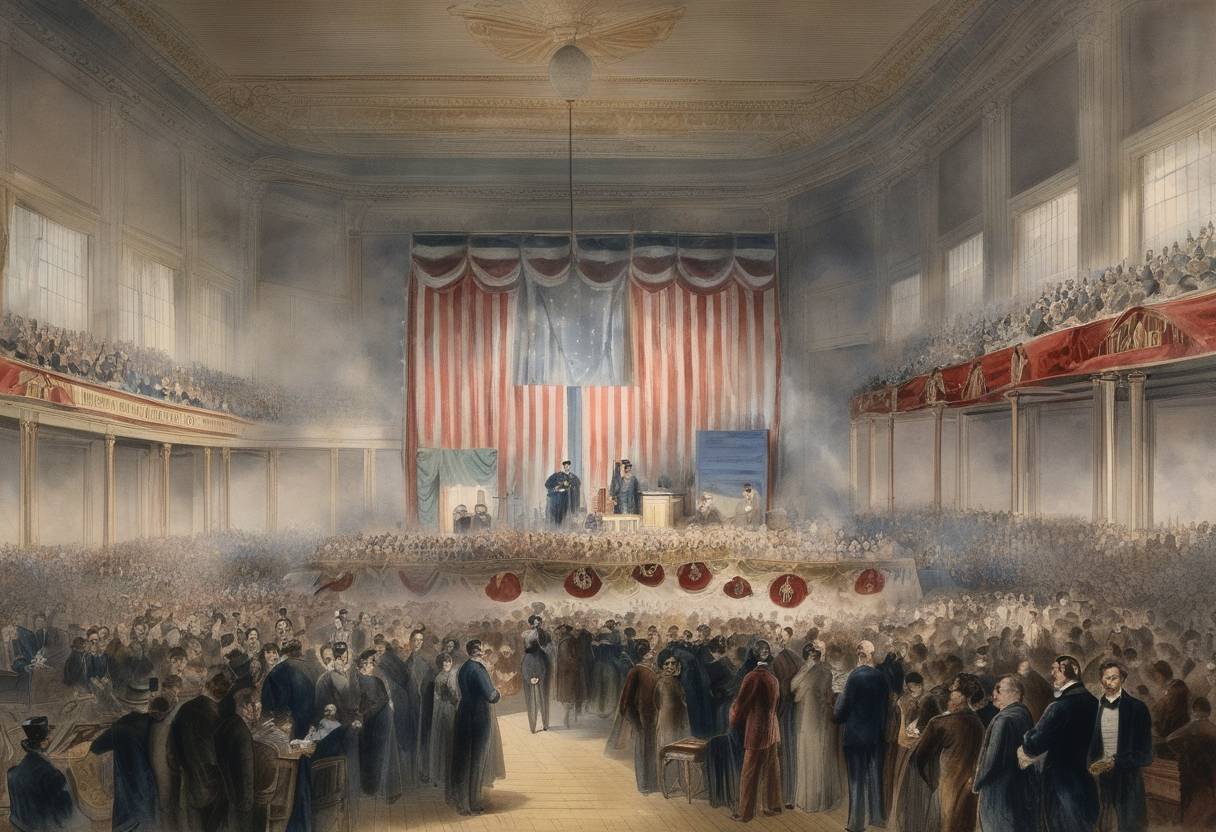
The 1860 Republican National Convention: Abraham Lincoln’s Nomination
On May 18, 1860, the Republican National Convention, held at the “Wigwam” in Chicago, Illinois, nominated Abraham Lincoln as their candidate for the presidency of the United States. This nomination was a pivotal moment in American political history and occurred amidst the heated backdrop of sectional tensions between the North and South over issues such as slavery and states’ rights.
Context and Background
By 1860, the United States was grappling with intense divisions over slavery. The Republican Party, founded in the mid-1850s, positioned itself against the expansion of slavery into new territories and was seen as the party of abolitionism and modernity. Key Republican figures at the time included William H. Seward, Salmon P. Chase, and Edward Bates, each a potential presidential nominee. Despite Seward being a front-runner, his perceived radicalism on slavery led some within the party to seek a more moderate candidate.
The Convention’s Proceedings
The convention began on May 16, 1860, with thousands of delegates and spectators gathering at a specially constructed venue known as the “Wigwam.” The first day involved organizing the platform and procedures, with initial ballots for the presidential candidate casting doubt on a clear favorite.
Abraham Lincoln, a relatively lesser-known politician from Illinois, emerged as an appealing compromise candidate. Known as “Honest Abe” and renowned for his debates with Stephen A. Douglas during the 1858 Illinois Senate race, Lincoln’s moderate stance on slavery helped garner broad support.
On May 18, after three sessions of balloting, Lincoln secured the nomination. He received crucial support from the Pennsylvania and Indiana delegations, among others, who viewed him as a unifying figure capable of challenging Democratic rivals in key battleground states.
Significance and Aftermath
Lincoln’s nomination marked a turning point in American politics. It signaled a shift towards a broader Republican coalition that included former Whigs, anti-slavery Democrats, and abolitionists. The 1860 election subsequently became one of the most contentious in U.S. history, resulting in Lincoln’s victory and the subsequent secession of Southern states leading to the Civil War.
Lincoln’s election underscored the growing national divisions and set the stage for his presidency, during which the preservation of the Union and the abolition of slavery became foremost objectives. His leadership throughout the Civil War indelibly shaped the nation’s trajectory and principles.
In summary, the 1860 Republican National Convention in Chicago was a seminal moment not only for Lincoln but for the United States, fundamentally altering the nation’s political landscape and setting the course for its future conflicts and resolutions.