Mikhail Romanov Elected Tsar of Russia - February 21, 1613
1613 · Moscow, Russia
Mikhail Romanov was elected Tsar of Russia, marking the beginning of the Romanov dynasty.
August 25, 1530
Ivan IV of Russia, known as Ivan the Terrible, was born. He was the first ruler to be crowned as Tsar of All Russia and centralized royal power, expanding Russian territory significantly during his reign.
Kolomenskoye, Russia | None
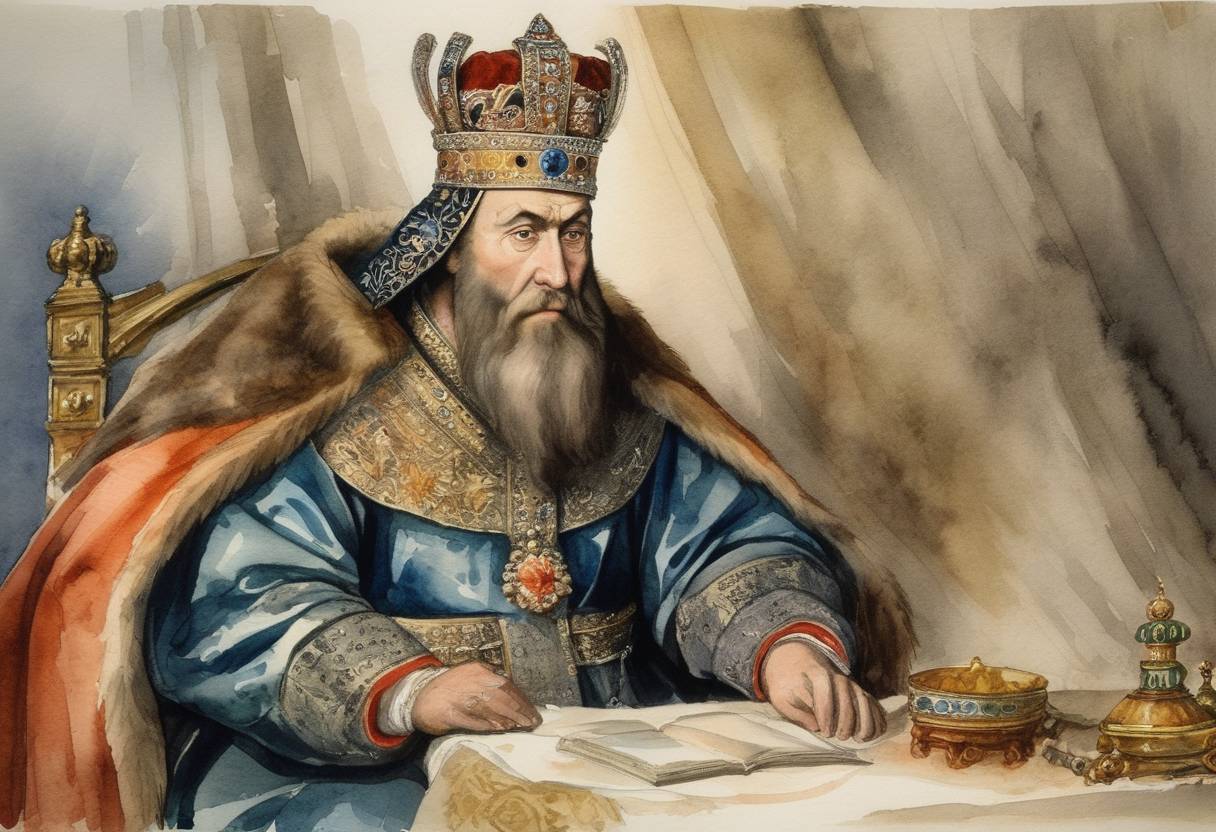
Ivan IV Vasilyevich, also known as Ivan the Terrible, was born on August 25, 1530, in Kolomenskoye, near Moscow, Russia. The son of Grand Prince Vasili III of Moscow and Elena Glinskaya, Ivan was born into a time of significant political intrigue and power struggles among the Russian nobility.
The early years of Ivan’s life were marked by the instability that followed his father’s death in 1533, when Ivan was just three years old. His mother, Elena Glinskaya, served as regent until her own death in 1538. During this period, boyars, or noble families, vied for power, often to the detriment of the young Ivan, leaving him deeply suspicious and hostile toward the nobility.
Ivan was crowned Grand Prince of Moscow in 1533 but only formally took power in 1547 when he was crowned as the first Tsar of All Russia. This coronation marked the transformation of the Russian state from a medieval principality into a tsardom, effectively elevating Ivan’s authority above that of mere regional rulers and centralizing power in the monarchy.
Ivan IV’s reign from 1547 to 1584 is noted for both the territorial expansion of Russia and the centralization of royal power. He reformed the central administration and legal systems, presided over military campaigns that expanded Russian territory into Siberia and the Khanates of Kazan and Astrakhan, and curtailed the power of the boyars through the controversial Oprichnina policy.
Ivan undertook extensive legal reforms, including the creation of the Sudebnik of 1550, which streamlined legal procedures and governance. His establishment of the Streltsy, a permanent standing army, furthered military modernization and contributed to his successful campaigns.
The Oprichnina (1565–1572) was a policy that divided Russia into two parts—one under Ivan’s direct control and the other managed by the boyars. This era was marked by widespread purges, terror, and executions of suspected traitors, solidifying Ivan’s control but at the cost of great human suffering and economic disruption.
Ivan IV’s reign left a mixed legacy. He significantly expanded Russian territory and centralized the government, laying foundations for a centralized Russian state. However, his reign also introduced periods of intense terror and conflict, earning him the moniker “the Terrible.”
Despite his fearsomeness, Ivan IV remains a pivotal figure in Russian history, representing both the might of the tsarist autocracy and the complex tapestry of Russian expansionism, reform, and internal strife in the 16th century.
Source: www.britannica.com