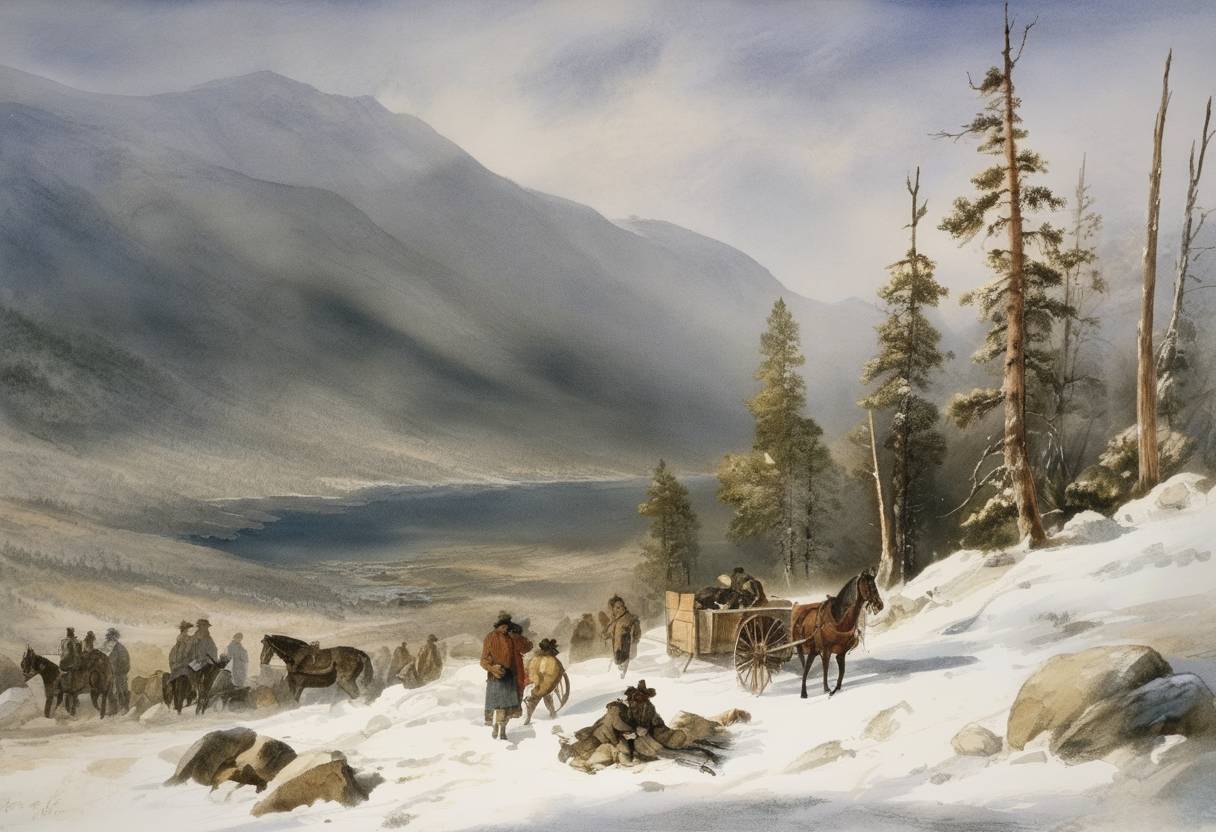
The Donner Party: October 31, 1846
On October 31, 1846, the Donner Party, a group of American pioneers, became trapped in the Sierra Nevada mountains, setting off a chain of harrowing events that would become one of the most infamous and discussed cases of survival cannibalism in American history.
Background and Journey
The Donner Party, led by brothers George and Jacob Donner, along with James F. Reed, consisted initially of 87 members. They departed from Independence, Missouri, in May 1846, heading towards California. The group intended to take a new, untested shortcut called the Hastings Cutoff. This route, which promised to save time, instead proved perilous, costing them valuable weeks and resources.
Events Leading to October 31
By late October, months of journeying had already sapped the group’s resources. They faced severe hardships, including rough terrain, loss of cattle, and dwindling supplies. As they approached the Sierra Nevada, early snowstorms swept the region.
October 31, 1846
On October 31, 1846, heavy snowfall effectively sealed the fate of the Donner Party. The group’s progress was halted near Truckee Lake (now Donner Lake). The snow meant they could no longer traverse the treacherous passes, forcing them to set up camp and prepare for a winter they had neither expected nor were equipped to survive.
Conditions and Survival Efforts
Trapped in their makeshift encampment, the party constructed crude shelters. With food supplies exhausted, starvation loomed. Efforts by small groups to cross the mountains and bring help met with limited success and significant hardship.
Consequences and Legacy
As the winter progressed, the famine led some members to resort to cannibalism to survive. While the first relief parties did not reach the stranded group until February 1847, only 48 of the original 87 members survived to be rescued.
The ordeal of the Donner Party highlighted the dangers of westward expansion and the potential consequences of inadequate preparation and misguided decisions. Their tragic story remains a somber chapter in the history of American pioneer migration, illustrating both human endurance and the extreme conditions faced by settlers pushing westward.