Capture of Ulundi: The End of the Anglo-Zulu War
1879 · Ulundi, South Africa
Anglo-Zulu War: The Zululand capital of Ulundi is captured by British forces, effectively ending the war.
January 11, 1879
The Anglo-Zulu War began when British troops under Lieutenant General Frederic Augustus invaded as part of a plan to confederate South Africa.
Ulundi, South Africa | British Empire
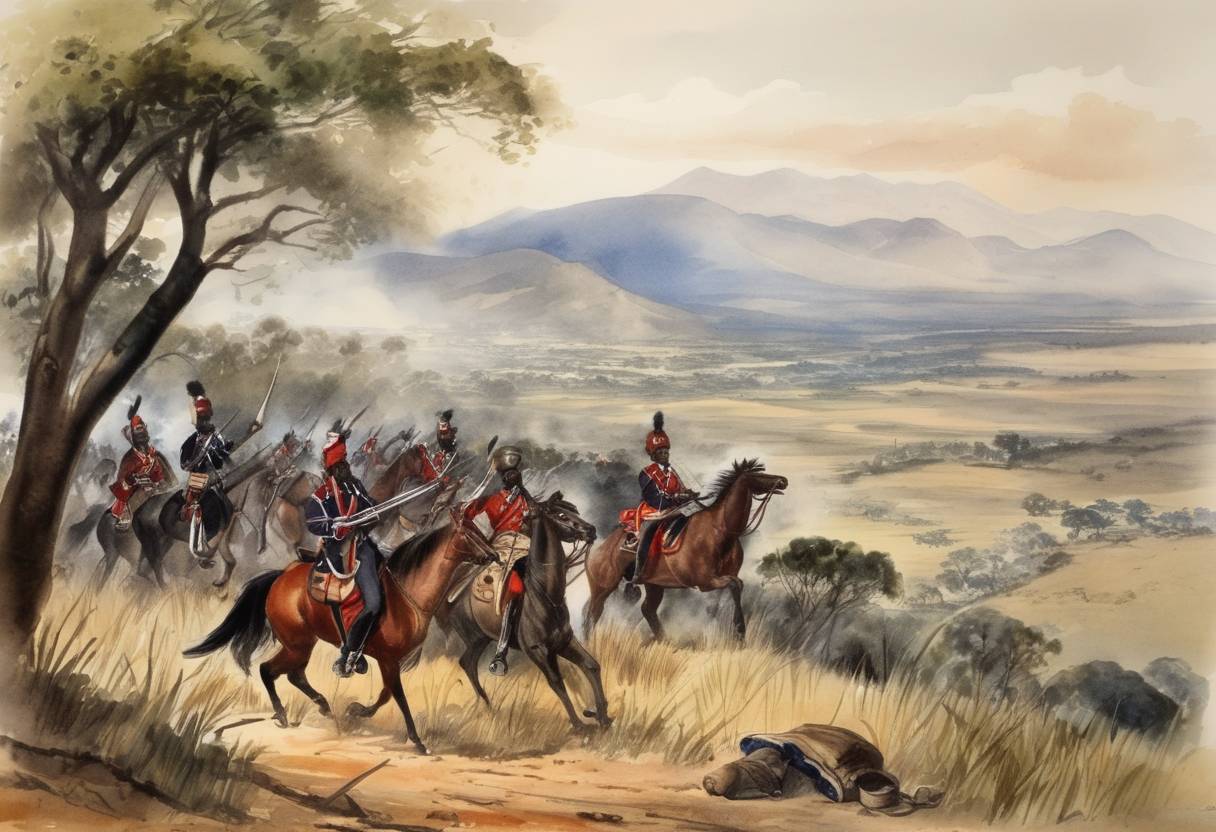
On January 11, 1879, the Anglo-Zulu War commenced when British forces, led by Lieutenant General Frederic Augustus Thesiger, 2nd Baron Chelmsford, invaded the Zulu Kingdom. This conflict was part of a broader British strategy to federate South Africa under British control. The war arose from tensions between the expanding British Empire and the established Zulu Kingdom, which was recognized for its military prowess and well-organized society.
The Zulu Kingdom, under the leadership of King Cetshwayo, had maintained its independence despite British colonial expansion in southern Africa. The British authorities, led by Sir Bartle Frere, the High Commissioner for Southern Africa, sought to incorporate the independent territories in the region into a single confederation. Frere viewed the military strength of the Zulu nation as a potential threat to this vision and used a series of local disputes as a pretext for war.
Frere’s Ultimatum: On December 11, 1878, Sir Bartle Frere presented King Cetshwayo with an ultimatum that demanded the disbandment of the Zulu military system and the acceptance of British authority. The terms were intentionally unacceptable, designed to provoke a conflict.
Lack of Diplomacy: King Cetshwayo attempted diplomatic approaches to avoid conflict, but communication breakdowns and the rigidity of the British demands led to a further escalation.
Military Mobilization: In response to the ultimatum, the British mobilized their forces in Natal, and war preparations intensified with the assembly of an invasion force.
On January 11, 1879, British forces crossed the Buffalo River into Zulu territory, marking the start of hostilities. This invasion was led by three British columns, with the central column directly under Lord Chelmsford’s command. The political motivations behind the invasion were rooted in the desire to weaken the Zulu Kingdom and establish a united British-controlled South Africa.
The invasion initiated a brutal conflict that would see initial victories by the Zulu, such as the infamous Battle of Isandlwana on January 22, and ultimately a costly victory for the British. The war had lasting impacts on the region, signaling the end of the Zulu Kingdom’s independence and the increased dominance of British colonial power in southern Africa.
Ultimately, the conflict laid the groundwork for the further expansion of British colonial rule in the area and the complex socio-political landscapes that would continue to evolve in the years leading up to the formation of the Union of South Africa in 1910.
Source: www.britannica.com