NASA Launches Mariner 10: A Historic Mission
1973 · Cape Canaveral, United States
NASA launches Mariner 10, the first spacecraft to fly by two planets, Venus and Mercury.
August 5, 1969
The Mariner 7 spacecraft made its closest flyby of Mars, contributing significant data about the planet's surface and atmosphere and marking a pivotal moment in the exploration of Mars.
NASA Jet Propulsion Laboratory, United States | NASA
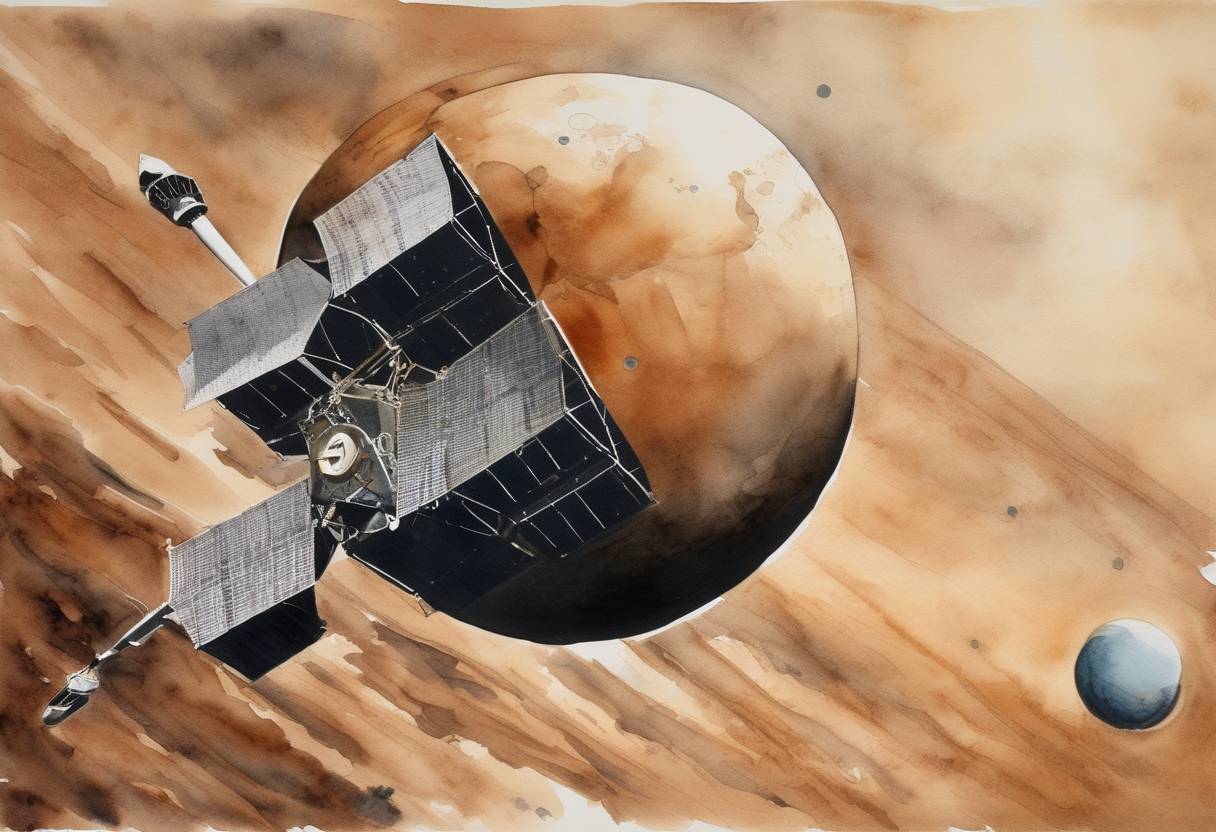
On August 5, 1969, the Mariner 7 spacecraft executed its closest flyby of Mars, significantly enhancing humanity’s understanding of the Red Planet. Part of NASA’s Mariner program, Mariner 7, along with its twin probe Mariner 6, was designed to study Mars’ surface and atmosphere.
The Mariner program aimed to conduct reconnaissance of Mars to gather data that could inform future space missions. Mariner 6 and Mariner 7 launched two months apart, with their flights coordinated to examine the planet from different vantage points. Their missions were timed to capitalize on the favorable opposition geometry of Mars, providing a close approach suitable for detailed study.
During its closest approach on August 5, 1969, Mariner 7 came within approximately 3,524 kilometers (2,189 miles) of the Martian surface. This allowed the spacecraft to transmit high-resolution images back to Earth, showcasing Mars’ equatorial and southern hemisphere. The mission’s flyby trajectory enabled comprehensive coverage, complementing the data previously gathered by Mariner 6.
Mariner 7’s observations contributed to several critical discoveries about Mars:
The successful flyby of Mariner 7 marked a pivotal moment in the exploration of Mars, setting the stage for subsequent missions in the Mariner series. The information obtained helped shape scientific understanding of Mars, guiding future missions and technologies aimed at exploring the planet more profoundly. The mission underscored the increasing capabilities of space exploration technology and solidified NASA’s position at the forefront of planetary science.
Mariner 7’s achievements contributed fundamentally to the advancement of interplanetary exploration, fostering global interest in Mars and the broader solar system.
Source: en.wikipedia.org