The March on Rome: October 28, 1922
1922 · Rome, Italy
Italian fascists led by Benito Mussolini march on Rome, leading to Mussolini's appointment as Prime Minister.
February 23, 1919
Benito Mussolini forms the Fascist Party in Italy.
Milan, Italy | Fascist Party
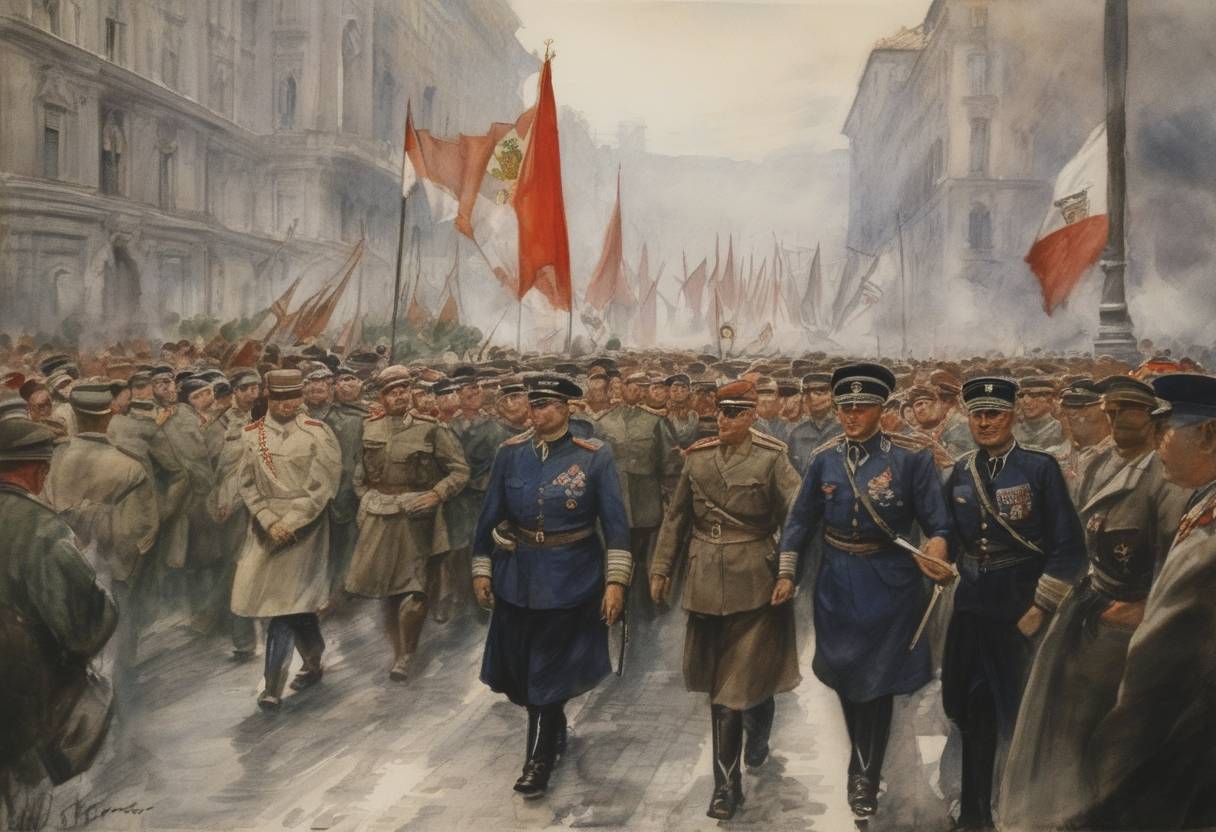
On February 23, 1919, Benito Mussolini founded the Fascist Party in Italy, marking a pivotal moment in 20th-century European history. This event took place in Milan, where Mussolini, a former socialist and newspaper editor, convened a meeting of about 100 like-minded individuals at the Piazza San Sepolcro. The assembly led to the establishment of the “Fasci Italiani di Combattimento” (Italian Combat Leagues), laying the groundwork for the development of fascism as a political movement.
Following World War I, Italy was plagued by economic turmoil, social unrest, and widespread dissatisfaction with the liberal government’s handling of post-war treaties and economic policies. Many Italians felt disillusioned by the perceived “mutilated victory” after the war, as the promises made by the Allied powers were not fully realized, fueling nationalist sentiment.
Mussolini leveraged these sentiments by advocating for a platform of national unity, authoritarian governance, and the suppression of socialism and communism, which were gaining momentum in Italy. The Fascist Party distinguished itself with its emphasis on nationalism and direct action, promising to restore Italy’s pride and power on the international stage.
The Fascist Party’s ideology combined ultranationalism, anti-communism, and anti-liberal principles. It emphasized:
Following its formation, the Fascist Party quickly began to attract members, including veterans, nationalists, and various disenchanted segments of society. Mussolini’s charisma and strategic use of propaganda helped consolidate power, transforming the party from a fringe movement to a significant political force throughout the early 1920s.
The party’s use of violence and intimidation by paramilitary groups, such as the Blackshirts, played a crucial role in suppressing opposition and gaining influence, eventually leading to Mussolini’s appointment as Prime Minister on October 31, 1922, after the March on Rome. This marked the beginning of the fascist regime in Italy, which lasted until Mussolini’s ousting from power in 1943 amid World War II.
The establishment of the Fascist Party on February 23, 1919, thus represents a turning point in Italian and European history, setting the stage for the rise of authoritarian regimes in the interwar period.
Source: en.wikipedia.org