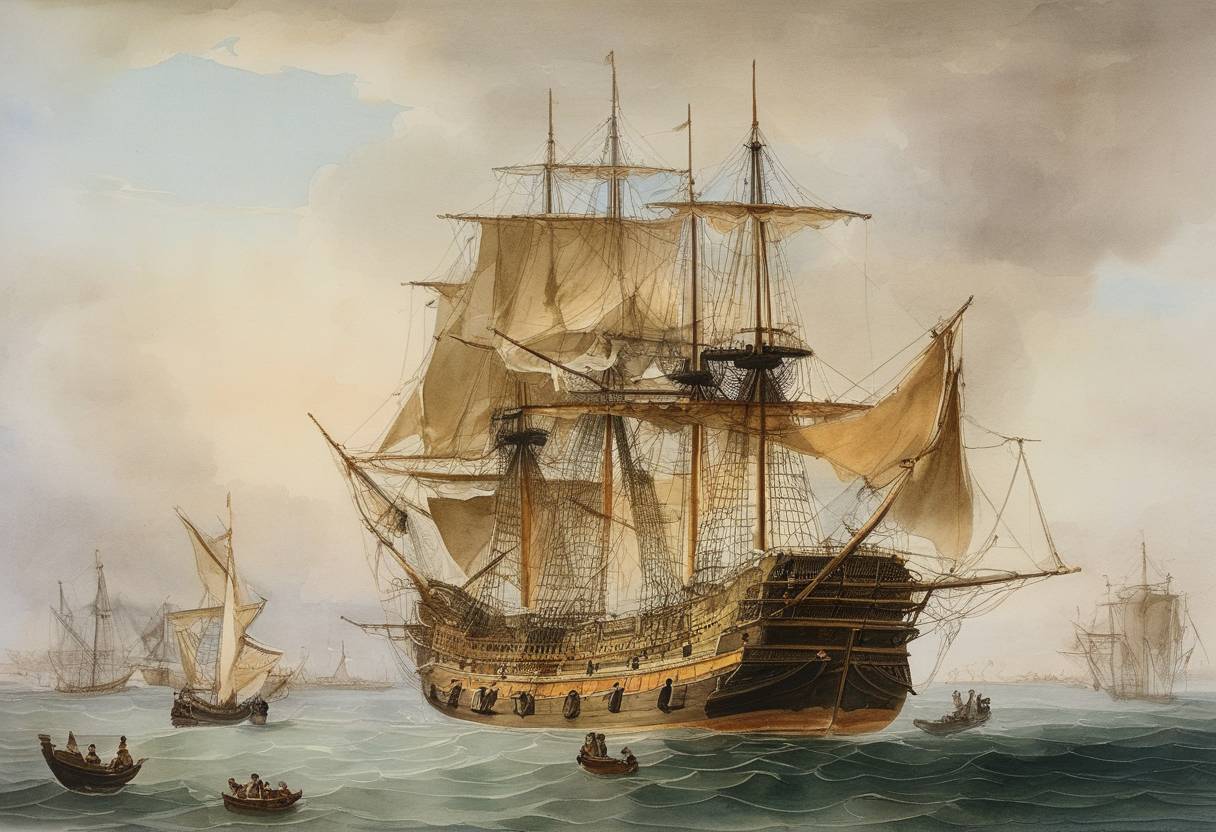
San Carlos Departs Manila: The Final Manila Galleon Trade Route
On June 19, 1756, the Spanish ship San Carlos departed from Manila, marking the commencement of what was to be the final leg of the storied Manila Galleon trade route. This event signified an important chapter in the history of global commerce, linking the economies of Asia and the Americas through the exchange of goods, culture, and influence.
Background
The Manila Galleon trade, which began in 1565 after Spanish navigator Andrés de Urdaneta discovered a viable trade route across the Pacific, allowed for the exchange of Asian luxuries with New World silver. For two and a half centuries, these galleons sailed between Manila in the Philippines and Acapulco in New Spain (present-day Mexico), serving as the only trade route directly connecting Asia with the Americas.
The Journey of San Carlos
The San Carlos was part of a complex web of maritime commerce that inevitably involved perilous voyages fraught with the challenges of weather, piracy, and navigation errors. Despite these challenges, the galleons carried an array of goods such as silk, spices, porcelain from Asia, and silver from the Americas, aiding in the economic and cultural exchange that defined this era of world trade.
Significance
This trading system had a profound impact, facilitating the globalization of goods long before modern times. Through these voyages, cultural and technological exchanges left lasting legacies on both sides of the Pacific. Economically, the trade provided a crucial flow of silver to China, which operated under a silver-based economy.
Aftermath and Historical Impact
While the departure of the San Carlos in 1756 was not the absolute last Manila Galleon voyage— the route formally ended in 1815 with Mexican independence—the significance of the San Carlos journey lay in its representation of the resilience and continuity of a trade system that had shaped global commerce.
The eventual decline and cessation of this route were due to multiple factors, including increasing hostilities in international politics, the growth of other trade routes, and the tumult of independence movements in Spanish colonies. The legacy of the Manila Galleon trade endures as an early precursor to the complex global trading systems in place today.