The First Warrants in the Salem Witch Trials: February 29, 1692
1692 · Salem, United States
The first warrants are issued in the Salem witch trials.
May 14, 1878
The last witchcraft trial in the United States began with the trial of Lucretia Brown in Salem, Massachusetts.
Salem, USA | none
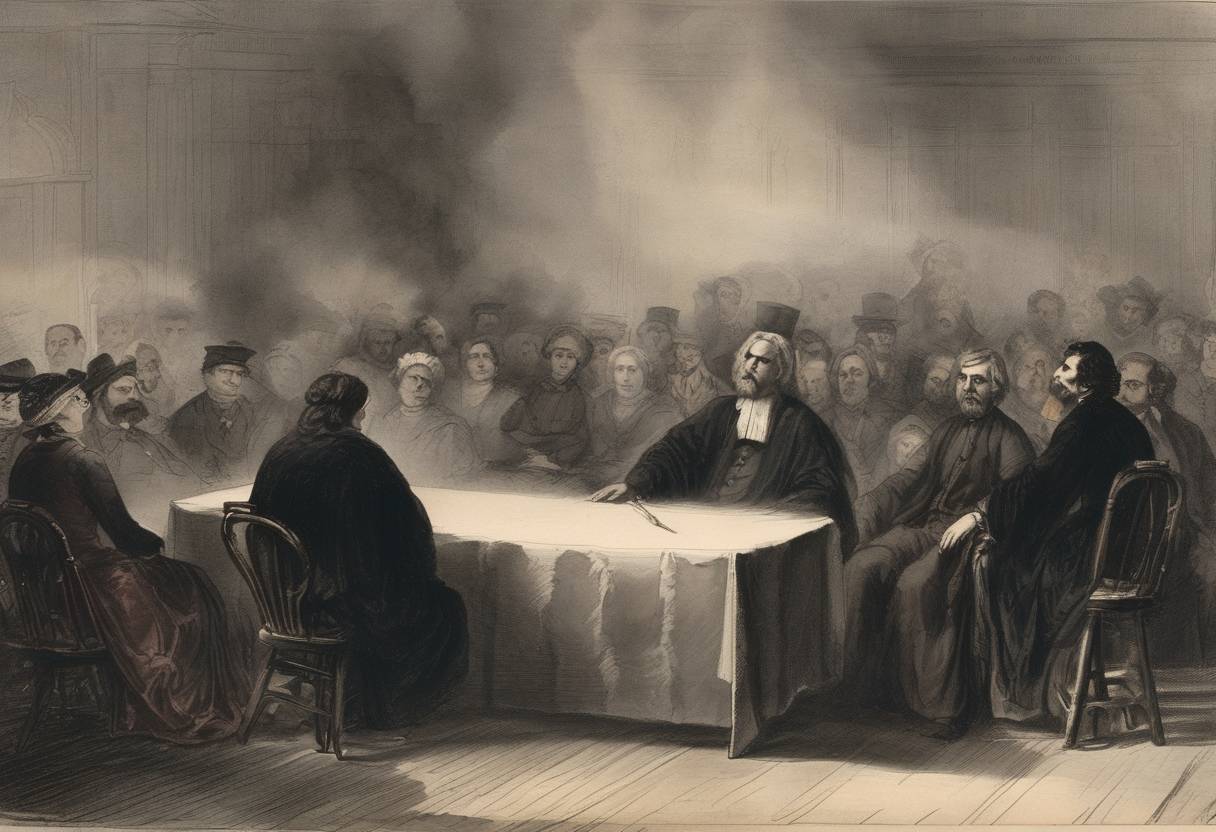
The trial of Lucretia Brown, often referred to as the last witchcraft trial in the United States, began on May 14, 1878, in Salem, Massachusetts. This case marked a peculiar moment in history, given its occurrence over two centuries after the infamous Salem witch trials of 1692.
Lucretia Brown was a member of the Christian Science movement, a religious organization founded by Mary Baker Eddy. Brown accused Daniel Spofford, a former member of the Church of Christ, Scientist and an adherent of the same religious sect, of using mesmerism, a form of hypnosis, to harm her. The case, formally noted as “Lucretia L. S. Brown v. Daniel H. Spofford,” attracted attention due to its anomalous claims at a time when scientific and rational explanations for phenomena were more commonly accepted.
The case was filed in the court at the Essex County Superior Court in Salem. Lucretia Brown alleged that Spofford’s use of mesmerism prevented her from recovering physically and spiritually. Her claim was largely influenced by the teachings of Mary Baker Eddy, who had also faced controversy for her beliefs.
The trial’s occurrence in Salem added a layer of historical irony and cultural intrigue, considering the city’s infamous past with witchcraft accusations. It reflected the still-prevalent superstitions and struggles between emerging scientific thought and mystical beliefs.
The court, led by Judge Horace Gray, dismissed the case, concluding it lacked tangible evidence. The verdict reflected the period’s evolving legal standards, valuing rational evidence over supernatural claims.
The dismissal of the trial underscored the gradual decline of superstition-infused court cases in the United States. It highlighted a shift towards a legal system grounded in empirical evidence and scientific reasoning. Despite the case’s dismissal, it remained a point of discussion regarding the persistence of mysticism in American society.
The trial of Lucretia Brown is often cited as a historical footnote illustrating the tension between old-world beliefs and the burgeoning modern legal and scientific frameworks of the late 19th century. As such, it stands as a testament to the cultural and judicial evolution occurring in post-Civil War America.
This trial serves as the closing chapter in the legal history of witchcraft-related cases in the United States, marking the end of an era dominated by irrational fears and illustrating progress towards a more rational legal landscape.