The Death of Sitting Bull: December 15, 1890
1890 · Standing Rock, United States
Sitting Bull, a Hunkpapa Lakota leader, is killed by Indian agency police on the Standing Rock Indian Reservation.
June 26, 1879
The Battle of Little Big Horn is fought five days earlier and on this date, the bodies of U.S. troops are buried on the battlefield in Little Bighorn.
Little Bighorn, United States | U.S. Army
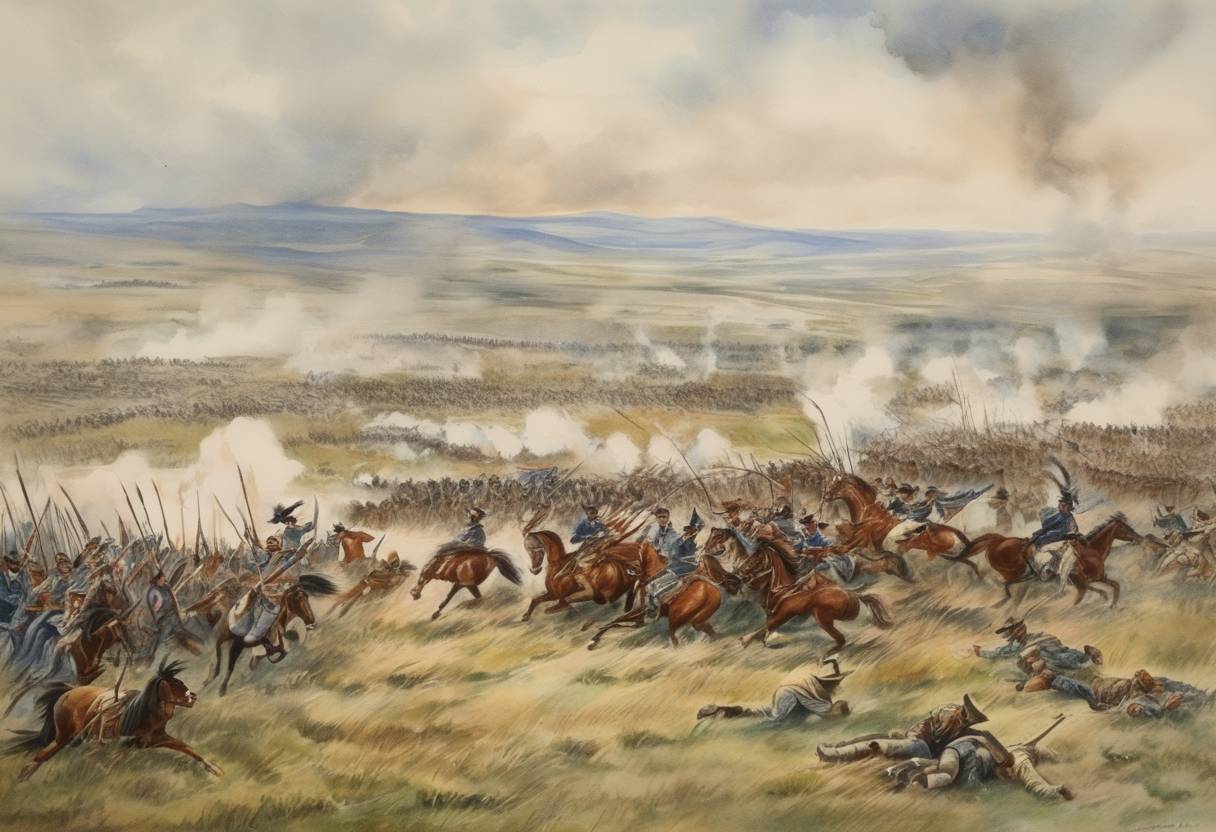
On June 26, 1876, the bodies of Lieutenant Colonel George Armstrong Custer’s men, who fell during the Battle of the Little Bighorn, were buried on the battlefield. The battle itself occurred on June 25, 1876, and is one of the most significant conflicts between the United States Army and Native American tribes.
The Battle of Little Bighorn was a major engagement in the Great Sioux War of 1876-1877. Tensions had been escalating between the U.S. government and Native American tribes, such as the Lakota Sioux and Northern Cheyenne, due to the U.S. government’s violation of the 1868 Treaty of Fort Laramie, which promised the Sioux exclusive possession of the Black Hills, an area that saw an influx of miners after gold was discovered.
The battle commenced on June 25, 1876, when Custer’s 7th Cavalry, tasked with compelling the Native American tribes to relocate to reservations, unexpectedly stumbled upon a massive encampment of Sioux, Northern Cheyenne, and Arapaho people, led by prominent leaders such as Sitting Bull and Crazy Horse.
Custer’s forces, consisting of around 700 men, faced an overwhelming force of Native American warriors, which some estimates place between 1,000 and 1,500. Despite Custer’s expectations of a quick victory, his detachment was quickly encircled and overwhelmed by the well-coordinated defense led by Native American warriors.
The battle resulted in the complete annihilation of five companies of the 7th Cavalry, with 268 U.S. soldiers and scouts killed, including Custer, and 55 seriously wounded. The bodies were initially left on the open battlefield, as the victorious Native American forces departed the area soon after the conflict.
It wasn’t until June 26, 1876, that General Alfred Terry’s troops arrived at the site. Initially, they focused on strategy and recovery operations, and on this date, the fallen soldiers were given slight burials. This hurried burial was a pragmatic necessity under challenging conditions, given the imminent threat of decay and the need to protect the site temporarily from scavengers.
The Battle of Little Bighorn was a humiliation for the U.S. Army and a symbolic victory for the Native American tribes involved, capturing public imagination and influencing public policy in the years that followed. In the longer term, however, it galvanized U.S. efforts to subdue Native American tribes, leading to further conflicts and subsequent loss of Native American lands.
In 1881, the remains of many of the soldiers were reinterred in a mass grave on the site, marked by a memorial, establishing the battlefield as a place of remembrance and reflection on a tumultuous period of American history. The site was designated the Little Bighorn Battlefield National Monument in 1946 and continues to serve as a historical landmark.
Source: www.britannica.com