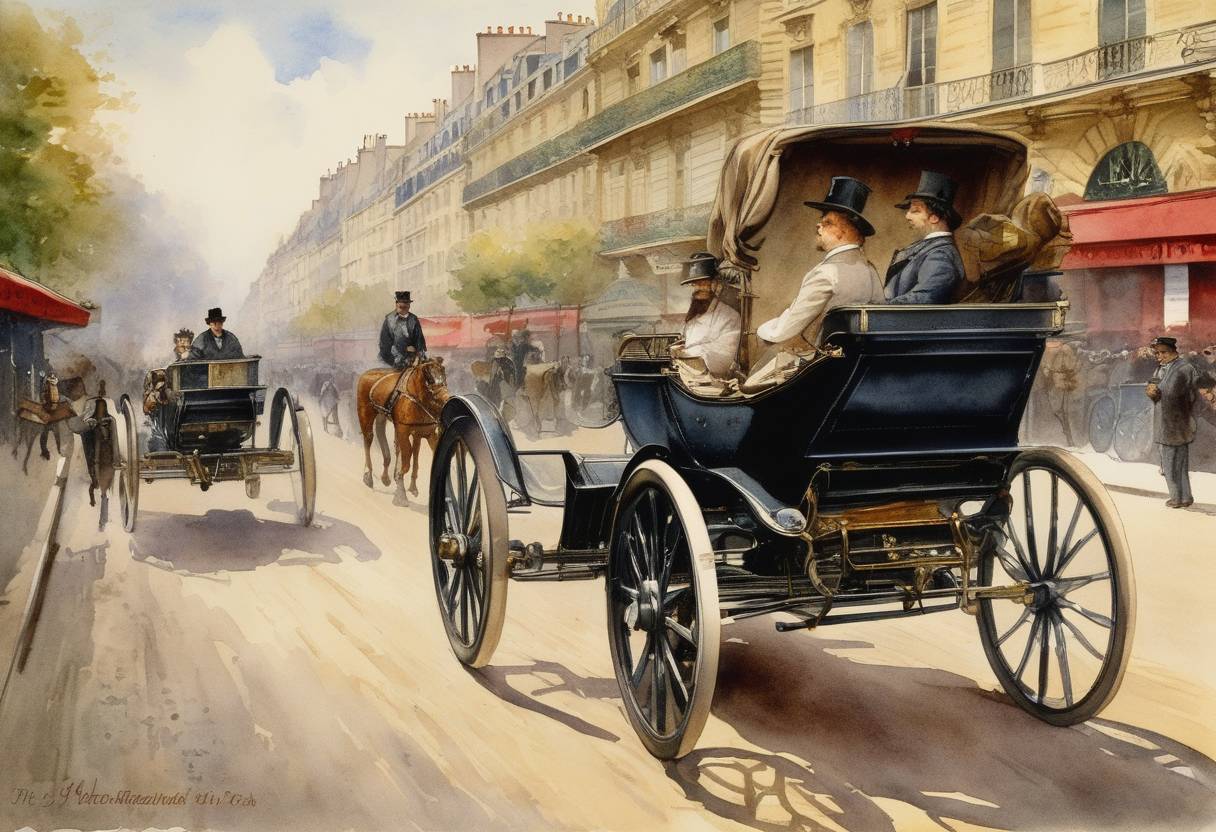
First Motorized Vehicle Advertisement in Paris: July 22, 1894
On July 22, 1894, Paris witnessed a pivotal moment in the annals of transportation history—the publication of the first advertisement for a motorized vehicle. This event marked a significant leap toward the modernization of personal and public transportation, heralding the era of the automobile.
Context and Background
By the late 19th century, Europe was abuzz with innovative technology, and the idea of a “horseless carriage” had captured the imagination of inventors and entrepreneurs alike. The internal combustion engine, particularly gasoline-powered, had begun to present viable alternatives to horse-drawn vehicles for the first time. This transformation was part of a broader industrial and scientific advancement wave sweeping across the continent.
The Vehicle
The vehicle advertised was a gasoline-powered horseless carriage, a concept that challenged and gradually shifted public perception about transportation. Pioneering inventors like Karl Benz and Gottlieb Daimler had achieved significant breakthroughs by developing practical internal combustion engines that could power vehicles reliably over longer distances. These developments laid the groundwork for what would become the modern automotive industry.
The Advertisement
The advertisement in Paris was more than just a marketing endeavor; it was a statement heralding the future of mobility. While details of the exact phrasing and medium remain scarce, the advertisement’s impact was profound, capturing the attention of a public curious about new technological possibilities. This event symbolized the opening of new frontiers for both personal convenience and industrial progress.
Broader Impact
The introduction and promotion of motorized vehicles set the stage for rapid advancement in vehicular technology. Shortly after the advertisement, automotive innovations accelerated, leading to enhanced designs, production techniques, and distribution methods. This burgeoning industry would go on to revolutionize economies, reshape landscapes with the construction of road networks, and fundamentally alter daily life and global trade.
Advertising for such modern conveniences also underscored the importance of public engagement in technological adoption. The growing acceptance and demand for automobiles eventually led to the decline of horse-drawn carriages and introduced regulations, safety standards, and infrastructure developments necessitated by the rise of motor vehicles.
Conclusion
The first motorized vehicle advertisement in Paris on July 22, 1894, was not merely an introduction to a new product but a herald of the profound societal shifts that were to follow. It encapsulated a moment of transformation, marking the dawn of the automotive age that would define the 20th century and beyond.