1814 · Niagara Falls, Canada
The Battle of Lundy's Lane, one of the bloodiest battles of the War of 1812, was fought in present-day Niagara Falls, Ontario, resulting in a stalemate between American and British forces.
November 11, 1813
The Battle of Crysler's Farm, part of the War of 1812, took place. British and Canadian forces defeated American troops.
Morrisburg, Canada | British Army
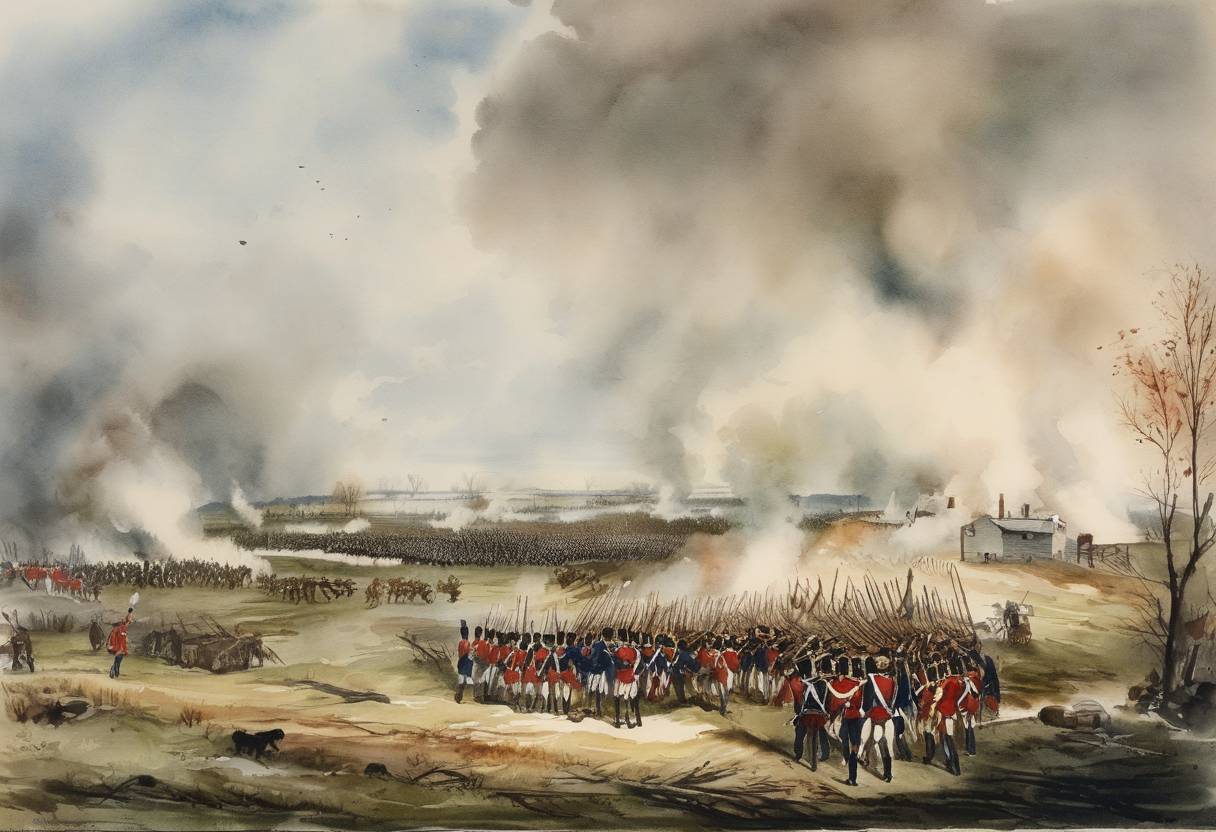
The Battle of Crysler’s Farm occurred on November 11, 1813, during the War of 1812. This pivotal confrontation saw British and Canadian forces achieve a decisive victory over American troops in Upper Canada, significantly impacting the broader military campaign known as the St. Lawrence campaign.
The War of 1812 was characterized by numerous battles predominantly along the United States-Canadian border. The St. Lawrence River was a critical strategic route, and the United States aimed to cut British supply lines by capturing Montreal. The American forces, commanded by Major General James Wilkinson, had initiated a campaign to move along the St. Lawrence River towards this objective.
British/Canadian Forces: The British forces, led by Lieutenant Colonel Joseph Wanton Morrison, consisted of approximately 900 troops. This force comprised elements of the 49th (Hertfordshire) Regiment of Foot, Canadian militia, and Indigenous warriors allied to the British cause.
American Forces: Under the command of Brigadier General John Parker Boyd, the American contingent included around 2,500 soldiers. These forces were primarily regular infantry, with artillery support.
Tactics: The British forces, though outnumbered, utilized their defensive advantage, choosing excellent terrain to station their troops. They positioned themselves on Crysler’s Farm, taking advantage of the natural cover and open fields to challenge the American advance.
Engagement: The battle commenced with an American assault intended to overcome the British defensive position. However, the Americans faced difficulties maneuvering in the muddy fields and thick woods, hampering their efforts. The British utilized artillery and disciplined musket volleys to repel repeated American attacks.
Outcome: The battle concluded with significant American casualties, and their forces were forced to retreat. British and Canadian forces demonstrated superior coordination and effective use of terrain, significantly hindering the larger American force’s progress towards Montreal.
The defeat at Crysler’s Farm, combined with the simultaneous failure at the Battle of Chateauguay, compelled the American campaign against Montreal to halt. The loss underscored the challenges faced by American forces operating in hostile terrain and overextended supply lines. This victory secured the strategic St. Lawrence corridor for the British, ensuring supply lines to Upper Canada remained intact and bolstering British defense in the region.
The Battle of Crysler’s Farm was instrumental in maintaining British control over Upper Canada during the War of 1812. It highlighted the effectiveness of combined British, Canadian, and Indigenous forces and stands as a testament to the intricacies of warfare where geography, troop morale, leadership, and strategy converge to determine outcomes beyond mere troop numbers.
Source: www.thecanadianencyclopedia.ca