Annie Edson Taylor: The First to Survive Niagara Falls in a Barrel
1901 · Niagara Falls, United States/Canada
Annie Edson Taylor became the first person to survive going over Niagara Falls in a barrel.
June 30, 1859
French acrobat Charles Blondin crossed Niagara Falls on a tightrope, a feat that captivated audiences and demonstrated the daring nature of 19th-century entertainment.
Niagara Falls, United States/Canada | none
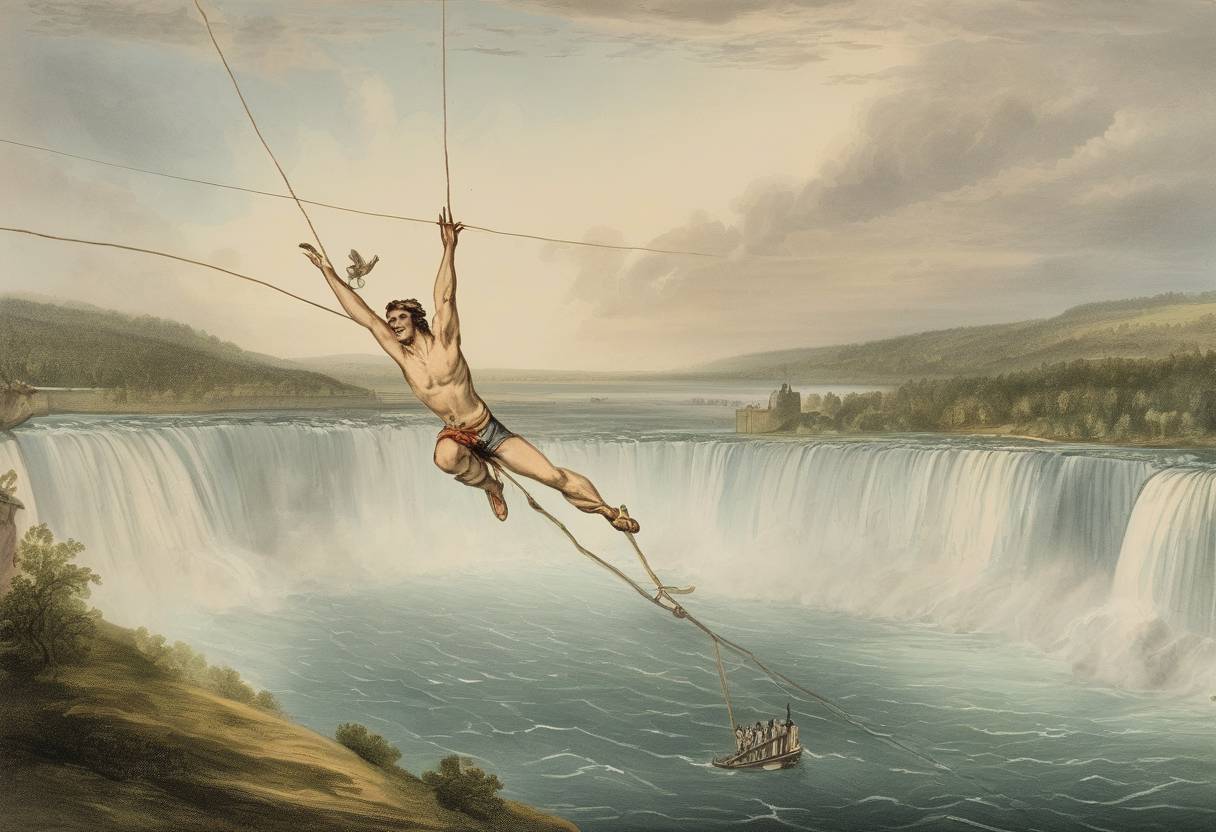
On June 30, 1859, French acrobat Charles Blondin achieved a remarkable and daring feat by crossing the Niagara Falls on a tightrope. This event not only captivated audiences of the time but also highlighted the adventurous spirit and daring nature of 19th-century entertainment.
Charles Blondin, born Jean François Gravelet in 1824 in St. Omer, France, was a renowned tightrope walker and acrobat. From a young age, he demonstrated exceptional balance and agility, which he honed through rigorous training. By the mid-19th century, Blondin had become a celebrated performer, known for his audacious stunts and innovative performances.
Blondin’s crossing of Niagara Falls was meticulously planned and executed. The tightrope was approximately 1,100 feet long and 3.25 inches in diameter, stretching across the Niagara Gorge, about 160 feet above the raging waters below. The event drew a massive crowd, eager to witness the spectacle.
On the day of the crossing, Blondin began his walk from the American side of the falls. He carried a balancing pole to aid his stability as he traversed the rope. The crossing took about 20 minutes, during which Blondin paused midway to sit down and even lay down on the rope, showcasing his extraordinary skill and confidence.
Blondin’s successful crossing of Niagara Falls was a sensational achievement that solidified his reputation as one of the greatest tightrope walkers of his time. It was a testament to human courage and the pursuit of pushing boundaries in entertainment. Following this feat, Blondin continued to perform various stunts at Niagara, including crossing the rope blindfolded, on stilts, and even carrying a man on his back.
The event also marked a significant moment in the history of public spectacles, reflecting the 19th-century fascination with daring feats and the burgeoning culture of mass entertainment. Blondin’s crossing remains an iconic moment in the annals of performance history, symbolizing the blend of skill, bravery, and showmanship that characterized the era.
Charles Blondin’s legacy as a pioneer of tightrope walking endures, inspiring future generations of performers to push the limits of what is possible. His crossing of Niagara Falls is remembered as a defining moment in the history of acrobatics and a testament to the enduring allure of human daring and spectacle.
Source: en.wikipedia.org