Fourth Fitna and the Escalation of the Alid Revolt in the Hejaz on January 9, 810
810 · Mecca, Abbasid Caliphate (modern-day Saudi Arabia)
The Abbasid Caliphate's Fourth Fitna, a civil war, intensifies when the Alid Revolt escalates in the Hejaz.
March 24, 0809
The Abbasid Caliph Harun al-Rashid died, leading to a succession crisis between his sons, al-Amin and al-Ma'mun, which eventually resulted in the Fourth Fitna, a civil war within the Islamic Caliphate.
Tus, Iran | Abbasid Caliphate
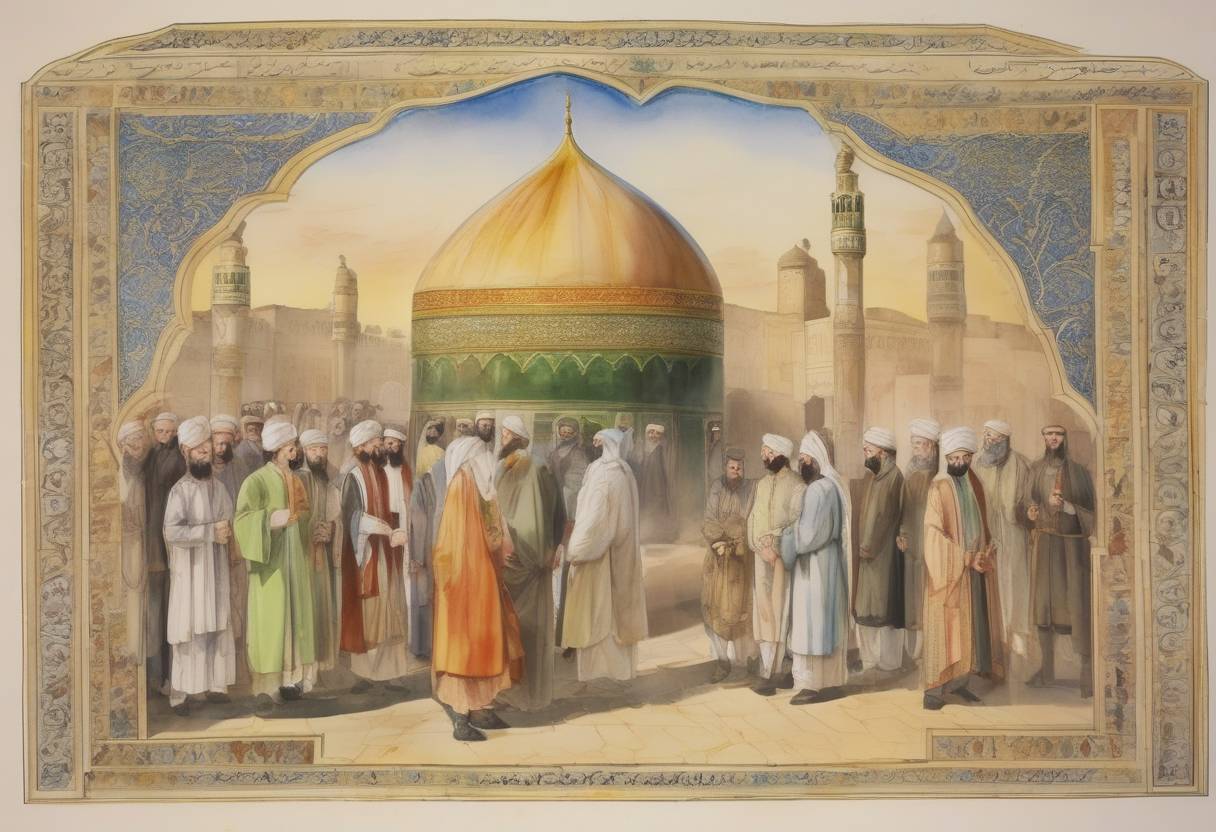
On March 24, 809, the Abbasid Caliph Harun al-Rashid passed away, marking the beginning of a significant succession crisis within the Islamic Caliphate. Harun al-Rashid, who reigned from 786 to 809, is often remembered for his role in the Islamic Golden Age, overseeing a period of cultural, scientific, and economic prosperity. However, his death led to a power struggle between his sons, al-Amin and al-Ma’mun, culminating in the Fourth Fitna, a civil war that had lasting impacts on the Abbasid Caliphate.
Harun al-Rashid had made arrangements for the succession of his empire to prevent disputes. He appointed his eldest son, al-Amin, as his immediate successor and designated his second son, al-Ma’mun, as the governor of Khorasan, with the understanding that al-Ma’mun would succeed al-Amin. This arrangement was intended to maintain unity within the empire, but it inadvertently sowed the seeds of discord.
Upon Harun al-Rashid’s death, al-Amin ascended to the caliphate in Baghdad. However, tensions quickly arose between him and al-Ma’mun. Al-Amin’s decision to remove al-Ma’mun from the line of succession and appoint his own son as his heir was seen as a direct challenge to the agreements made by their father. This move alienated al-Ma’mun and his supporters, particularly in the eastern provinces, where al-Ma’mun had established a strong base of power.
The conflict between al-Amin and al-Ma’mun escalated into a full-scale civil war known as the Fourth Fitna, which lasted from 811 to 813. The war was characterized by a series of battles and sieges, with al-Ma’mun’s forces, led by his capable general Tahir ibn Husayn, eventually gaining the upper hand. In 813, al-Ma’mun’s forces captured Baghdad, leading to the execution of al-Amin.
Al-Ma’mun’s victory solidified his position as caliph, and he ruled from 813 to 833. His reign is noted for efforts to reconcile the factions within the empire and for his patronage of the arts and sciences, continuing the legacy of the Islamic Golden Age. The Fourth Fitna, however, exposed the vulnerabilities within the Abbasid Caliphate, highlighting the challenges of maintaining a vast and diverse empire.
The civil war also had significant implications for the political landscape of the Islamic world, as it demonstrated the potential for regional powers to challenge the central authority of the caliphate. The events following Harun al-Rashid’s death underscored the complexities of succession in hereditary monarchies and the potential for internal strife to weaken even the most prosperous of empires.
Source: en.wikipedia.org