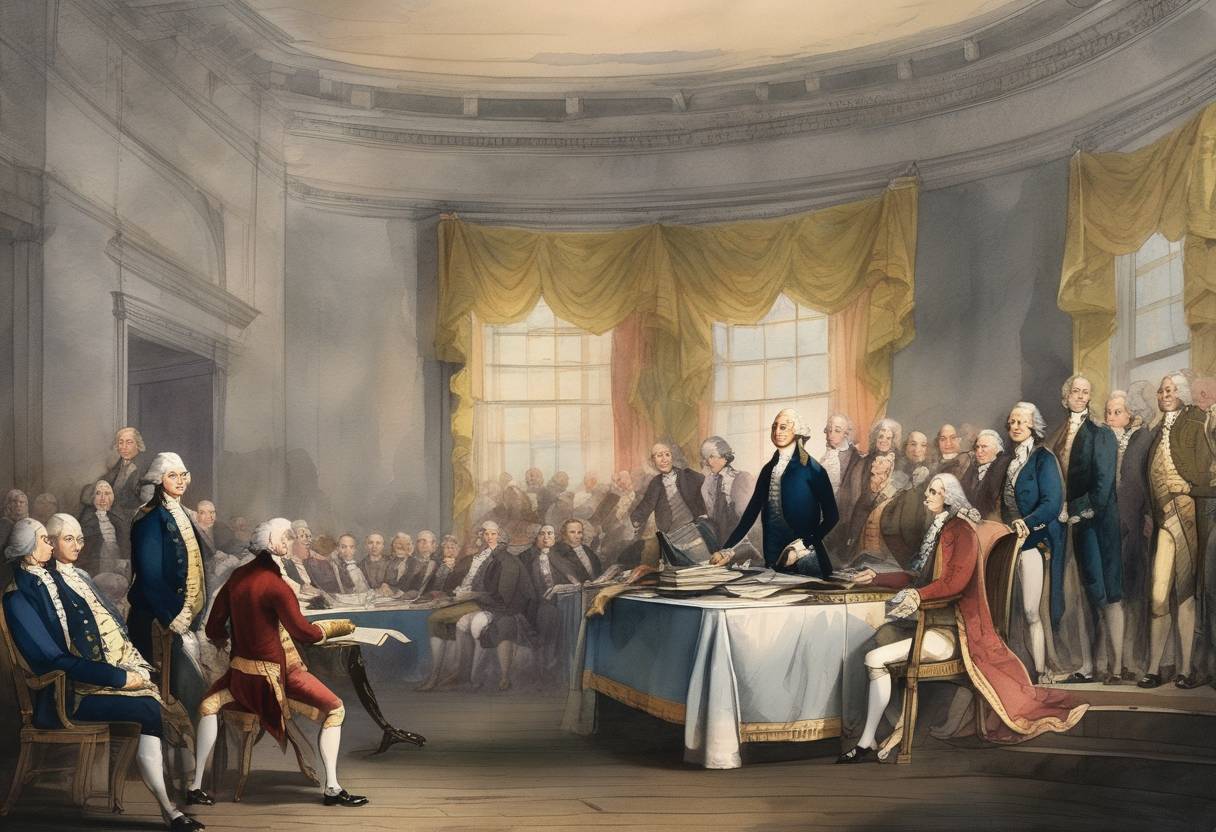
George Washington’s Unanimous Election as the First President of the United States
On February 4, 1789, George Washington was unanimously elected as the first President of the United States by the Electoral College. This historic event marked the beginning of the United States’ executive branch under the newly ratified Constitution, which had been adopted in 1788.
Context Leading Up to the Election
The Constitutional Convention: In 1787, the Constitutional Convention was held in Philadelphia to address the weaknesses of the Articles of Confederation. The result was the drafting of the U.S. Constitution, which established a stronger federal government with an executive branch led by a president.
Ratification of the Constitution: By June 1788, the Constitution was ratified by the required nine states, paving the way for the first federal elections.
Washington’s Reputation: George Washington was a revered figure, known for his leadership during the American Revolutionary War and his role as president of the Constitutional Convention. His reputation for integrity and leadership made him the natural choice for the presidency.
The Election Process
Electoral College: The Electoral College, as established by the Constitution, was responsible for electing the president. Each state appointed electors equal to the number of its Senators and Representatives.
Unanimous Decision: On February 4, 1789, the electors cast their votes, and George Washington received all 69 electoral votes, making him the only president in U.S. history to be unanimously elected.
Aftermath and Significance
Inauguration: Washington was inaugurated on April 30, 1789, in New York City, which was then the nation’s capital. His inauguration set many precedents for future presidents, including the inaugural address and the swearing-in ceremony.
Washington’s Presidency: As president, Washington established key aspects of the executive branch, including the creation of the Cabinet and the implementation of policies that would shape the young nation.
Legacy: Washington’s unanimous election and subsequent presidency set a standard for leadership and governance in the United States. His commitment to the principles of the Constitution and his decision to step down after two terms established a tradition of peaceful transitions of power.
George Washington’s election as the first president was a pivotal moment in American history, symbolizing the successful implementation of the new Constitution and the beginning of a new era in governance. His leadership laid the foundation for the future of the United States and its democratic institutions.