June 25, 1530

The Augsburg Confession, a central document of Lutheranism, was presented to the Holy Roman Emperor Charles V at the Diet of Augsburg.


Augsburg, Holy Roman Empire | Lutheran Church
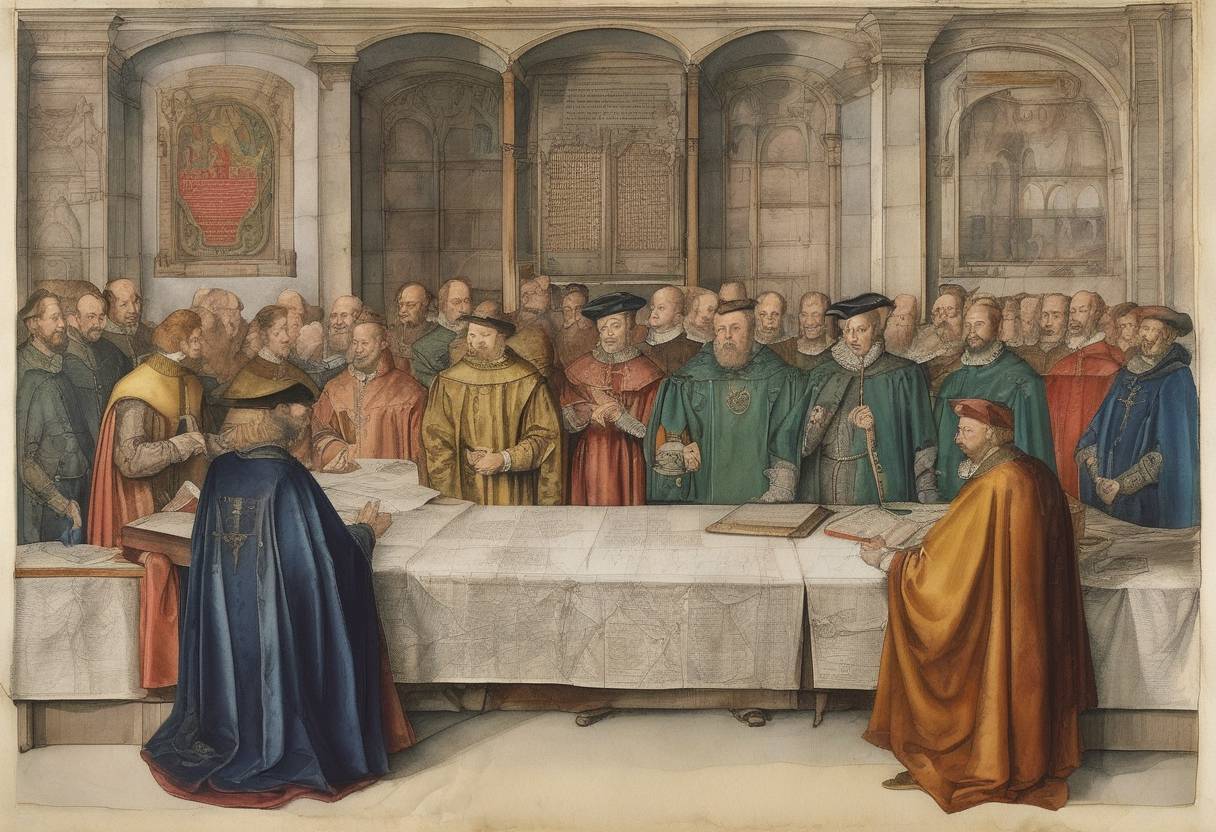
Watercolor painting based depiction of The Augsburg Confession, a central document of Lutheranism, was presented to the Holy Roman Emperor Charles V at the Diet of Augsburg. (1530)

The Augsburg Confession: A Pivotal Moment in Lutheranism

Historical Context

The Augsburg Confession, presented on June 25, 1530, was a defining moment in the Protestant Reformation. This document was crafted during a time of significant religious upheaval in Europe, as Martin Luther’s teachings had sparked widespread debate and reform within the Christian Church. The Holy Roman Empire, under the rule of Emperor Charles V, was a patchwork of territories with varying degrees of allegiance to the Catholic Church. The Diet of Augsburg was convened by Charles V to address the growing religious divisions and to seek a resolution that could unify his empire.

Key Events Leading to the Confession

  • 1517: Martin Luther’s Ninety-Five Theses were published, challenging the Catholic Church’s practices and sparking the Protestant Reformation.
  • 1521: Luther was excommunicated by Pope Leo X and declared an outlaw at the Diet of Worms.
  • 1529: The Diet of Speyer resulted in the Protestation at Speyer, where Lutheran princes protested against the Catholic majority’s decisions, leading to the term “Protestant.”

The Presentation at the Diet of Augsburg

The Augsburg Confession was primarily authored by Philipp Melanchthon, a close associate of Martin Luther. It was intended to be a clear statement of Lutheran beliefs, aimed at demonstrating that the reformers’ teachings were in line with the true Christian faith and not heretical.

  • Date: June 25, 1530
  • Location: Diet of Augsburg, held in the city of Augsburg, within the Holy Roman Empire.
  • Purpose: To present a unified statement of Lutheran doctrine to Emperor Charles V and to seek a peaceful resolution to the religious disputes.

Content of the Confession

The Augsburg Confession consists of 28 articles, which can be broadly divided into two parts:

  1. Articles 1-21: These outline the core Lutheran beliefs, emphasizing justification by faith, the sacraments, and the role of the Church. They aim to show that Lutheranism is consistent with the teachings of the early Church.
  2. Articles 22-28: These address specific abuses and practices within the Catholic Church that the reformers sought to correct, such as clerical celibacy and the use of Latin in church services.

Aftermath and Significance

The presentation of the Augsburg Confession was a significant moment in the history of the Reformation:

  • Immediate Reaction: Emperor Charles V rejected the Confession, demanding that the Protestant princes return to Catholic orthodoxy. This rejection led to further entrenchment of the religious divide.
  • Formation of the Schmalkaldic League: In response to the rejection, Protestant princes formed the Schmalkaldic League in 1531, a defensive alliance against potential military action by the Emperor.
  • Long-term Impact: The Augsburg Confession became a foundational document for Lutheranism and remains a key text in Lutheran theology. It also set the stage for future religious negotiations, such as the Peace of Augsburg in 1555, which allowed for the legal coexistence of Lutheranism and Catholicism within the Holy Roman Empire.

The Augsburg Confession’s presentation marked a critical juncture in the Reformation, solidifying the theological and political divisions that would shape the religious landscape of Europe for centuries.