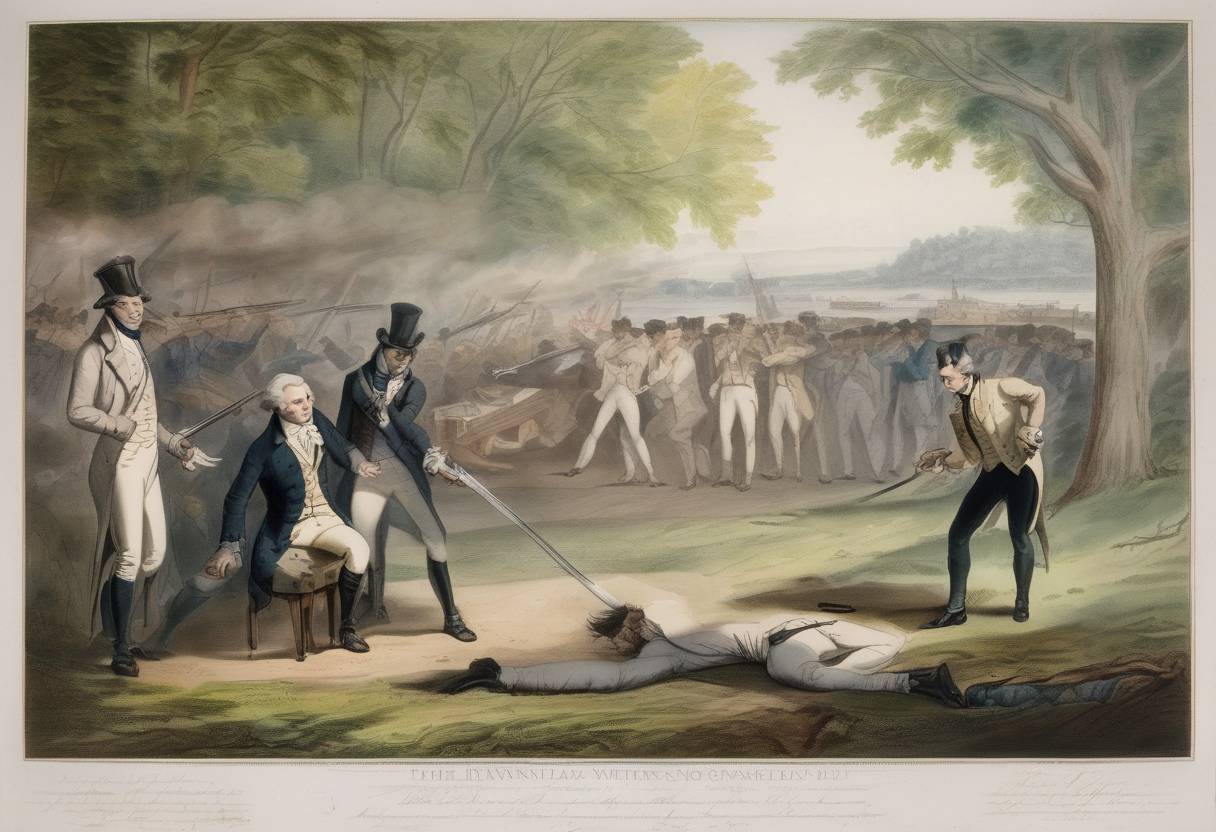
The Duel Between Alexander Hamilton and Aaron Burr
On July 11, 1804, a pivotal and tragic event in American history unfolded: Alexander Hamilton, one of the Founding Fathers of the United States, was mortally wounded in a duel with Aaron Burr, the sitting Vice President, in Weehawken, New Jersey.
Background
The animosity between Hamilton and Burr had been building for years, rooted in both political and personal conflicts. Hamilton, a Federalist, and Burr, a Democratic-Republican, had clashed repeatedly in the political arena. Their rivalry intensified during the presidential election of 1800, where Hamilton’s influence was instrumental in Thomas Jefferson’s victory over Burr, despite both receiving the same number of electoral votes. This outcome relegated Burr to the vice presidency, a position of diminished power.
The immediate cause of the duel was a series of derogatory remarks Hamilton allegedly made about Burr at a dinner party, which were later published in a newspaper. Burr, feeling his honor was at stake, demanded an explanation. Hamilton’s refusal to retract his statements or apologize led Burr to challenge him to a duel.
The Duel
The duel took place at dawn on the heights of Weehawken, New Jersey, a popular dueling ground due to its relative seclusion and the fact that dueling was illegal in New York. Both men were accompanied by their seconds and a physician.
According to accounts, Hamilton fired his shot into the air, a practice known as a “delopement,” which some historians interpret as a deliberate miss to uphold his honor without intending to harm Burr. Burr, however, took aim and shot Hamilton in the lower abdomen, causing severe damage to his internal organs.
Aftermath
Hamilton was transported back to New York City, where he died the following day, on July 12, 1804, surrounded by family and friends. His death was met with widespread mourning and had significant political repercussions.
Burr, though legally acquitted of murder charges, faced public outrage and political ruin. His career never recovered, and he spent the remainder of his life in relative obscurity and financial distress.
Historical Significance
The duel between Hamilton and Burr is emblematic of the intense personal and political rivalries of the early American republic. It underscored the fragility of political alliances and the volatile nature of personal honor during this period. Hamilton’s death deprived the nation of one of its most influential and visionary leaders, whose contributions included the establishment of the national bank and the financial system.
The event also marked a turning point in public opinion against the practice of dueling, which gradually fell out of favor in the United States as a means of resolving disputes.
In summary, the duel between Alexander Hamilton and Aaron Burr remains a poignant reminder of the personal and political tensions that shaped the early years of the United States, with lasting impacts on the nation’s history.