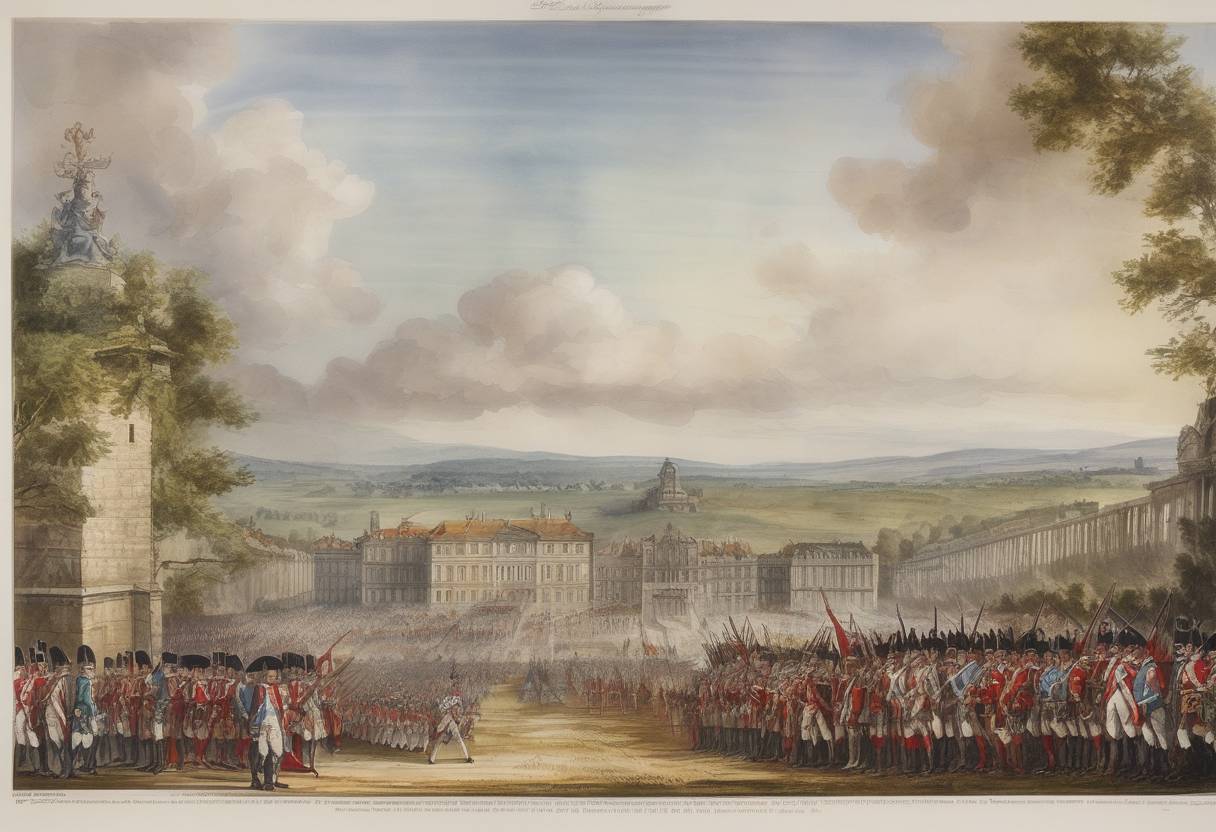
Battle of Blenheim: August 4, 1704
Context
The Battle of Blenheim, fought on August 13, 1704 (August 4 in the Julian calendar), was a pivotal engagement during the War of the Spanish Succession (1701-1714). This war was primarily triggered by the death of the childless Charles II of Spain, which left a power vacuum and led to a struggle for control over the Spanish Empire. The conflict saw the Grand Alliance, comprising England, the Dutch Republic, and the Holy Roman Empire, among others, pitted against France and Spain, with Bavaria as a key ally of France.
- John Churchill, Duke of Marlborough: The English commander who played a crucial role in orchestrating the victory for the Grand Alliance.
- Prince Eugene of Savoy: A brilliant military leader who commanded the Imperial forces alongside Marlborough.
- Marshal Tallard: The French commander who led the Franco-Bavarian forces.
The Battle
The Battle of Blenheim took place near the village of Blindheim (Blenheim in English) in Bavaria. The Grand Alliance sought to prevent the French and Bavarian forces from advancing into Vienna, which would have threatened the Habsburg dominance in the region.
Key Events
Strategic March: Marlborough executed a daring and strategic march from the Low Countries to the Danube, covering over 250 miles in five weeks, which caught the French off guard.
Allied Forces: The Grand Alliance fielded approximately 52,000 troops, while the Franco-Bavarian forces numbered around 56,000.
Battle Formation: The battle commenced with the Allies attacking the French and Bavarian positions. Marlborough and Eugene coordinated their forces to strike simultaneously at different points.
Decisive Engagement: The battle was marked by intense fighting, particularly around the villages of Blenheim and Lutzingen. Marlborough’s forces managed to break through the French lines, leading to a collapse of the Franco-Bavarian army.
Outcome: The battle concluded with a decisive victory for the Grand Alliance. The French suffered approximately 30,000 casualties, including prisoners, while the Allies incurred around 12,000 casualties.
Aftermath and Significance
Strategic Impact: The victory at Blenheim was a turning point in the War of the Spanish Succession. It effectively ended the French threat to Vienna and shifted the momentum in favor of the Grand Alliance.
Political Consequences: The defeat weakened France’s position in Europe and bolstered the reputation of Marlborough and Eugene as military leaders.
Legacy: The battle demonstrated the effectiveness of coordinated multinational forces and highlighted the importance of strategic mobility and surprise in military campaigns.
The Battle of Blenheim remains a significant example of early 18th-century warfare and is often studied for its strategic and tactical innovations.