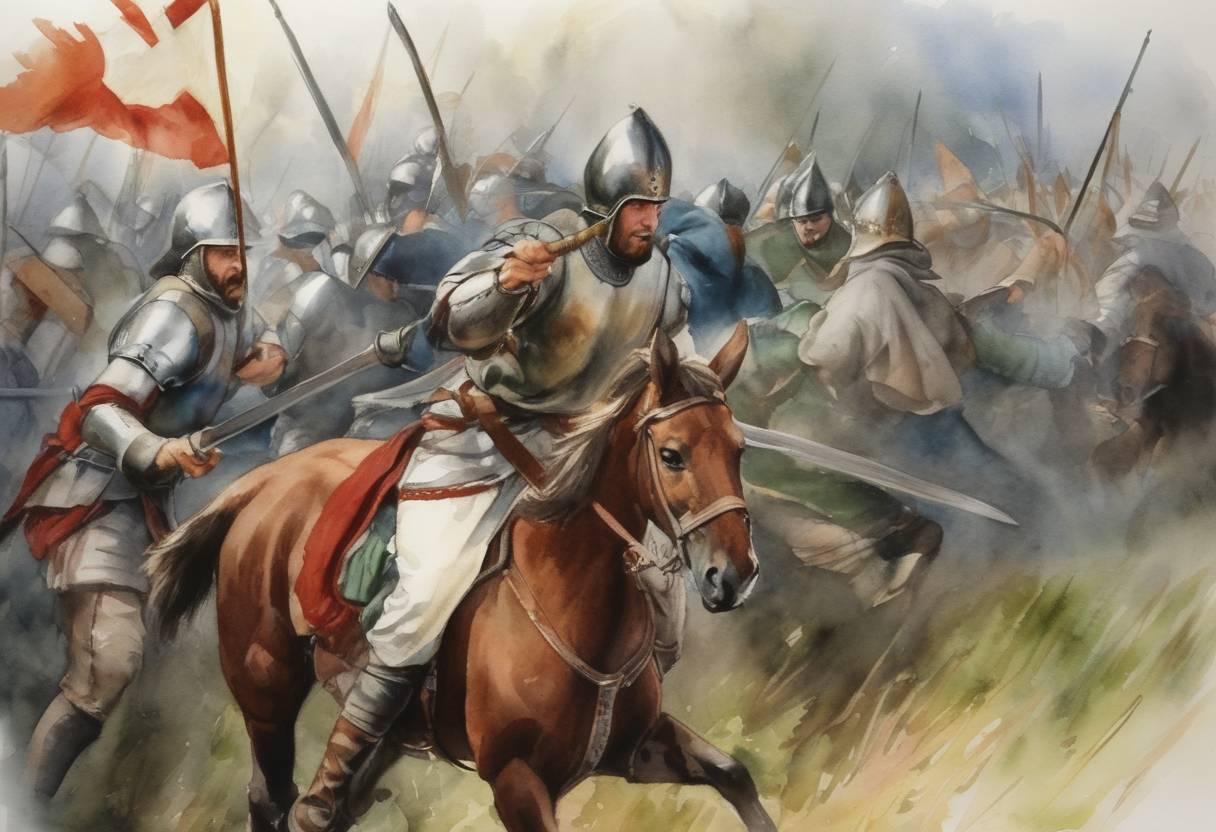
Battle of Viljandi - October 15, 1211
Context
The Battle of Viljandi was a significant conflict during the Livonian Crusade, a series of military campaigns in the early 13th century orchestrated by Pope Innocent III and other ecclesiastical authorities to convert the pagan peoples of the eastern Baltic to Christianity. These campaigns were part of the larger Northern Crusades.
Livonian Brothers of the Sword
The military order known as the Livonian Brothers of the Sword, founded in 1202 by Albert of Riga, played a central role in the Livonian Crusade. The order was composed of German knights and was tasked with the subjugation and conversion of the pagan populations in what is today Latvia and Estonia.
The Battle
The Battle of Viljandi occurred on October 15, 1211, near the fortress town of Viljandi, located in modern-day southern Estonia. Facing the advancing Crusader forces, the Estonians made a concerted attempt to resist the domination of the Christian knights. The Estonian army, composed primarily of local tribesmen, was organized to defend their territory and preserve their pagan traditions against the proselytizing Crusader forces.
The Livonian Brothers of the Sword, led with military efficiency and equipped with superior armor and weaponry, clashed with the Estonian army. Utilizing tactics that had been honed through earlier campaigns, the Brothers overwhelmed the Estonians, achieving a decisive victory on the field.
Outcomes
This battle reinforced the military dominance of the Livonian Brothers of the Sword in the region. Following the victory at Viljandi, the German knights further consolidated their control over southern Estonia, continuing their efforts to Christianize the indigenous populace. The defeat of the Estonian forces at Viljandi symbolized the beginning of the decline of traditional pagan resistance in the area.
Historical Significance
The battle is a pivotal example of the broader effort to expand Latin Christianity into Eastern Europe during the medieval period. It underscores the complex interactions between military campaigns, religious conversion, and territorial expansion. The success of the Livonian Brothers at Viljandi helped solidify the platforms from which the Crusaders would continue their campaigns, shaping the religious and cultural landscape of the Baltics for centuries to come.