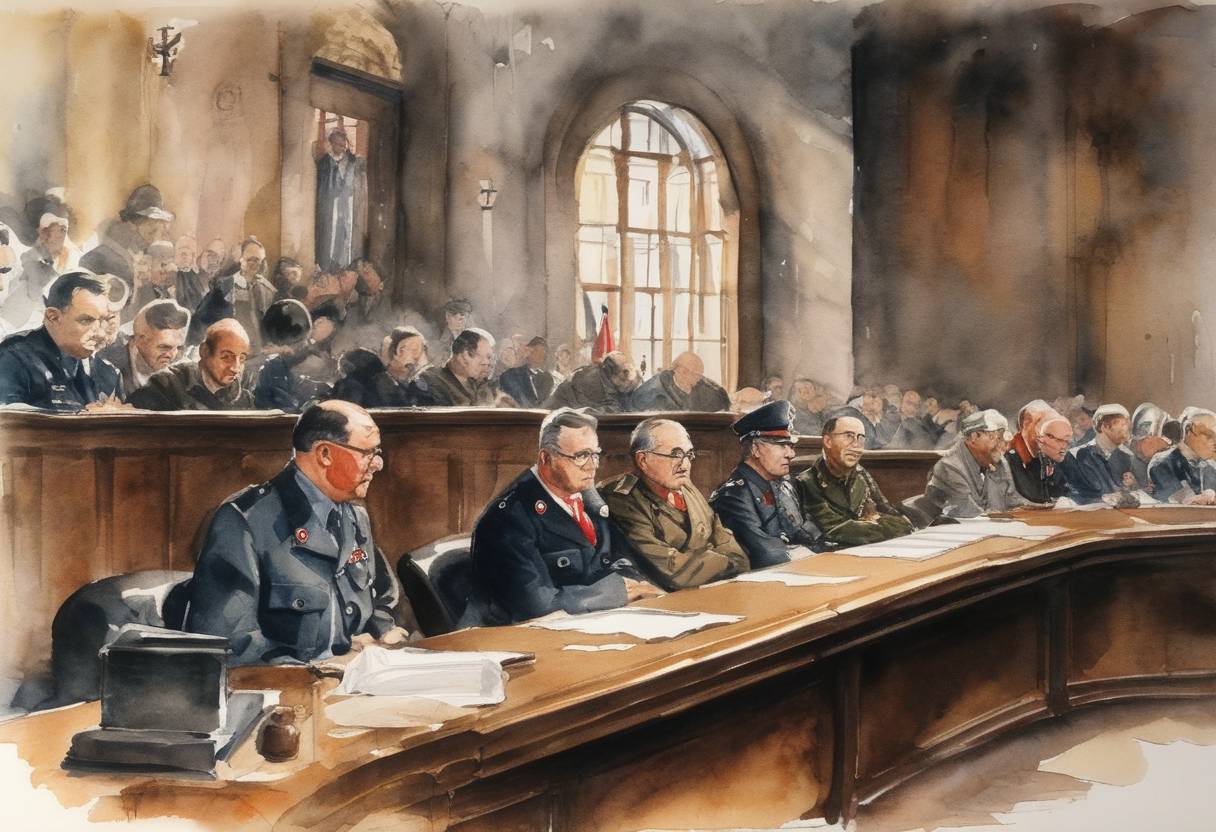
Nuremberg Trials: Conclusion of Last Public Session
On December 9, 1946, the International Military Tribunal at Nuremberg concluded its last public session of the “Trial of the Major War Criminals.” This trial marked the most prominent of the Nuremberg Trials conducted to prosecute prominent leaders of Nazi Germany for war crimes after World War II. It was a defining moment in international law and post-war justice, representing an unprecedented legal effort to hold individuals accountable for crimes against humanity, war crimes, and genocide.
Context and Significance
The Nuremberg Trials began on November 20, 1945, in the Palace of Justice in Nuremberg, Bavaria, Germany. They were conducted by the Allied forces who had emerged victorious in World War II, including the United States, the Soviet Union, the United Kingdom, and France. The trials aimed to bring justice to victims of the Holocaust and other wartime atrocities by prosecuting top Nazi officials and military leaders.
Presiding over the trials were judges from each of the Allied powers, with the chief prosecutors including figures like Robert H. Jackson from the United States. The trial of the major war criminals was the first of 13 Nuremberg Trials that sought to establish a precedent for dealing with war crimes.
The Final Public Session
The proceedings on December 9, 1946, marked the end of public hearings featuring extensive evidence, testimonies, and defenses over many months. During these sessions, prosecutors presented a vast array of documentary evidence and testimony to detail the systematic atrocities committed by the Nazi regime.
The session encapsulated the culmination of testimony and legal arguments, closing the phase in which the defense and prosecution had access to presenting their cases. This set the stage for the judicial panels to deliberate and release their verdicts in the coming months.
Outcome and Aftermath
The final verdicts were delivered on October 1, 1946, resulting in 12 of the defendants receiving the death penalty, three receiving life imprisonment, and others being sentenced to various terms in prison. Three defendants were acquitted. The outcomes of the Nuremberg Trials established a legacy in international law, fueling the development of future international criminal tribunals and principles laid down in the Nuremberg Charter, which continues to influence global justice systems.
The trials’ conclusion marked a significant historical milestone, underscoring an international commitment to justice and accountability that resonated far beyond the post-war era and helped shape the post-war order.