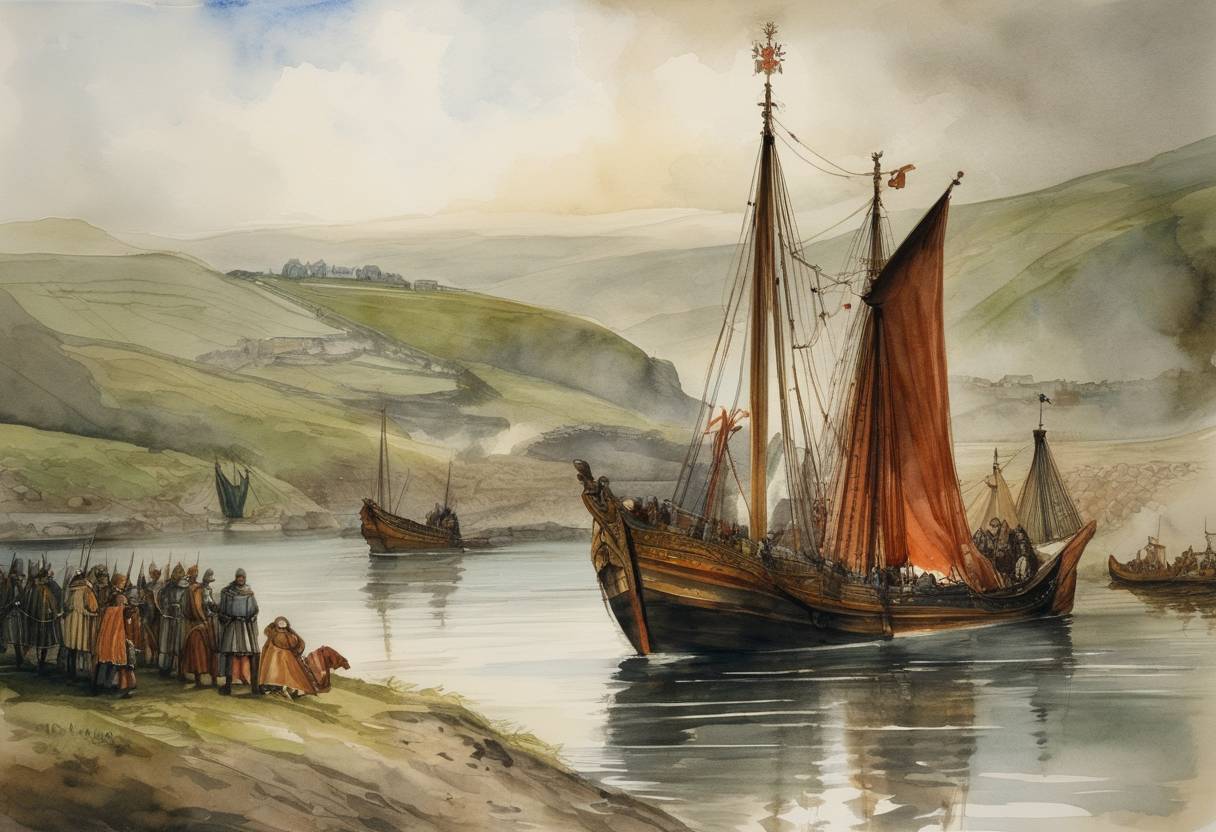
Henry II’s Arrival in Ireland - October 18, 1171
Henry II of England’s landing in Waterford on October 18, 1171, marked a pivotal moment in the history of Ireland, setting the stage for centuries of English political and cultural influence. His arrival was primarily motivated by the complex interplay of power dynamics within Ireland and the need to assert control over unruly barons.
Background
The Angevin Empire under Henry II was expansive, covering significant portions of France and England. By the late 12th century, however, the power Henry wielded was increasingly threatened by disobedient vassals and the independent actions of Norman barons. The immediate catalyst for his Irish intervention was the arrival of Richard de Clare, known as Strongbow, in Ireland in 1169. Strongbow’s successful campaigns and subsequent marriage to Diarmait Mac Murchada’s daughter, Aoife, secured him the position of the ruler in Leinster, alarming Henry due to the potential emergence of a rival power base.
The Campaign
Henry landed with a substantial force, including a large fleet to underscore his serious intentions. His expedition was strategically planned to consolidate royal authority over the expanding spheres of Norman influence in Ireland. Upon arrival in Waterford, Henry received homage from the various Norman lords, effectively placing the Anglo-Norman incursion under his control. The leadership of towns like Wexford, Waterford, and Dublin swiftly submitted to his authority, acknowledging him as their sovereign, which paved the way for the establishment of English governance structures.
Consequences and Significance
Henry’s presence in Ireland was relatively brief but highly impactful. By the conclusion of his campaign in 1172, he had secured recognition from the Irish kings of English suzerainty, although this was a formal gesture that often lacked substantive power in day-to-day governance. Despite this, his intervention laid the groundwork for subsequent English expansion and facilitated the eventual establishment of the Lordship of Ireland, which formally extended English legal and administrative systems onto Irish soil.
Lasting Impact
Henry II’s expedition initiated a long period of English influence in Ireland that profoundly shaped its political and cultural landscape. The introduction of feudal structures, the re-organization of land ownership, and the subsequent tensions between native Irish leaders and Anglo-Norman settlers sowed seeds of conflict and transformation that would echo down through the centuries, ultimately contributing to Ireland’s complex history of contested sovereignty and cultural change.
The shifts initiated by Henry’s campaign would set the tone for English-Irish relations, influencing everything from land tenure systems to legal practices and laying the foundational tensions that would repeatedly emerge in the ensuing centuries of Anglo-Irish history.