Capture of William Wallace - August 6, 1305
1305 · Glasgow, Scotland
William Wallace, a key leader in the Wars of Scottish Independence, is captured by the English near Glasgow.
July 22, 1298
The Battle of Falkirk took place during the First War of Scottish Independence, where the English army led by King Edward I defeated the Scots led by William Wallace.
Falkirk, Scotland | English Army
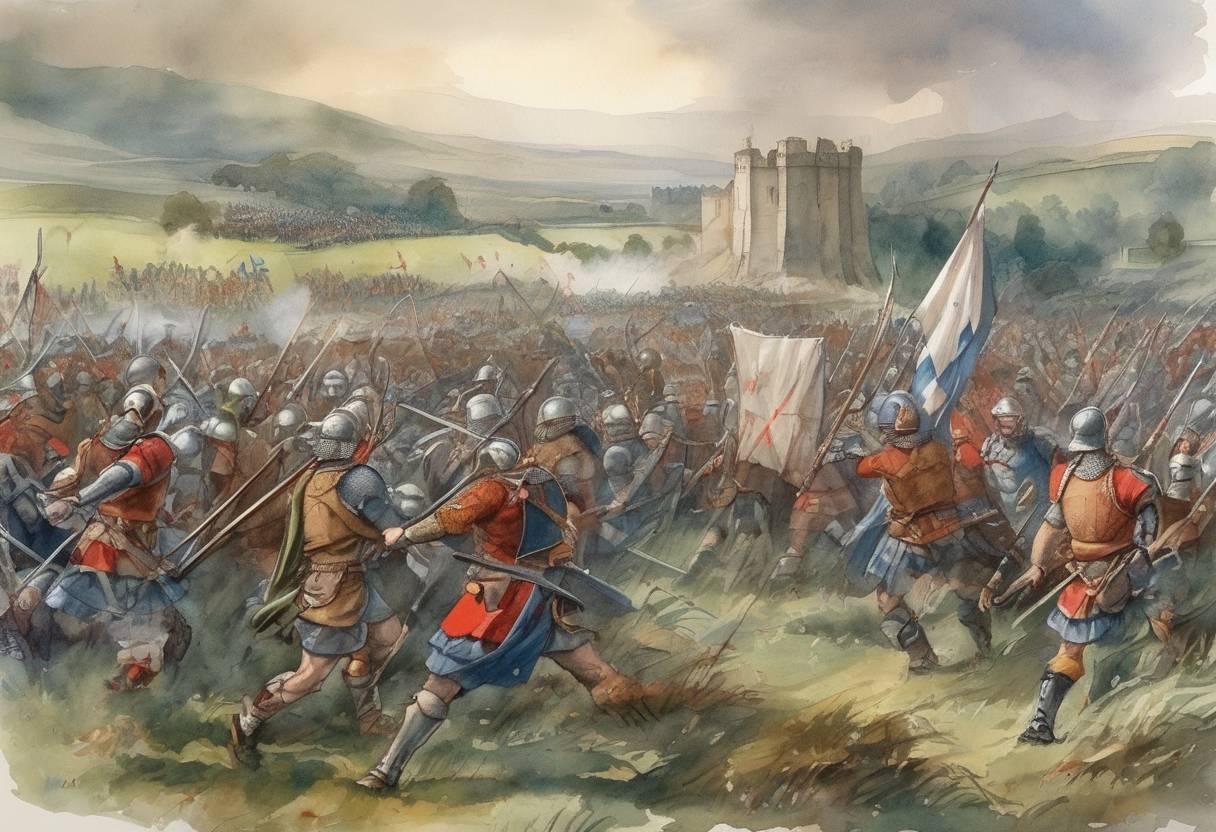
The Battle of Falkirk was a pivotal conflict during the First War of Scottish Independence, marking a significant confrontation between the forces of England and Scotland. This battle took place on July 22, 1298, and resulted in a decisive victory for the English army led by King Edward I over the Scottish forces commanded by William Wallace.
The First War of Scottish Independence began in 1296, following King Edward I’s invasion of Scotland. Edward sought to assert his authority over Scotland, leading to widespread resistance among the Scots. William Wallace emerged as a key figure in the Scottish resistance, gaining prominence after his victory at the Battle of Stirling Bridge in 1297.
In the aftermath of Stirling Bridge, Wallace was appointed Guardian of Scotland, ruling in the name of the deposed King John Balliol. However, the Scots faced challenges in maintaining their momentum against the English, who were determined to reassert control.
Strategic Positioning: Wallace positioned his forces in a defensive formation, utilizing schiltrons—dense formations of spearmen—to counter the English cavalry.
English Tactics: King Edward I effectively utilized his longbowmen to disrupt the Scottish schiltrons. The English archers inflicted heavy casualties, weakening the Scottish defensive lines.
Cavalry Charge: Following the initial barrage, the English cavalry charged the disorganized Scottish forces, breaking through their lines and causing significant losses.
Scottish Retreat: Overwhelmed by the superior numbers and tactics of the English, the Scottish forces were forced to retreat, resulting in a decisive English victory.
Scottish Losses: The Scots suffered heavy casualties, and the defeat significantly weakened Wallace’s position as Guardian of Scotland.
Wallace’s Resignation: Following the defeat, Wallace resigned as Guardian, and his influence waned. He continued to resist English rule but was eventually captured in 1305 and executed.
English Dominance: The victory at Falkirk solidified English control over much of Scotland, although resistance continued under other Scottish leaders, such as Robert the Bruce.
The Battle of Falkirk was a crucial moment in the First War of Scottish Independence, demonstrating the effectiveness of English military tactics, particularly the use of longbowmen. It highlighted the challenges faced by the Scots in their struggle for independence and set the stage for continued conflict in the years to come. Despite the setback, the Scottish spirit of resistance endured, eventually leading to future successes in their quest for independence.
Source: en.wikipedia.org