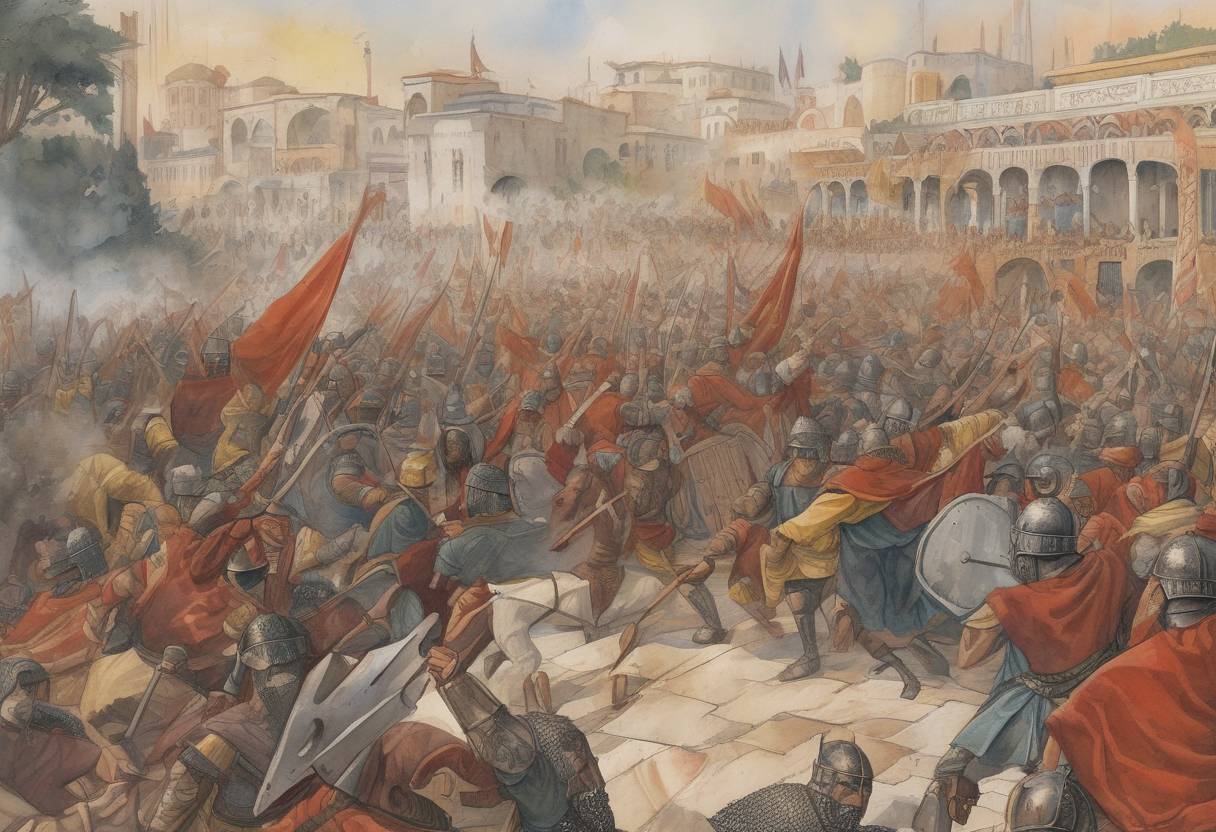
The Nika Riots: January 11, 532
The Nika Riots, which began on January 11, 532, in Constantinople, were among the most violent and destructive riots in the history of the Byzantine Empire. These riots were fueled by a combination of political, social, and economic tensions, and they posed a significant threat to the reign of Emperor Justinian I.
Background
The Byzantine Empire, under Emperor Justinian I, was experiencing a period of ambitious reform and expansion. Justinian sought to consolidate and expand the empire’s territories, codify Roman law, and undertake massive building projects, including the construction of the Hagia Sophia. However, his reign was also marked by heavy taxation and unpopular policies, which led to widespread discontent among the populace.
Political and Social Tensions
- Factions and Chariot Racing: The immediate spark for the riots was rooted in the popular chariot races held at the Hippodrome of Constantinople. The city was divided into factions, the most prominent being the Blues and the Greens, who supported different chariot teams and held significant political influence.
- Dissatisfaction with Justinian: Both factions were dissatisfied with Justinian’s rule, particularly his harsh tax policies and perceived favoritism. The execution of members from both factions for previous riots further inflamed tensions.
The Riots
- Initial Outbreak: On January 11, 532, during a chariot race, members of the Blues and Greens united in their opposition to Justinian, chanting “Nika” (meaning “Conquer” or “Win”). The unrest quickly escalated into a full-scale riot.
- Destruction and Chaos: Over the course of a week, rioters set fire to much of the city, including the Hagia Sophia, and attacked the imperial palace. The chaos resulted in significant loss of life and property.
Justinian’s Response
- Theodora’s Influence: As the situation worsened, Justinian considered fleeing the city. However, his wife, Empress Theodora, reportedly persuaded him to stay and fight, famously stating that “royalty is a good burial shroud.”
- Suppression of the Riots: Justinian ordered his generals, Belisarius and Mundus, to suppress the riots. They lured the rioters into the Hippodrome and launched a brutal crackdown, resulting in the deaths of thousands.
Aftermath and Significance
- Consolidation of Power: The suppression of the Nika Riots allowed Justinian to consolidate his power and continue his ambitious projects, including the rebuilding of the Hagia Sophia.
- Legal and Administrative Reforms: In the aftermath, Justinian intensified his efforts to reform the empire’s legal and administrative systems, culminating in the creation of the Corpus Juris Civilis, a foundational work in the history of Western law.
- Legacy: The Nika Riots highlighted the volatile nature of urban politics in Constantinople and the significant influence of public opinion on imperial authority. They also underscored the importance of strong leadership and the role of the imperial family in maintaining stability.
The Nika Riots remain a pivotal moment in Byzantine history, illustrating the complex interplay of politics, society, and imperial ambition in one of history’s most enduring empires.