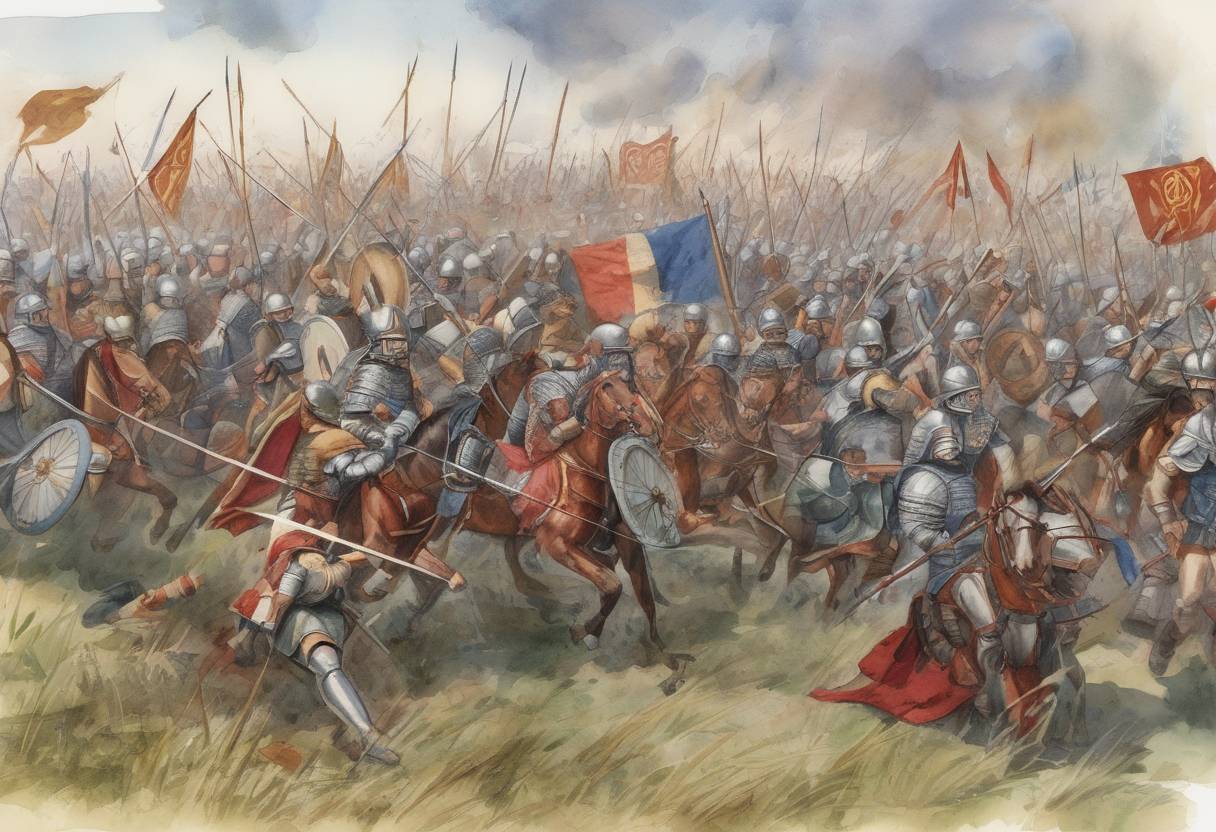
The Battle of Chalons (Battle of the Catalaunian Plains)
Overview
The Battle of Chalons, also known as the Battle of the Catalaunian Plains, took place on June 20, 451 AD. This significant conflict was fought between the forces of the Western Roman Empire, led by General Flavius Aetius, and the Huns, commanded by the formidable Attila. The battle is renowned for being one of the last major military operations of the Western Roman Empire and played a crucial role in halting the Hunnic advance into Western Europe.
Context and Prelude
The Hunnic Threat: By the mid-5th century, the Huns, under Attila, had become a formidable power, exerting pressure on the Roman Empire and its territories. Attila’s campaigns across Europe had already caused widespread devastation, and his sights were set on further expansion into Gaul (modern-day France).
Roman and Allied Forces: Recognizing the threat posed by Attila, the Roman general Flavius Aetius formed an alliance with various Germanic tribes, including the Visigoths led by King Theodoric I, the Franks, and other smaller groups. This coalition was crucial in amassing a force capable of confronting the Huns.
The Battle
Location: The battle took place on the Catalaunian Plains, near present-day Châlons-en-Champagne in northeastern France.
Forces and Strategy: The Roman-Visigothic alliance was strategically positioned to counter the Hunnic forces. Aetius and Theodoric coordinated their troops to exploit the terrain and prevent Attila from utilizing his cavalry’s full potential.
Combat and Outcome: The battle was fiercely contested, with heavy casualties on both sides. The Visigothic King Theodoric I was killed during the fighting. Despite the losses, the Roman alliance managed to repel the Huns, forcing Attila to retreat. This marked a significant check on Hunnic expansion into Western Europe.
Aftermath and Significance
Attila’s Retreat: Although not a decisive victory in terms of annihilating the Hunnic threat, the battle effectively ended Attila’s campaign in Gaul. He withdrew his forces, and the immediate threat to the Western Roman territories was averted.
Legacy: The Battle of Chalons is often cited as a pivotal moment in European history. It demonstrated the potential of Roman and barbarian alliances against common threats and underscored the strategic acumen of leaders like Aetius.
Western Roman Empire: Despite this temporary success, the Western Roman Empire continued to decline, facing internal strife and external pressures. The battle, however, remains a testament to the empire’s resilience in its waning years.
In summary, the Battle of Chalons was a critical engagement that showcased the complexities of late Roman military and diplomatic strategies. It highlighted the shifting power dynamics of the time and the importance of alliances in the face of formidable adversaries like the Huns.