The Tragic Death of Cosmonaut Vladimir Komarov
1967 · Orenburg Oblast, Soviet Union
Cosmonaut Vladimir Komarov became the first human to die during a space mission when the Soyuz 1 capsule crashed upon re-entry.
March 18, 1965
Soviet cosmonaut Alexei Leonov became the first person to conduct a spacewalk, exiting the spacecraft Voskhod 2 for 12 minutes. This achievement marked a significant milestone in human space exploration.
Voskhod 2 (spacecraft), Soviet Union | Soviet Space Program
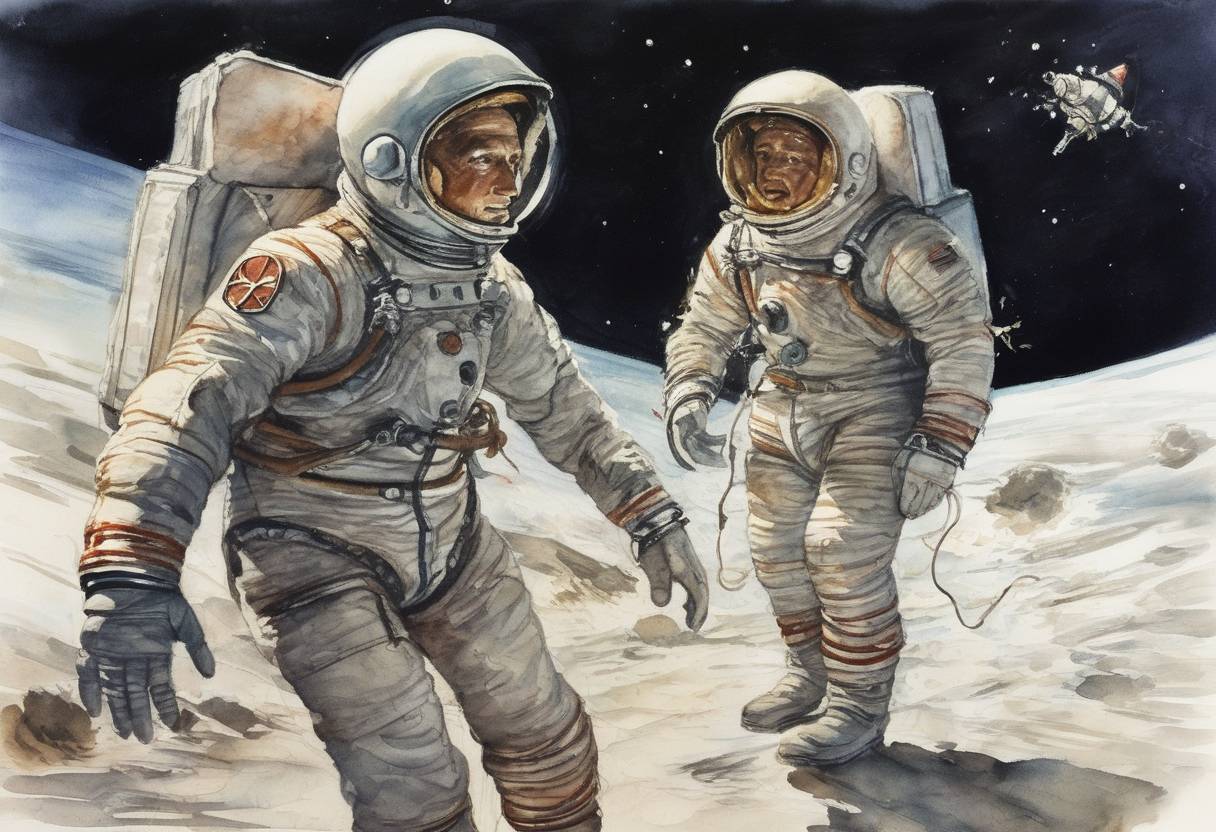
On March 18, 1965, Soviet cosmonaut Alexei Leonov made history by becoming the first human to conduct an extravehicular activity (EVA), commonly known as a spacewalk. This groundbreaking event took place during the Voskhod 2 mission, marking a significant milestone in the era of human space exploration.
The space race between the United States and the Soviet Union was at its peak during the 1960s. Following the Soviet Union’s successful launch of the first artificial satellite, Sputnik, in 1957, and Yuri Gagarin’s historic first human spaceflight in 1961, the Soviets aimed to achieve another first by conducting a spacewalk. This mission was part of a broader strategy to demonstrate Soviet prowess in space exploration.
Voskhod 2 was launched on March 18, 1965, from the Baikonur Cosmodrome in Kazakhstan. The spacecraft was an upgraded version of the earlier Vostok series, designed to accommodate two cosmonauts. Alexei Leonov and Pavel Belyayev were the crew members on this mission. The primary objective was to perform the first EVA and test the feasibility of human activity outside a spacecraft.
Leonov’s spacewalk lasted approximately 12 minutes. He exited the spacecraft through an inflatable airlock, a crucial innovation that allowed the cabin to remain pressurized while he ventured outside. During the EVA, Leonov was tethered to the spacecraft and wore a specially designed spacesuit to protect him from the harsh conditions of space.
Leonov encountered several unexpected challenges during the spacewalk. His spacesuit inflated in the vacuum of space, making it difficult for him to maneuver and re-enter the airlock. He had to manually release some of the suit’s pressure to fit back inside, a risky maneuver that demonstrated his quick thinking and composure under pressure.
The successful completion of the spacewalk was celebrated as a major achievement for the Soviet space program and a testament to human ingenuity and courage. It provided valuable data and experience that would inform future EVAs and space missions. Leonov’s spacewalk paved the way for subsequent missions, including the American Gemini and Apollo programs, which further expanded human capabilities in space.
Alexei Leonov’s pioneering EVA remains a symbol of human exploration and the relentless pursuit of knowledge beyond our planet. His achievement is remembered as a critical step in the journey toward more complex and ambitious space endeavors, including the construction of space stations and the exploration of other celestial bodies.
In summary, Leonov’s spacewalk on March 18, 1965, was a landmark event that underscored the potential of human space exploration and set the stage for future advancements in the field.
Source: en.wikipedia.org