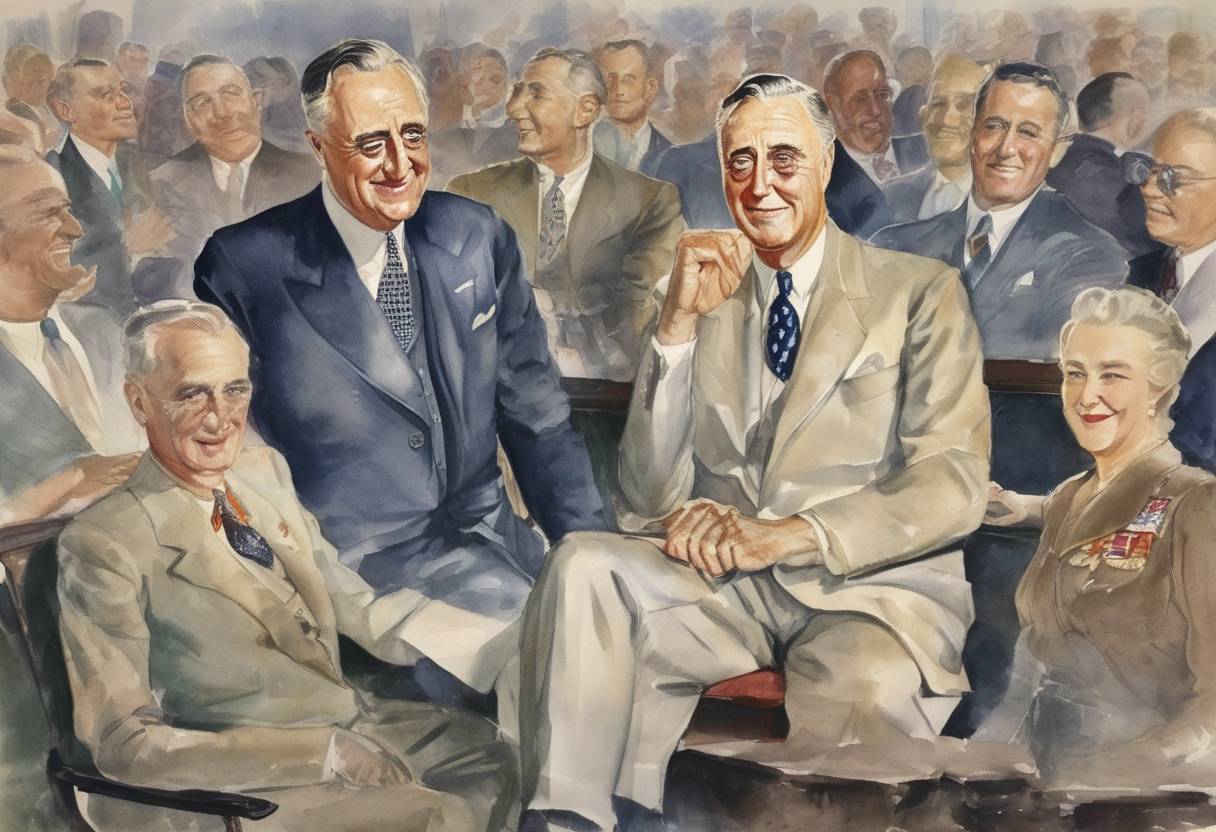
Franklin D. Roosevelt’s Fourth Term Election
On November 6, 1944, Franklin D. Roosevelt was elected to an unprecedented fourth term as President of the United States. This remarkable event marked a significant moment in American political history, as Roosevelt remains the only U.S. president to have served more than two terms.
Context Leading Up to the Election
World War II: The world was engulfed in the Second World War, and Roosevelt’s leadership was seen as crucial to the Allied war effort. His experience and established international relationships were viewed as assets in navigating the complex global conflict.
The New Deal Legacy: Domestically, Roosevelt’s New Deal policies had reshaped the American economy and society in response to the Great Depression. These programs had garnered substantial support among many Americans, though they also faced criticism.
Health Concerns: Despite his popularity, Roosevelt’s health was a growing concern. By 1944, he was visibly frail, but he remained determined to continue his leadership during the war.
The 1944 Presidential Election
Democratic Nominee: Roosevelt ran as the Democratic candidate, with Senator Harry S. Truman of Missouri as his vice-presidential running mate. Truman was chosen to replace Henry A. Wallace, partly due to concerns about Wallace’s political views and Roosevelt’s health.
Republican Opponent: The Republican candidate was Thomas E. Dewey, the Governor of New York. Dewey campaigned on a platform of efficiency and criticized the New Deal’s expansion of government.
Campaign Focus: The election campaign was dominated by issues related to the ongoing war and post-war planning. Roosevelt emphasized his experience and the need for continuity in leadership to secure victory and peace.
Election Outcome
- Victory: Roosevelt won the election with 432 electoral votes to Dewey’s 99, securing 53.4% of the popular vote. His victory was attributed to his wartime leadership and the public’s trust in his ability to lead the nation through the conflict.
Aftermath and Historical Significance
Fourth Term Challenges: Roosevelt’s fourth term was short-lived. He was inaugurated on January 20, 1945, but passed away on April 12, 1945, just months into his term. Vice President Harry S. Truman succeeded him and led the country through the final stages of World War II.
22nd Amendment: Roosevelt’s unprecedented four terms prompted the passage of the 22nd Amendment to the U.S. Constitution in 1951, which limits presidents to two terms in office.
Franklin D. Roosevelt’s election to a fourth term underscored his significant impact on both domestic and international fronts. His leadership during one of the most tumultuous periods in modern history left a lasting legacy on the presidency and the nation.