Death of Clovis I - November 27, 511
511 · Paris, Frankish Kingdom
Clovis I, the first King of the Franks to unite all of the Frankish tribes under one ruler, died. His reign laid the foundations for the future Merovingian dynasty.
September 13, 0509
The Battle of Vouillé takes place, where the Franks, led by Clovis I, defeat the Visigoths, leading to the Frankish control of Aquitaine.
Vouillé, France | Frankish Kingdom
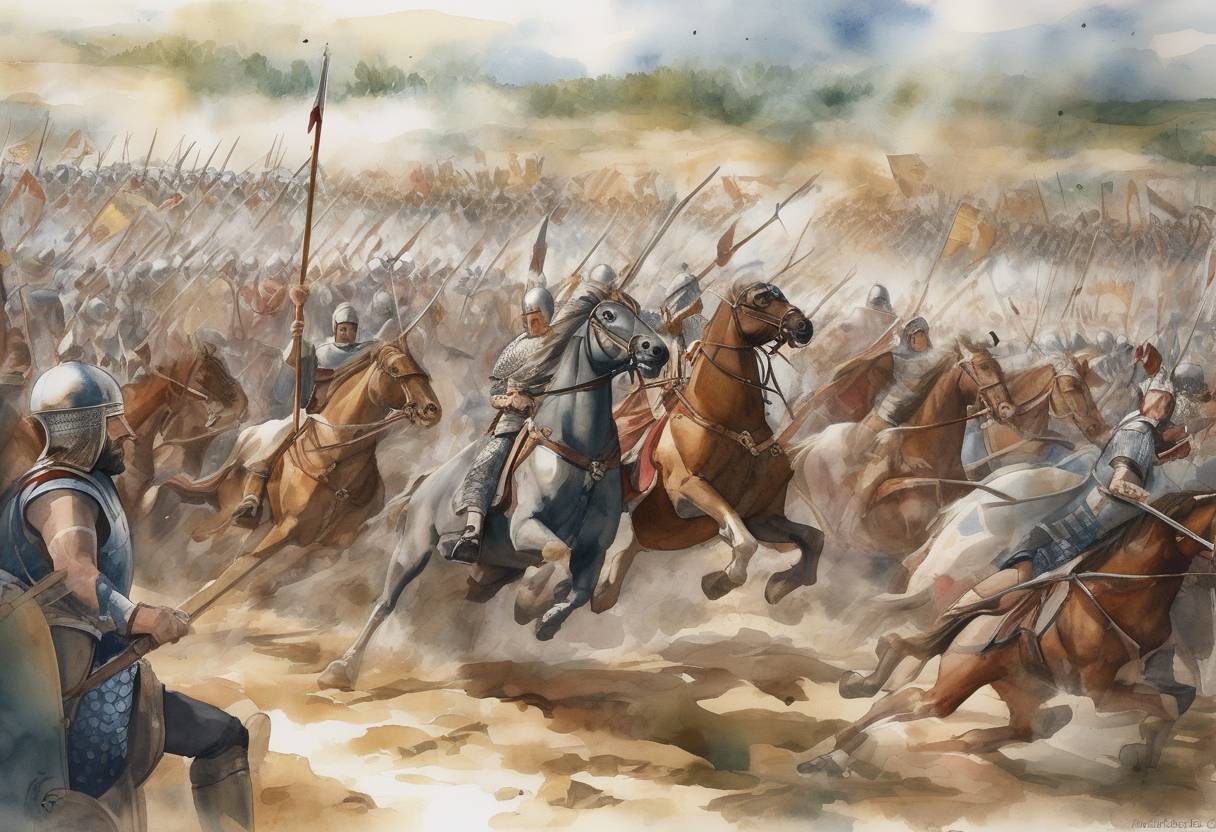
The Battle of Vouillé took place in the spring of 507, not on September 13, 509, as sometimes mistakenly noted. This battle was a significant conflict between the Franks, led by King Clovis I, and the Visigoths, under King Alaric II. It marked a pivotal moment in the power dynamics of early medieval Europe.
Clovis I, the first King of the Franks to unite all the Frankish tribes under one ruler, was a member of the Merovingian dynasty. His reign marked the beginning of the Frankish expansion and consolidation of power in what is now modern-day France and parts of Germany. Clovis converted to Christianity around 496, which helped him gain the support of the Roman Catholic Church and the Gallo-Roman population.
The Visigoths, a Germanic tribe, had established a kingdom in the region of Aquitaine, with their capital at Toulouse. Alaric II, their king, was known for his attempts to maintain peace with the Roman Empire and other neighboring powers. However, religious differences and territorial ambitions led to tensions with the Franks.
The battle occurred near Vouillé, close to Poitiers in present-day France. This location was strategically significant as it lay on the route to the Visigothic capital of Toulouse.
The victory at Vouillé allowed Clovis to annex Aquitaine, significantly expanding the Frankish kingdom. This expansion laid the groundwork for the future Carolingian Empire.
The defeat weakened the Visigothic kingdom, which eventually retreated to Hispania (modern-day Spain). This loss marked the beginning of the decline of Visigothic power in Gaul.
Clovis’s victory reinforced the spread of Nicene Christianity in Western Europe, aligning the Frankish kingdom more closely with the Roman Catholic Church. This alliance would have lasting implications for the religious and cultural landscape of Europe.
The Battle of Vouillé was a decisive moment in the early Middle Ages, contributing to the rise of the Frankish kingdom as a dominant power in Western Europe. It also set the stage for the future unification of France and the establishment of a Christianized European identity.
In summary, the Battle of Vouillé was not only a military triumph for Clovis I but also a transformative event that reshaped the political and religious map of Europe.
Source: en.wikipedia.org