Harry S. Truman's Inauguration - January 20, 1949
1949 · Washington, D.C., United States
Harry S. Truman is inaugurated as President of the United States, beginning his first full term after succeeding Roosevelt following his death in 1945.
December 31, 1946
President Harry S. Truman officially proclaimed the end of hostilities in World War II, marking the formal conclusion of the war for the United States.
Washington, D.C., United States | U.S. Government
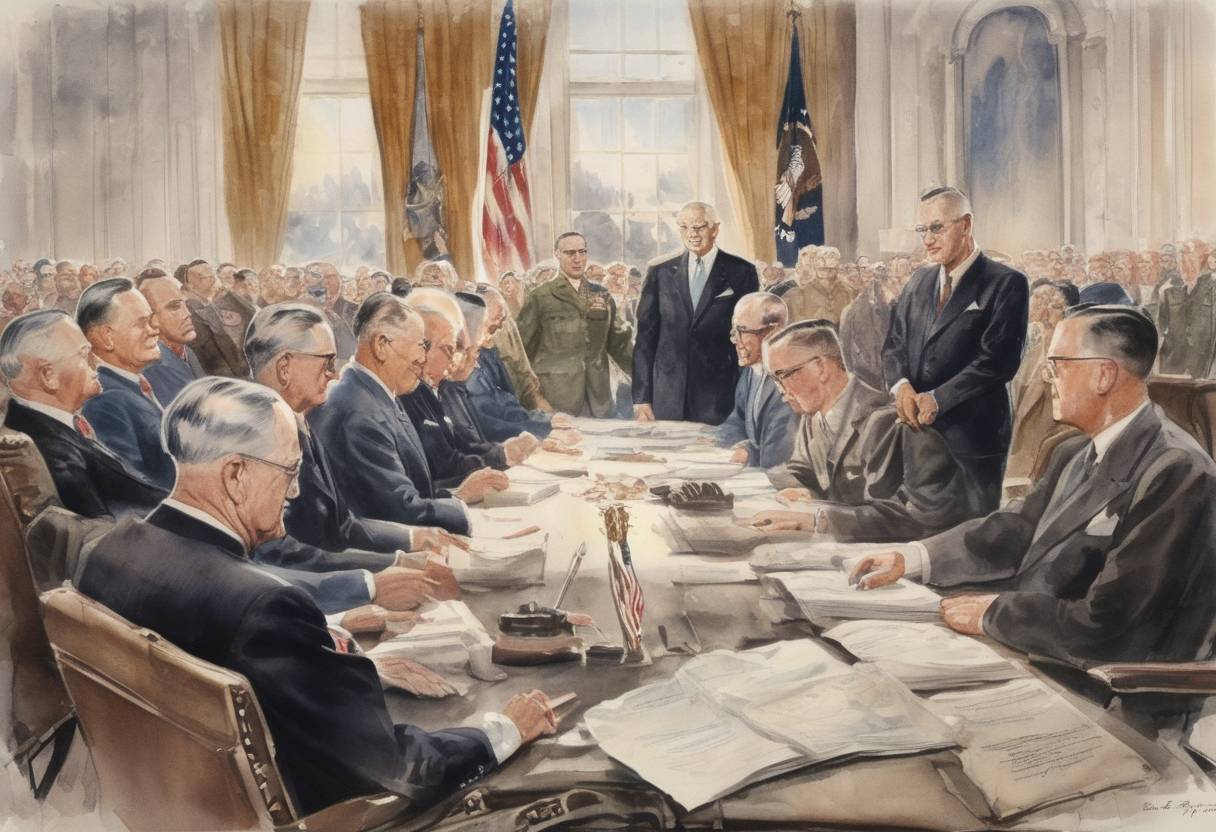
On December 31, 1946, President Harry S. Truman officially proclaimed the end of hostilities in World War II, marking a significant moment in U.S. history as it formally concluded the war for the United States. This proclamation was a crucial step in transitioning from wartime to peacetime, impacting both domestic and international policies.
End of Combat Operations: The active combat operations of World War II had effectively ended over a year earlier, with Germany’s unconditional surrender on May 8, 1945 (V-E Day), and Japan’s surrender on September 2, 1945 (V-J Day).
Legal and Administrative Closure: Despite the cessation of fighting, a formal declaration was necessary to address legal and administrative matters, such as the termination of wartime laws and the re-establishment of peacetime governance.
International Relations: The proclamation also played a role in shaping post-war international relations, as the United States sought to transition from a wartime alliance to a peacetime global leader, particularly in the emerging Cold War context.
Formal Conclusion: Truman’s proclamation officially ended the state of hostilities, which had significant implications for the U.S. military and its personnel, as well as for the nation’s economy and legal system.
Impact on Legislation: The end of hostilities allowed for the repeal or modification of numerous wartime measures, including rationing, price controls, and other regulations that had been implemented during the war.
Veterans and Demobilization: The proclamation facilitated the continued demobilization of American troops and the reintegration of millions of veterans into civilian life, a process that had begun immediately after the war.
Economic Transition: The formal end of the war accelerated the transition to a peacetime economy, contributing to the post-war economic boom known as the “Golden Age of Capitalism.”
Cold War Dynamics: As the United States moved away from wartime alliances, it increasingly focused on countering Soviet influence, laying the groundwork for the Cold War.
International Institutions: The proclamation underscored the U.S. commitment to international cooperation, as evidenced by its support for the United Nations and other global institutions aimed at preventing future conflicts.
In summary, President Truman’s proclamation on December 31, 1946, was a pivotal moment that not only marked the formal end of World War II for the United States but also set the stage for significant domestic and international developments in the ensuing years.
Source: en.wikipedia.org