Albert II: The First Monkey in Space
1949 · White Sands, United States
Albert II, a rhesus monkey, rides a V-2 rocket to an altitude of 83 miles, becoming the first monkey in space.
October 24, 1946
A camera on board the V-2 No. 13 rocket took the first photograph of Earth from outer space.
White Sands Missile Range, United States | U.S. Army
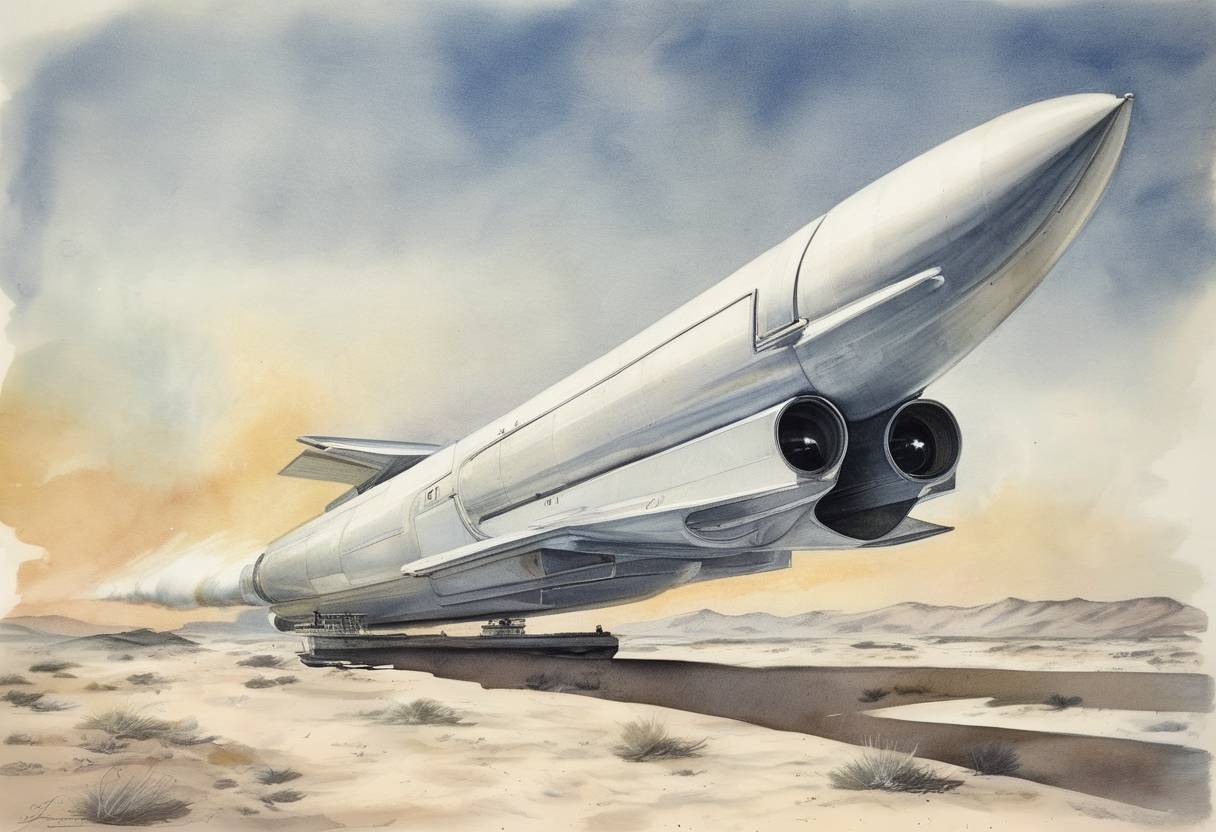
On October 24, 1946, a significant milestone in the history of space exploration was achieved when a camera aboard the V-2 No. 13 rocket captured the first photograph of Earth from outer space. This event marked a pivotal moment in both scientific and technological advancements, providing humanity with its initial glimpse of Earth from beyond the atmosphere.
The V-2 rocket, originally developed by Nazi Germany during World War II, was the world’s first long-range guided ballistic missile. After the war, many of these rockets were captured by the United States and repurposed for scientific research under the auspices of the U.S. Army and various research institutions.
The V-2 No. 13 was equipped with a 35mm motion picture camera housed in its nose cone. As the rocket ascended to an altitude of approximately 65 miles (104 kilometers), the camera captured a series of black-and-white photographs at a rate of one frame every second and a half.
The images taken by the V-2 No. 13 provided a groundbreaking perspective of Earth, showing the curvature of the planet against the blackness of space. These photographs were the first to depict Earth from an altitude high enough to be considered outer space, offering a new vantage point that was previously unattainable.
The success of the V-2 No. 13 mission laid the groundwork for subsequent space exploration efforts. It highlighted the potential of using rockets for scientific purposes, eventually leading to the development of more advanced space missions and the eventual human exploration of space.
In summary, the first photograph of Earth from outer space taken on October 24, 1946, was a landmark achievement that not only advanced scientific knowledge but also inspired a new era of exploration beyond our planet.
Source: en.wikipedia.org