The Knesset Votes to Move the Capital of Israel to Jerusalem - December 13, 1949
1949 · Jerusalem, Israel
The Knesset voted to move the capital of Israel to Jerusalem.
June 11, 1950
Ben-Gurion delivers the 'Law of Return' speech, which becomes the basis for the Israeli Law of Return, allowing Jews the world over the right to immigrate to Israel and gain citizenship.
Jerusalem, Israel | Knesset
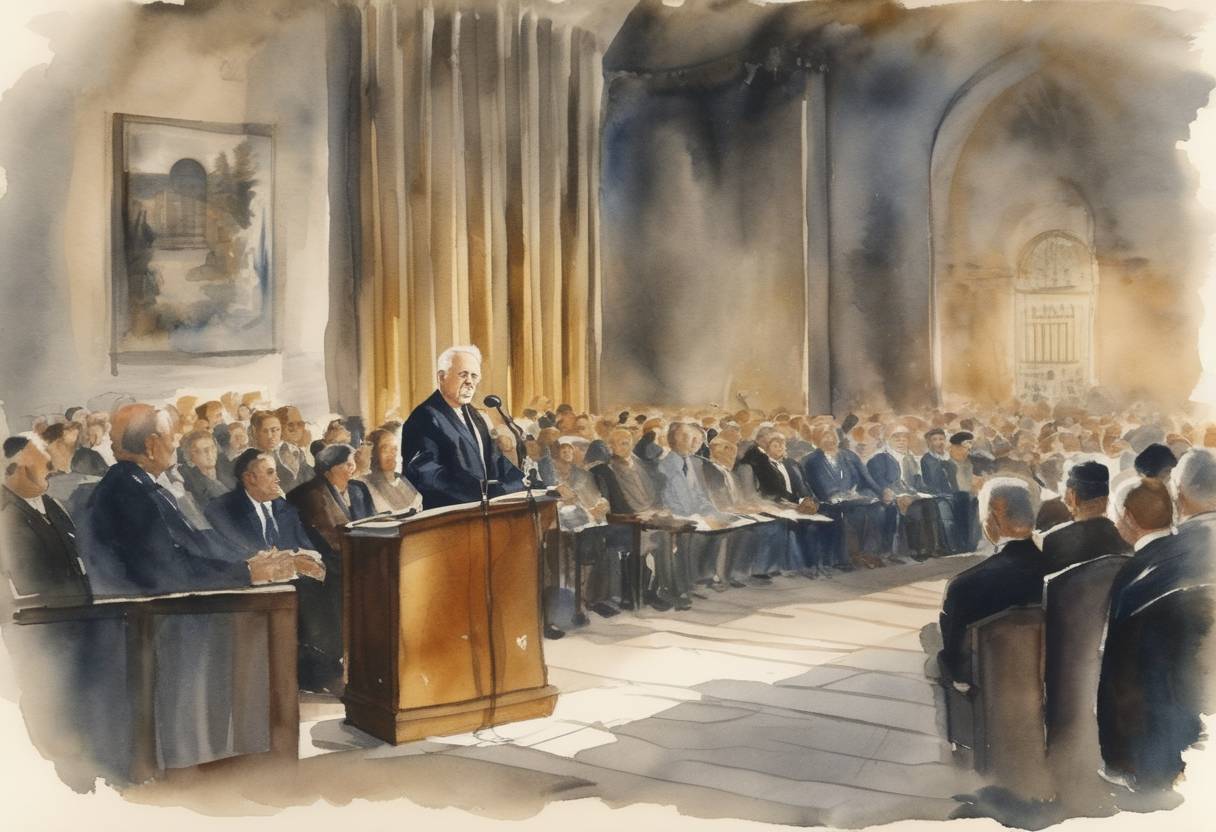
On June 11, 1950, David Ben-Gurion, the Prime Minister of Israel, delivered a pivotal speech in the Knesset, which set the foundation for what would become the Israeli Law of Return. This address articulated the principles that would later be formalized into law, allowing Jews from all over the world to immigrate to Israel and gain citizenship.
Post World War II, Jewish communities faced significant challenges, with many displaced persons grappling with the aftermath of the Holocaust. The creation of the State of Israel in 1948 was a response to these crises, offering a homeland for Jews worldwide. The new state’s leaders saw it as essential to establish legal frameworks that would facilitate Jewish immigration or ‘Aliyah’.
Historical Right and Continuity: Ben-Gurion emphasized the historical connection between the Jewish people and the Land of Israel. He asserted that the establishment of the State of Israel was the realization of a historical promise for a national homeland.
National Rebirth: The Prime Minister framing the Law of Return as a means of ensuring the Jewish nation’s continuity and addressing the needs of Jews globally reflected the nation’s ethos of being open to all Jews returning to their ancestral land.
Inclusivity in Citizenship: Ben-Gurion insisted on a broad and inclusive approach, offering Israeli citizenship to every Jew choosing to settle in Israel, thus reinforcing the concept of a Jewish state welcoming its diaspora.
Following the speech, the Knesset passed the Law of Return on July 5, 1950. This legislation formally granted every Jew the right to come to Israel as an ‘oleh’ (immigrant) and to become an Israeli citizen.
Immigration and Growth: The Law of Return became a cornerstone policy of Israel, prompting waves of Jewish immigration from across the globe. This significantly contributed to Israel’s demographic and cultural development.
Debate and Amendments: Over the ensuing decades, the law would be subject to debates and modifications, particularly concerning the definitions of Jewish identity and eligibility criteria.
Symbolic Importance: Beyond its practical implications, the law served as a powerful symbol of Israel’s commitment to being a home for the Jewish people, emphasizing solidarity and continuity within the global Jewish community.
Ben-Gurion’s speech and the subsequent legislation marked a monumental moment in Israeli history, reflecting the nation’s founding ideals and shaping its demographic and cultural landscape for years to come.
Source: encyclopedia.ushmm.org