Death of Pol Pot - April 15, 1998
1998 · Anlong Veng, Cambodia
Pol Pot, the notorious leader of the Khmer Rouge regime responsible for the Cambodian genocide, died.
April 17, 1975
The Khmer Rouge forces capture Phnom Penh, Cambodia, effectively gaining control of the country and leading to the establishment of the Democratic Kampuchea regime.
Phnom Penh, Cambodia | Khmer Rouge
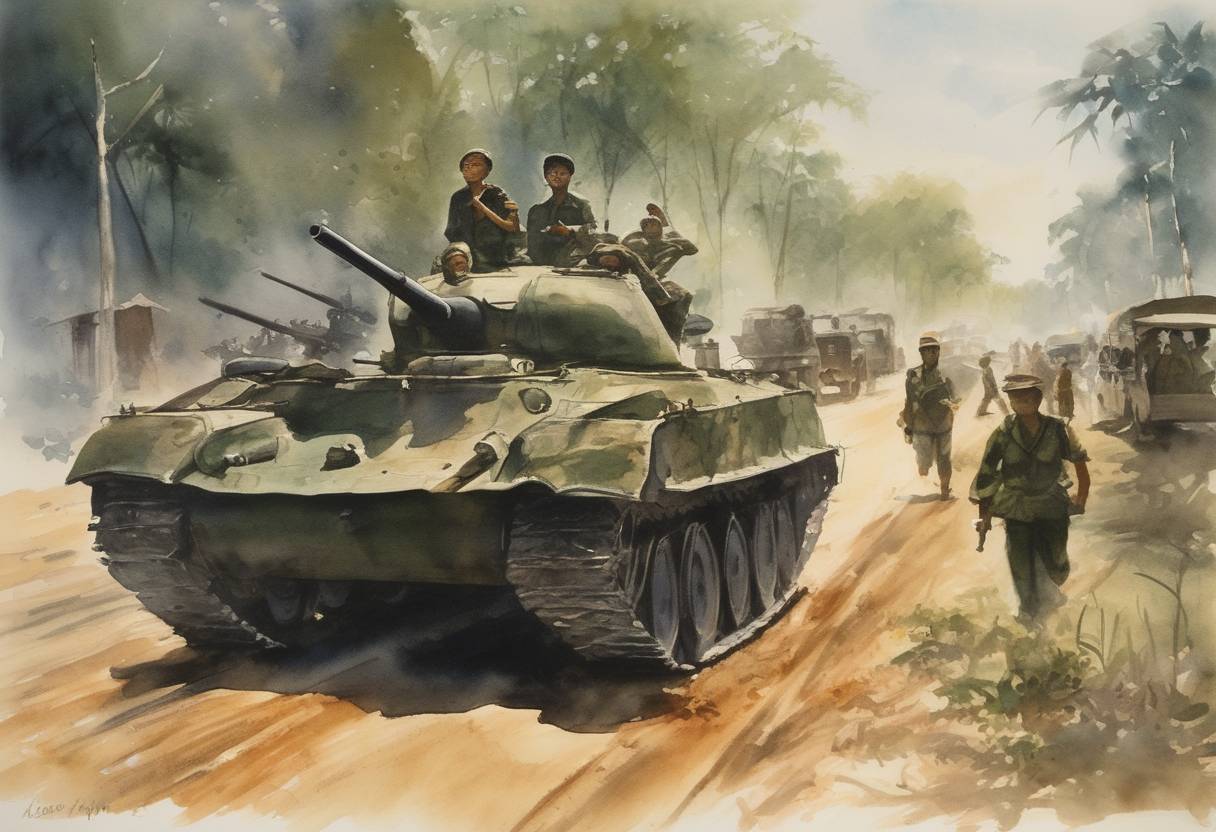
On April 17, 1975, the Khmer Rouge forces captured Phnom Penh, the capital of Cambodia, marking a significant turning point in the Cambodian Civil War. This event led to the establishment of the Democratic Kampuchea regime under the leadership of Pol Pot. The capture of Phnom Penh effectively signified the fall of the Lon Nol government, which had been supported by the United States.
The Khmer Rouge, officially known as the Communist Party of Kampuchea, was a radical communist movement that grew in the shadow of the Vietnam War. The group was heavily influenced by Maoist ideology and aimed to create a classless agrarian society. The civil war in Cambodia, which began in 1970, was characterized by its brutality and was exacerbated by the regional instability due to the conflict in neighboring Vietnam.
The U.S.-backed regime of Marshal Lon Nol had been engaged in ongoing conflict with the Khmer Rouge since 1970. Despite extensive military and financial aid from the United States, the Lon Nol government struggled against the guerrilla warfare tactics employed by the Khmer Rouge. As the U.S. withdrew from Vietnam and reduced its involvement in Cambodia, the Lon Nol government weakened, leading to a rapid offensive by the Khmer Rouge starting in early 1975.
By April 17, the Khmer Rouge had successfully surrounded Phnom Penh. Efforts to evacuate key personnel from the city were complicated and disorganized. As the Khmer Rouge forces entered the capital, they were initially greeted by some residents with relief, as many were war-weary. However, the atmosphere quickly shifted as the new regime began implementing drastic and oppressive measures.
Following the fall of Phnom Penh, the Khmer Rouge established Democratic Kampuchea and soon began a radical transformation of Cambodian society. The regime evacuated cities, abolishing money, markets, and modern education, and relocated urban populations to rural farming communities. The aim was to eliminate all class distinctions and create self-reliant agricultural cooperatives.
The Khmer Rouge regime, characterized by extreme totalitarian control and paranoia, led to one of the most tragic genocides of the 20th century. Between 1975 and 1979, it is estimated that approximately 1.7 to 2 million people died due to forced labor, malnutrition, torture, and executions. The regime fell in January 1979 when Vietnamese forces invaded Cambodia, but the country remained in a state of conflict and instability for many years.
The capture of Phnom Penh remains a pivotal moment in Cambodian history and continues to influence the political and social landscape of the region.
Source: www.britannica.com