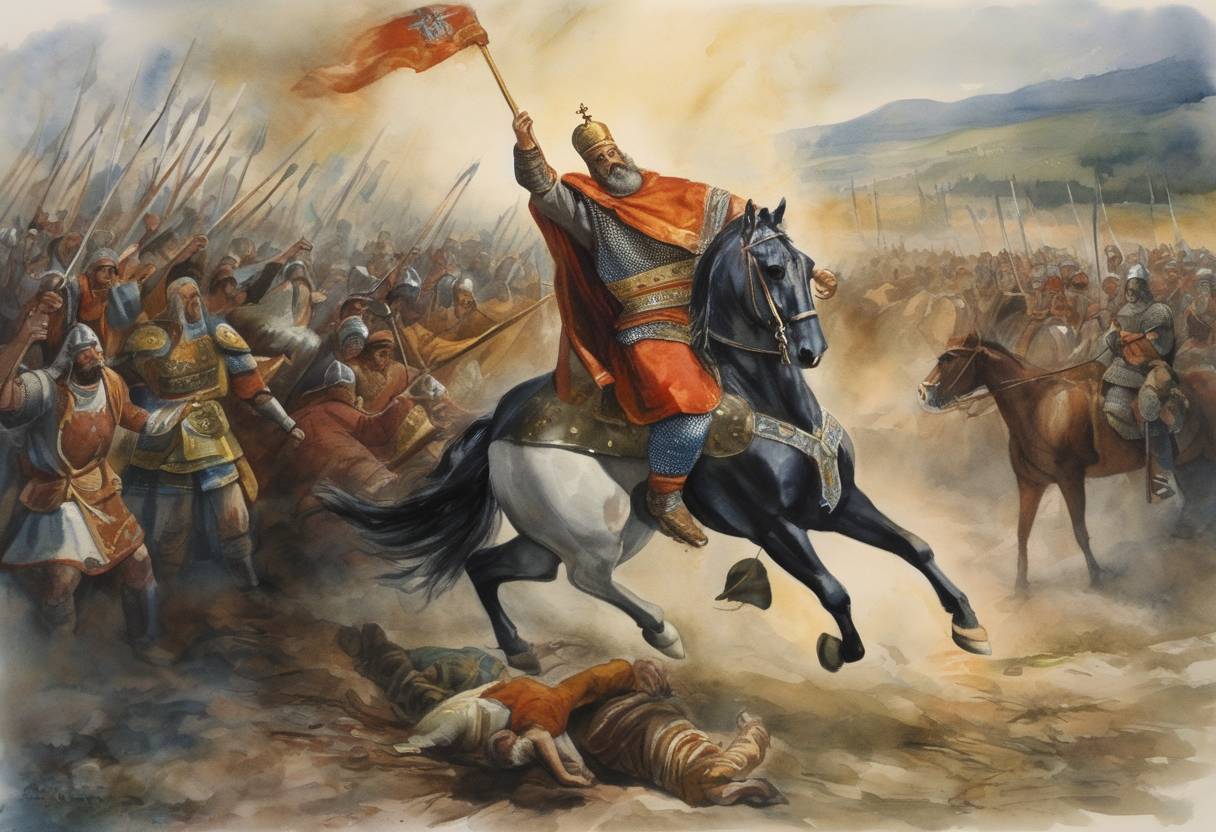
Battle of Kleidion: July 29, 1014
The Battle of Kleidion, fought on July 29, 1014, marked a crucial victory for Byzantine Emperor Basil II over the Bulgarian forces led by Tsar Samuel’s son, Gavril Radomir. The battle was a pivotal moment in the prolonged Byzantine-Bulgarian conflicts and significantly impacted the regional power dynamics of the Middle Ages.
Context
- Background: The Byzantine Empire and the Bulgarian Empire had been engaged in intermittent warfare for decades. The conflict was fueled by both territorial disputes and Basil II’s determination to end Bulgarian resistance and consolidate Byzantine influence in the Balkans.
- Tsar Samuel’s Resistance: Under Tsar Samuel, the Bulgarians had been persistent in challenging Byzantine authority, employing guerrilla tactics and leveraging the mountainous terrain to their advantage.
The Battle
- Location: The battle took place near the village of Kleidion in the Klyuch (present-day region in North Macedonia).
- Strategy: Basil II implemented a well-planned strategy to outmaneuver the Bulgarian defenses. He divided his forces, with one segment engaging the Bulgarians directly, while another, led by General Nikephoros Xiphias, executed a flanking maneuver.
- Outcome: The Byzantine forces successfully ambushed the Bulgarian army from the rear, leading to a decisive Byzantine victory. The Bulgarian defenses collapsed, and thousands of soldiers were captured or killed.
Aftermath
- Tsar Samuel’s Health: Although Tsar Samuel escaped the battlefield, the defeat reportedly led to a heart attack, affecting his health significantly. He died a few months later in October 1014.
- Basil II’s Actions: Basil II is historically noted for his harsh punishment of the captured Bulgarian soldiers. According to chronicles, he ordered the blinding of 99 out of every 100 soldiers, leaving every hundredth man with one eye to lead the others home. This act earned him the moniker “Boulgaroktonos,” meaning “Bulgar-slayer.”
- Long-term Impact: The victory at Kleidion significantly weakened Bulgarian resistance, eventually leading to the annexation of Bulgaria into the Byzantine Empire in 1018, thus ending the First Bulgarian Empire.
Historical Significance
- Basil II’s Legacy: The triumph at Kleidion solidified Basil II’s reputation as one of the most effective and formidable Byzantine emperors. His military success laid the groundwork for the empire’s stability and territorial expansion during his reign.
- Bulgarian History: The battle and its aftermath marked the beginning of a period of Byzantine dominance in the Balkans, altering the course of Bulgarian history and diminishing its status as a powerful independent kingdom for many decades.
The Battle of Kleidion remains a crucial event in medieval European history, exemplifying the intense and often brutal nature of medieval warfare and the strategic prowess of Basil II in his unyielding quest to fortify Byzantine supremacy in southeastern Europe.